
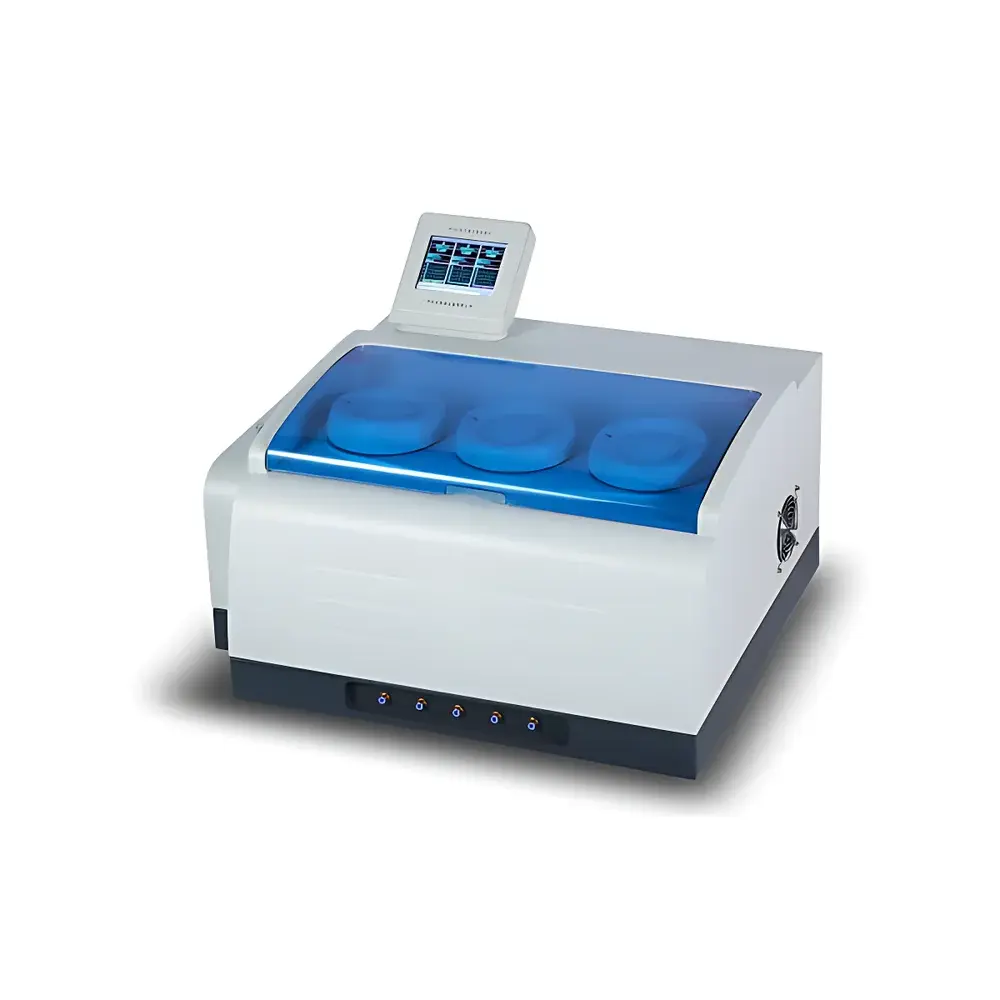
GBPI W413Q Infrared Water Vapor Transmission Rate (WVTR) Analyzer
| Brand | GBPI |
|---|---|
| Origin | Guangdong, China |
| Manufacturer Type | Direct Manufacturer |
| Model | W413Q |
| Test Range | 0.002–1000 g/(m²·24h) |
| Accuracy | 0.001 g/(m²·24h) |
| Temperature Control Range | 15–45 °C (optional up to 60 °C) |
| Temp. Stability | ±0.1 °C |
| Humidity Control Range | 30–90 %RH |
| Humidity Stability | ±1 %RH |
| Test Area | 50.24 cm² (down to 0.785 cm² with optional fixtures) |
| Specimen Size | Φ100 mm |
| Max. Thickness | ≤3 mm |
| Sample Capacity | 1–3 independent chambers |
| Carrier Gas | ≥99.999% N₂, pressure ≥0.1 MPa, flow 5–120 mL/min |
| Interface | 1/8″ metal tubing |
| Dimensions | 700 × 560 × 370 mm |
| Weight | 80 kg |
| Power | 750 W, AC 220 V / 50 Hz (110 V optional) |
Overview
The GBPI W413Q Infrared Water Vapor Transmission Rate (WVTR) Analyzer is a precision metrology instrument engineered for quantitative determination of water vapor permeation through packaging materials and functional barriers under controlled temperature and humidity conditions. It operates on the principle of modulated infrared (IR) detection: water vapor diffusing through a test specimen is carried by a dry nitrogen carrier gas stream into a high-sensitivity IR absorption cell, where real-time quantification is achieved via Beer–Lambert law-based spectroscopic measurement at the characteristic 2.7 µm absorption band of H₂O. This non-destructive, continuous monitoring method eliminates reliance on gravimetric weighing or electrolytic sensors, delivering superior long-term stability, immunity to condensation artifacts, and trace-level sensitivity—critical for evaluating ultra-high-barrier substrates such as aluminum foil, SiOₓ-coated PET, and multilayer pharmaceutical blister films. Designed for compliance-driven environments, the W413Q meets the physical measurement requirements of ISO 15106-2:2005, ASTM F1249–2013, JIS K7129:2008, GB/T 26253–2010, and YBB 00092003–2015, making it suitable for QC laboratories operating under GMP, GLP, and ISO/IEC 17025 frameworks.
Key Features
- Triple-chamber independent testing architecture enables concurrent analysis of up to three dissimilar specimens—with individual start/stop control, separate data logging, and autonomous report generation per chamber.
- High-resolution IR sensor with automatic over-range protection ensures operational integrity during transient humidity excursions or sensor saturation events.
- Electromagnetic programmable stepwise temperature control delivers ±0.1 °C uniformity across the test zone; dual-stream humidity regulation (dry + saturated gas mixing) achieves ±1 %RH stability in 30–90 %RH range.
- Embedded ARM-based controller supports standalone operation—no external PC required. Integrated 7-inch color touchscreen provides real-time visualization of temperature, RH, WVTR, and H₂O concentration curves with toggleable preview and historical overlay.
- Modular mechanical design facilitates field serviceability: sensor modules, gas manifolds, and environmental chambers are mechanically decoupled and tool-free replaceable.
- Comprehensive calibration traceability: certified reference standards (GBW(E)130543/4) issued by China’s National Administration of Metrology enable in-house verification and regulatory audit readiness.
Sample Compatibility & Compliance
The W413Q accommodates planar and three-dimensional specimens. Standard configuration supports flat films and sheets (Φ100 mm, ≤3 mm thick) with defined test area (50.24 cm²); optional mini-cell fixtures reduce effective area to 0.785 cm² for micro-scale barrier evaluation. Container testing (bottles, pouches, trays) is enabled via custom sealing adapters compliant with ASTM F1249 Annex A3. Material compatibility spans polymer films (LDPE, PP, EVOH), metallized laminates, ceramic coatings, silicone elastomers, hydrogel dressings, and photovoltaic backsheet composites. All hardware and firmware conform to IEC 61000-4 electromagnetic compatibility standards. The system satisfies data integrity requirements per FDA 21 CFR Part 11 (electronic records/signatures), EU Annex 11 (computerized systems), and WHO TRS 996 Annex 6 (GxP data governance), including role-based access control, full audit trail (system, method, and run-level), and immutable raw data archiving.
Software & Data Management
The GBPI WVTR Studio software is validated for regulated use and implements ALCOA+ principles (Attributable, Legible, Contemporaneous, Original, Accurate, Complete, Consistent, Enduring, Available). Login requires unique credentials with tiered permissions (Administrator, Operator, Reviewer, Viewer). Each user action—including parameter modification, calibration execution, report export, and audit trail review—is timestamped, user-identified, and cryptographically logged. Method templates support customizable test profiles (e.g., high-barrier mode: 37 °C / 90 %RH; low-permeability mode: 23 °C / 50 %RH). Raw spectral data, environmental logs, and calculated WVTR values are stored in encrypted SQLite databases with configurable backup intervals. Reports comply with ISO/IEC 17025 clause 7.8.2: generated in PDF/A-1b and XLSX formats, embedding instrument ID, calibration status, environmental metadata, uncertainty estimates, and digital signatures.
Applications
- Pharmaceutical packaging: validation of blister foil lamination integrity, cold-form foil barrier performance, and desiccant-containing sachet efficacy per USP and EP 2.6.27.
- Food packaging R&D: accelerated shelf-life modeling of retort pouches, vacuum-sealed trays, and modified-atmosphere packaging (MAP) films under dynamic RH cycling protocols.
- Flexible electronics: moisture ingress assessment of OLED encapsulation layers, touch panel adhesives, and thin-film transistor (TFT) substrate barriers.
- Medical device sterility assurance: WVTR qualification of Tyvek® pouches, peel-open lids, and breathable wound dressings per ISO 11607-1.
- Renewable energy: lifetime prediction of PV module backsheet delamination risk using Arrhenius-accelerated testing at elevated T/RH combinations.
FAQ
What carrier gas is required, and why is ultra-high-purity nitrogen specified?
Ultra-high-purity nitrogen (≥99.999%) is mandatory to eliminate interference from ambient CO₂, hydrocarbons, and residual moisture in the carrier stream—any contaminant absorbing near 2.7 µm would distort IR signal baseline and compromise accuracy.
Can the W413Q validate container WVTR per ASTM F2622?
Yes—when equipped with GBPI’s certified container test fixture set (P/N FIX-W413C), the system complies with ASTM F2622–18 methodology for rigid and semi-rigid packaging, including purge protocol validation and leakage rate compensation.
How does the system ensure measurement traceability to national standards?
Each unit ships with calibration verification using GBW(E)130543/4 certified water vapor permeation standards, traceable to China’s National Institute of Metrology (NIM). Certificate of Conformance includes as-tested deviation against certified values at multiple RH levels.
Is remote monitoring supported?
Yes—via Ethernet interface, the embedded controller supports SNMP v3 and Modbus TCP protocols for integration into centralized lab infrastructure management systems (LIMS/SCADA), with secure TLS 1.2 encrypted data streaming.
What maintenance intervals are recommended for IR sensor longevity?
The IR detector requires no routine optical cleaning. Annual verification of zero-point drift and span response using dry N₂ and certified humidified gas standards is advised; sensor mean time between failures exceeds 15,000 operational hours under typical lab conditions.




