
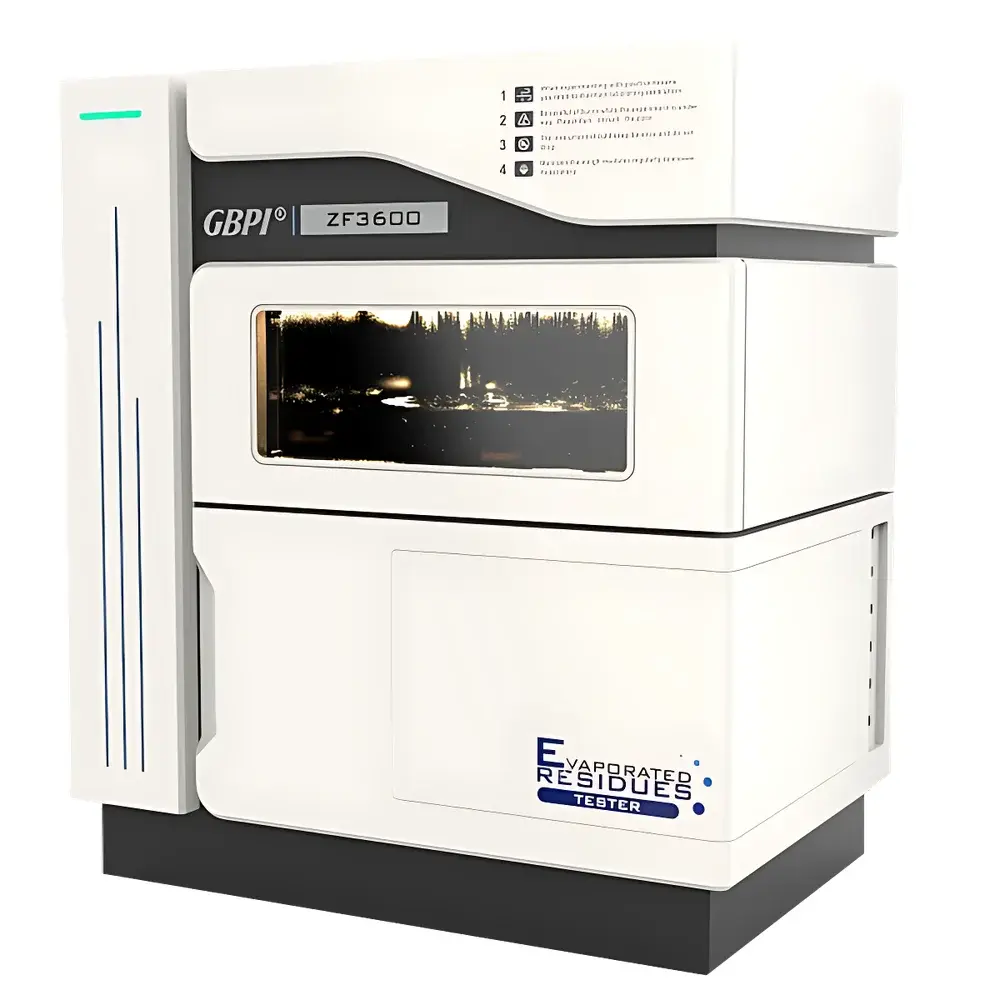
GBPI ZF3600L Total Migration and Non-Volatile Residue Analyzer
| Brand | GBPI |
|---|---|
| Origin | Guangdong, China |
| Manufacturer Type | Manufacturer |
| Origin Category | Domestic |
| Model | ZF3600L |
| Pricing | Upon Request |
Overview
The GBPI ZF3600L Total Migration and Non-Volatile Residue Analyzer is an integrated, fully automated laboratory instrument engineered for precise determination of total migration (evaporation residue) and non-volatile residue in food contact materials, pharmaceutical packaging, purified water, tobacco-related paper, chemical reagents, and solid dosage forms. It operates on the gravimetric principle: a defined volume of extract solution—obtained via standardized extraction protocols—is transferred into pre-weighed evaporation dishes; the solvent is removed under controlled conditions (water bath evaporation below boiling point, followed by forced-air drying at 105 °C), and residual mass is determined via high-resolution microbalance after cooling to ambient temperature and achieving constant weight (≤ 0.3 mg deviation between consecutive weighings). This methodology aligns with internationally recognized pharmacopoeial and regulatory frameworks governing extractables and leachables assessment, including USP , EP 9.0, and Chinese Pharmacopoeia 2020 Edition.
Key Features
- Fully automated workflow integrating solvent dispensing, water bath evaporation (room temperature to 100 °C), hot-air drying (room temperature to 125 °C), active cooling, and high-precision gravimetric analysis—eliminating manual intervention and operator-induced variability.
- Dual-chamber thermal architecture with independent water bath and heating oven zones, each equipped with electromagnetic temperature control (±0.5 °C accuracy) and real-time monitoring of liquid level, temperature, and humidity.
- Three high-accuracy imported analytical balances (0.01 mg resolution, 220 g capacity), housed in thermally isolated, water-jacketed enclosures to ensure stable weighing conditions during and after thermal cycles.
- 36 parallel test stations with interchangeable 50 mL or 100 mL evaporation dishes, enabling high-throughput screening across diverse sample matrices—including aqueous solutions, organic solvents (e.g., hexane, ethanol, acetic acid, chloroform), powders, and solid extracts.
- Integrated solvent recovery system featuring a large-capacity recirculating chiller (cool-down to ambient within 30 min) and dedicated collection bottles achieving >90% solvent recovery efficiency—reducing hazardous waste generation and operational cost.
- Comprehensive safety subsystems: automatic water replenishment/drainage, overtemperature cutoff, leak detection, and fail-safe exhaust management for volatile organic compounds.
Sample Compatibility & Compliance
The ZF3600L supports regulatory testing for a broad spectrum of regulated materials per globally harmonized standards. For pharmaceutical purified water and packaging components, it fulfills requirements outlined in Chinese Pharmacopoeia (2020 Ed., Vol. II & IV), USP-NF , and EP 9.0 WATER, PURIFIED. For food contact materials, it complies with GB 31604.8–2016, EN 1186-3:2002 Method A, and Korea MOHW Chapter IV Section 2–8. In tobacco industry applications (e.g., tipping paper), it meets GB/T 9740–2008. For environmental and drinking water analysis, it implements GB 8538–2016, DZ/T 0064.9–2021, GB/T 14415–2007, and GB/T 5750.4–2006. All workflows are traceable and support GLP/GMP-compliant environments through audit-trail-enabled operation logs and electronic signature capability.
Software & Data Management
The instrument runs on a purpose-built Windows 10 Pro 64-bit platform with modular, icon-driven GUI designed in accordance with Annex 11 and FDA 21 CFR Part 11 principles. Users configure test parameters—including evaporation time, drying temperature/duration, cooling delay, and convergence criteria—via intuitive templates. The system captures timestamped weight, temperature, and humidity data at sub-second intervals, storing raw and processed datasets in encrypted, tamper-evident format. Audit trails record all user actions, parameter changes, and instrument events with immutable timestamps. Reports are customizable (PDF, CSV, Excel), include digital signatures, and support electronic submission to LIMS or QA review portals. Language switching (English/Chinese) and multi-level access control (admin, operator, reviewer) are natively supported.
Applications
- Quantification of non-volatile residue in pharmaceutical primary packaging (e.g., blister foils, vial stoppers, syringe barrels) following simulated extraction with polar/non-polar solvents.
- Total migration testing of food packaging films, laminates, and coatings per EU Regulation 10/2011 and national equivalents.
- Determination of dissolved solids (TDS) in purified water, mineral water, and process water used in biopharmaceutical manufacturing.
- Moisture content and loss on drying (LOD) analysis of herbal extracts, APIs, and excipients per Chinese Pharmacopoeia and USP .
- Residual solvent quantification in tobacco-related substrates where volatile organics are extracted and evaporated under controlled thermal profiles.
FAQ
What standards does the ZF3600L directly support?
It is validated for GB 31604.8–2016, EN 1186-3:2002 Method A, USP , EP 9.0, Chinese Pharmacopoeia 2020, GB/T 9740–2008, and multiple water quality standards including GB 8538–2016.
Can the instrument handle organic solvents safely?
Yes—integrated solvent recovery, explosion-proof chamber design, and dedicated exhaust routing ensure safe handling of flammable solvents such as hexane, ethanol, and chloroform.
Is remote monitoring and diagnostics available?
Yes—the system supports secure cloud-based connectivity via GBPI’s Laboratory IoT Platform, enabling remote data access, software updates, and technician-assisted troubleshooting.
How is data integrity ensured?
Through 21 CFR Part 11–compliant audit trails, role-based access control, electronic signatures, and cryptographic hashing of all raw measurement files.
What maintenance is required for long-term stability?
Scheduled calibration of balances and temperature sensors per ISO/IEC 17025 guidelines; quarterly verification of water bath level sensors and pneumatic dispensing accuracy; annual validation of drying chamber uniformity and cooling performance.





