
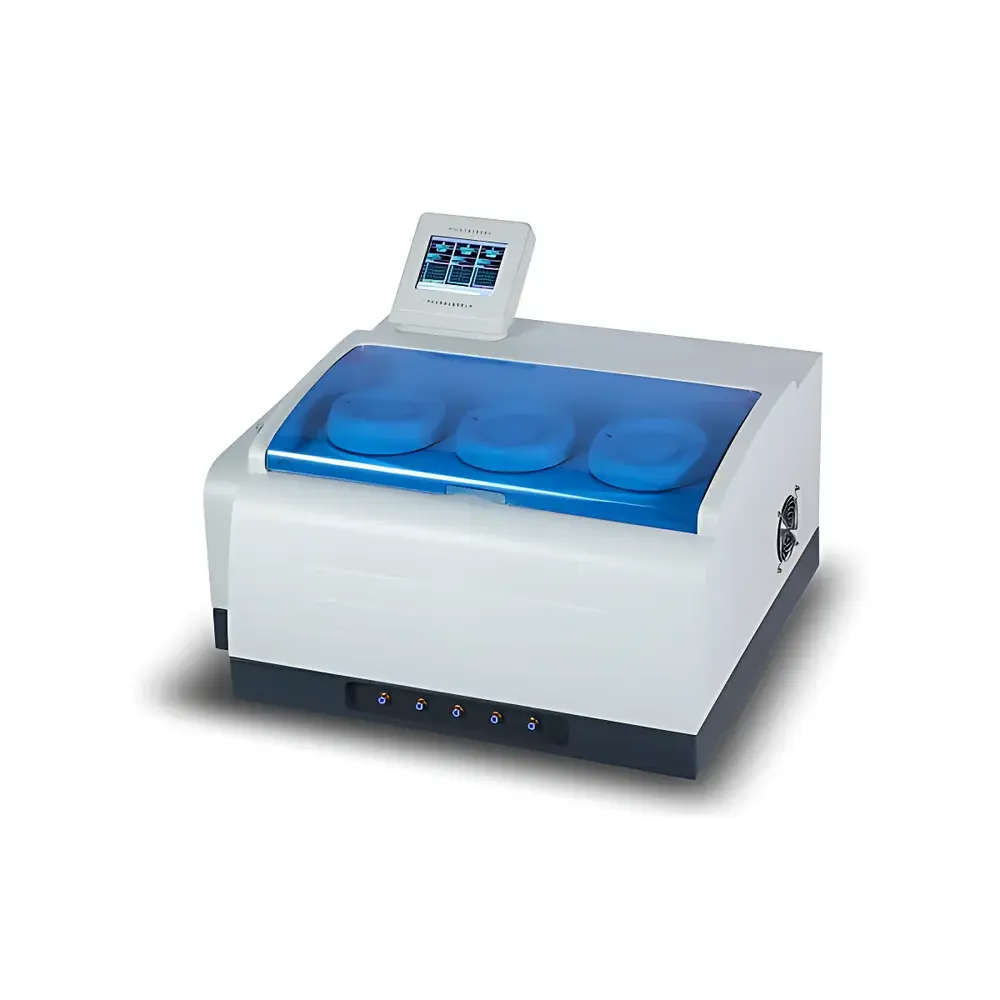
GBPI W203K Tri-Chamber Independent Water Vapor Transmission Rate (WVTR) Tester
| Brand | GBPI |
|---|---|
| Origin | Guangdong, China |
| Manufacturer Type | Original Equipment Manufacturer (OEM) |
| Country of Origin | China |
| Model | W203K |
| Price Range | USD 42,000 – 70,000 |
| Test Range | 0.001–50 g/(m²·24h) (film & sheet) |
| Test Accuracy | 0.001 g/(m²·24h) |
| Temperature Control Range | 15–45 °C |
| Temperature Stability | ±0.1 °C |
| Humidity Control Range | 30–90 %RH |
| Humidity Stability | ±1 %RH |
| Test Area | 50.24 cm² |
| Specimen Diameter | Φ100 mm |
| Max Specimen Thickness | ≤3 mm |
| Sample Capacity | 3 independent chambers |
| Carrier Gas | ≥99.999% N₂ (user-supplied) |
| Gas Pressure | ≥0.1 MPa |
| Gas Flow Rate | 0–100 mL/min |
| Gas Inlet | 1/8″ stainless steel tubing |
| Dimensions | 700 × 560 × 370 mm |
| Weight | 100 kg |
| Power | 750 W |
| Electrical Supply | AC 220 V, 50 Hz (110 V optional) |
Overview
The GBPI W203K Tri-Chamber Independent Water Vapor Transmission Rate (WVTR) Tester is a gravimetric-coulometric hybrid instrument engineered for high-precision, regulatory-compliant measurement of water vapor permeation through packaging materials and functional barriers. It operates on the principle of dynamic relative humidity gradient generation across a test specimen—using dual-stream (dry/wet) gas control—and quantifies transmitted moisture via a high-stability electrolytic sensor calibrated against certified national reference standards (GBW(E)130543/4). Unlike single-chamber systems, the W203K integrates three physically isolated test chambers, each equipped with dedicated temperature and humidity sensors, enabling concurrent, non-interfering evaluation of heterogeneous samples under identical or independently programmed environmental conditions. This architecture supports rigorous method validation, inter-laboratory comparison, and accelerated stability testing workflows required in pharmaceutical packaging qualification, medical device barrier certification, and advanced electronics encapsulation R&D.
Key Features
- Triple independent test chambers with fully decoupled thermal and humidification control—enabling simultaneous testing of three distinct materials or replicates without cross-contamination or parameter crosstalk.
- High-resolution electrolytic moisture sensor (imported, long-term drift <0.5% per 1,000 h), auto-protected against over-range exposure to prevent calibration degradation.
- ARM-based embedded control system—capable of autonomous operation without external PC; real-time monitoring via 7-inch color touchscreen interface displaying temperature, RH, sensor output, and cumulative WVTR curves.
- Electromagnetic programmable step-control heating/cooling system with ±0.1 °C stability and dual-gas humidity regulation achieving ±1 %RH accuracy across 30–90%RH range.
- Full automation sequence: baseline establishment → purge → conditioning → permeation measurement → automatic endpoint detection → report generation.
- GMP-aligned software architecture compliant with FDA 21 CFR Part 11 and EU Annex 11 requirements—featuring role-based access control (administrator, operator, reviewer), audit trails for system events, method changes, and data modifications.
Sample Compatibility & Compliance
The W203K accommodates flat specimens up to 3 mm thick and 100 mm in diameter—including polymer films (PET, PE, PP), metallized laminates, aluminum foil, ceramic substrates, rubber sheets, and rigid plastic panels. With optional accessories (e.g., container adapters), it extends to 3D packaging forms such as blister trays, pouches, bottles, and shallow bowls. All measurements adhere to internationally harmonized test protocols: ISO 15106-3 (coulometric detection), ASTM E398-2013 (desiccant method), DIN 53122-2, GB/T 21529-2008, and YBB00092003-2015 (Chinese pharmaceutical packaging standard). The instrument’s traceability chain is anchored to GBPI’s nationally certified reference materials, supporting ISO/IEC 17025-accredited laboratories in fulfilling metrological requirements for method validation and equipment qualification.
Software & Data Management
The embedded Windows CE-based software provides intuitive workflow configuration, real-time multi-parameter visualization (temperature, RH, sensor current, cumulative transmission), and customizable reporting templates exportable to PDF, Excel, and Word formats. Database architecture stores raw sensor logs, environmental profiles, and calculation metadata with timestamped integrity checks. Audit trail records include user login/logout events, method parameter edits, manual interventions, and final result approvals—each tagged with operator ID and system timestamp. Data export functions support CSV batch extraction for LIMS integration. Calibration history and maintenance logs are retained within the local database for full lifecycle traceability.
Applications
- Pharmaceutical packaging: Quantifying WVTR of cold-form blister foils, sachets, and child-resistant closures per USP and ICH Q5C stability guidelines.
- Medical device packaging: Validating sterile barrier integrity of Tyvek®-based pouches and thermoformed trays under accelerated aging conditions.
- Flexible electronics: Measuring moisture ingress resistance of OLED encapsulation films and solar backsheet laminates per JEDEC JESD22-A121.
- Food packaging R&D: Benchmarking high-barrier coatings (SiOₓ, AlOₓ) and evaluating shelf-life prediction models using Arrhenius-based acceleration factors.
- Academic & regulatory labs: Supporting GLP-compliant studies for FDA submissions, EMA scientific advice requests, and ISO 11607-1 validation dossiers.
FAQ
Does the W203K require external computer hardware to operate?
No—the instrument features an integrated ARM controller and 7-inch industrial touchscreen, allowing complete standalone operation including test initiation, real-time monitoring, and report generation.
Can the W203K measure containers such as bottles or cups?
Yes—with optional container adapters (sold separately), the system supports ASTM F1249-based headspace analysis for rigid and semi-rigid packaging formats.
What documentation is provided for IQ/OQ/PQ validation?
GBPI supplies a comprehensive validation package including URS, FAT/SAT protocols, traceable calibration certificates, sensor linearity reports, and GxP-compliant installation and operational qualification templates.
Is nitrogen gas purity critical for accurate results?
Yes—carrier gas must be ≥99.999% pure N₂ to avoid interference from O₂ or residual moisture; impurities introduce systematic bias in coulometric sensor response and invalidate compliance with ISO 15106-3.
How does the tri-chamber design improve measurement reproducibility?
Independent chamber control eliminates thermal/humidity coupling artifacts common in shared-environment instruments, enabling true parallelism essential for statistical process control (SPC) and DOE-based material screening.
Related Products






