
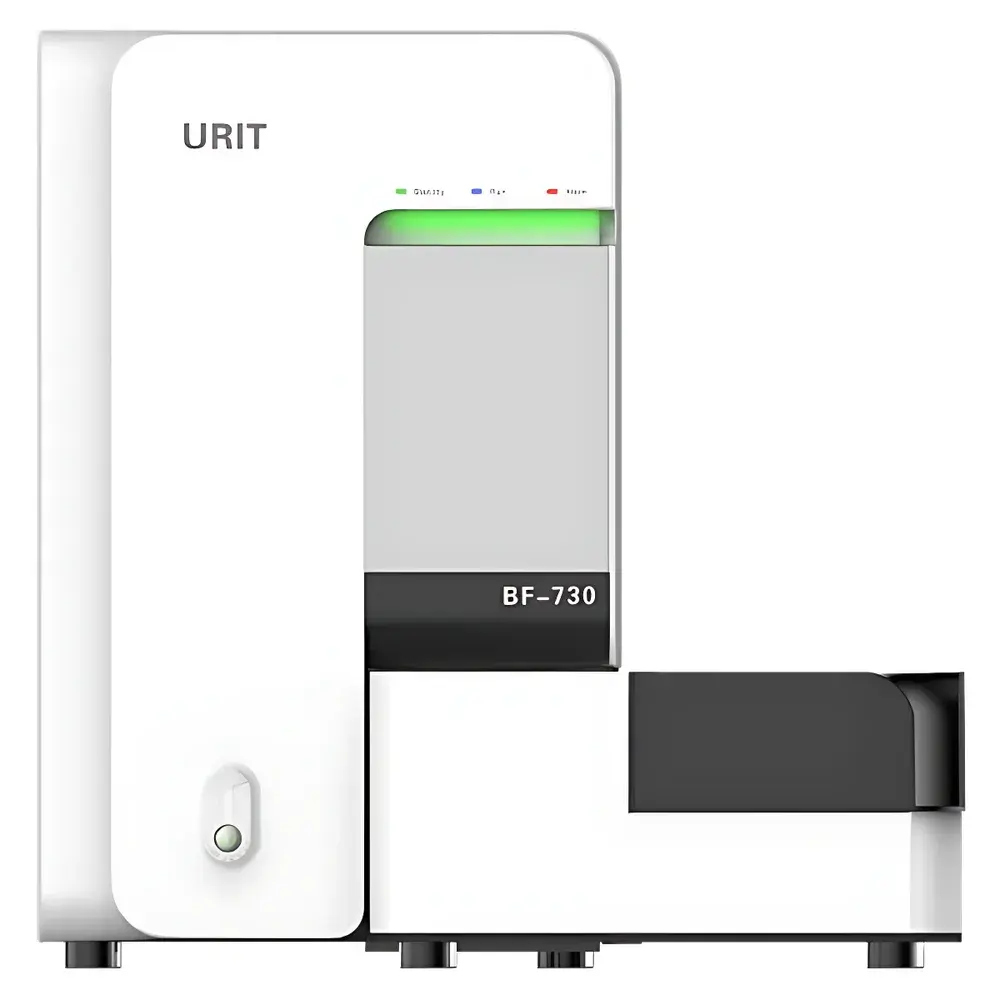
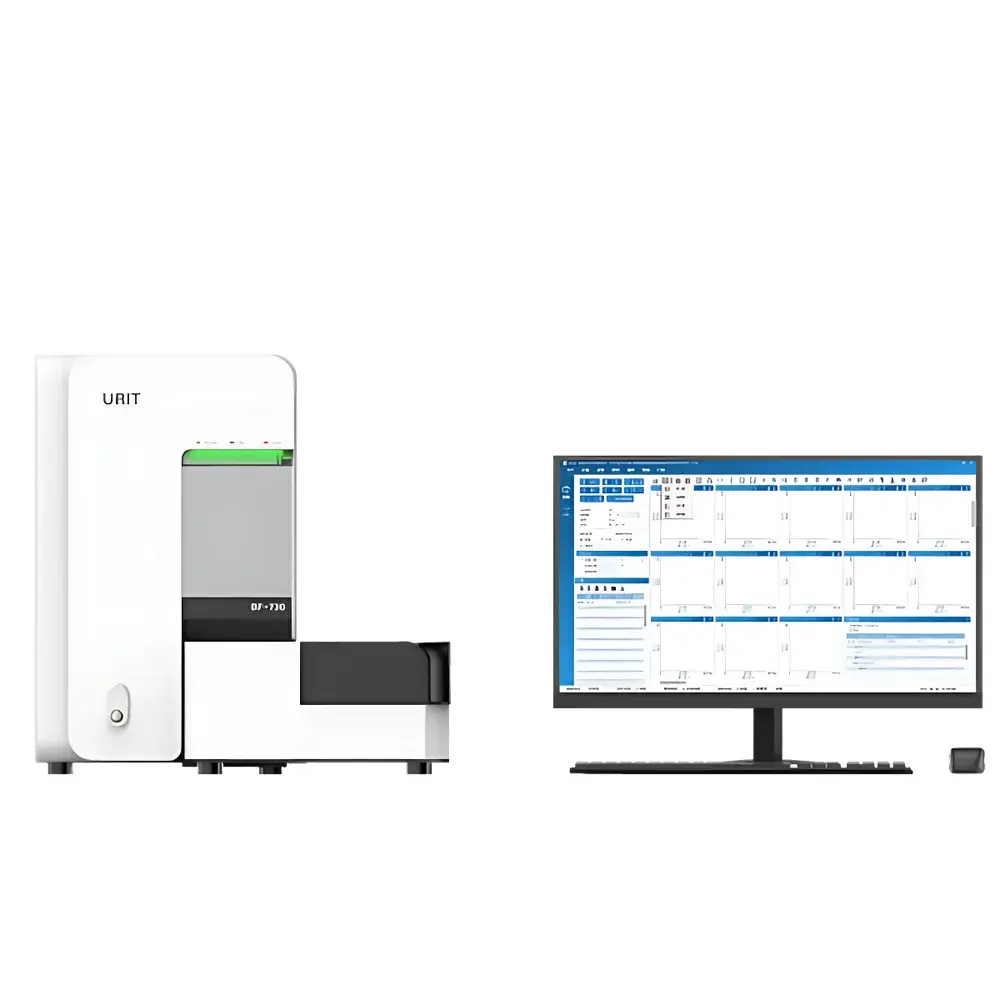
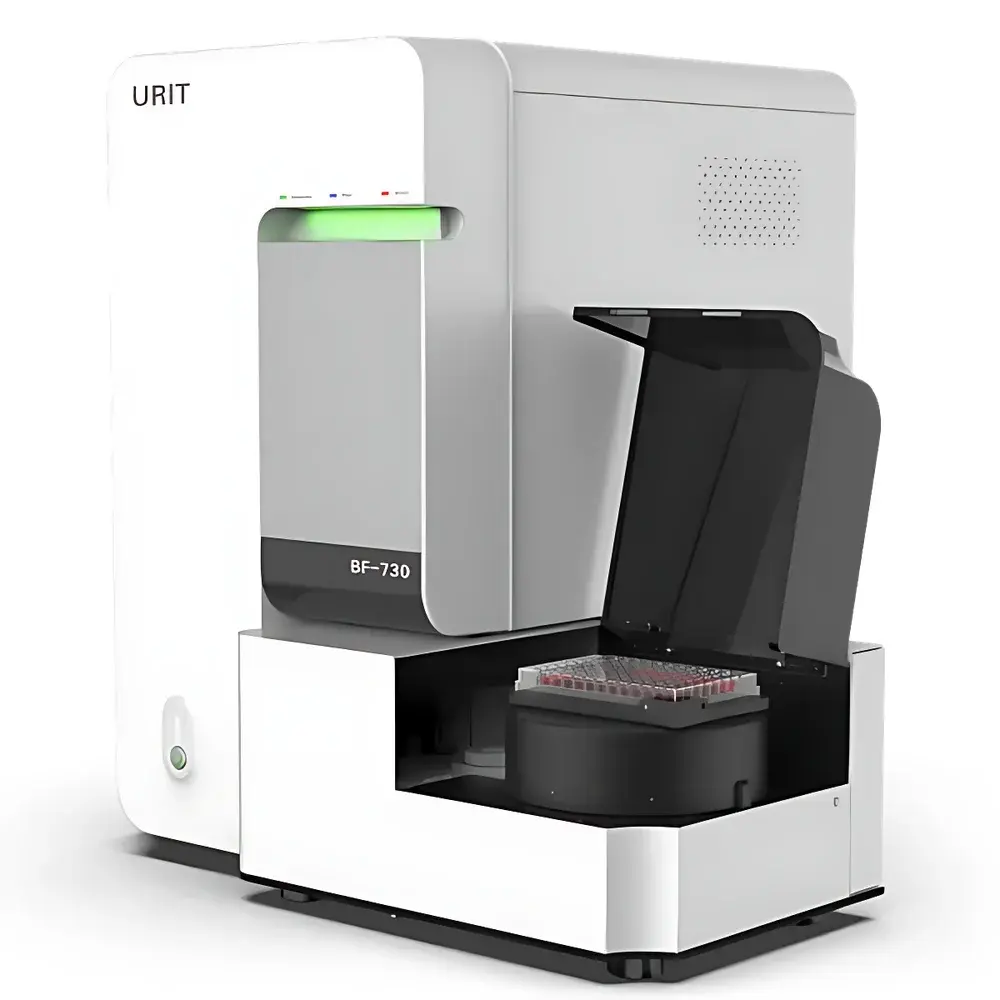
URIT BF-730 Advanced Analytical Flow Cytometer
| Brand | URIT |
|---|---|
| Origin | Guangxi, China |
| Manufacturer Type | Original Equipment Manufacturer (OEM) |
| Regional Classification | Domestic (PRC) |
| Model | BF-730 |
| Price Range | USD 14,000 – 140,000 |
| Technology Platform | Analytical Flow Cytometry |
| Instrument Type | Benchtop Flow Cytometer |
| Primary Use Case | Life Science Research & Clinical Assay Development |
| Lasers | Up to 3 solid-state lasers — 405 nm (≥85 mW), 488 nm (≥50 mW), 638 nm (≥60 mW) |
| Optical Detection Channels | 14 fluorescence parameters + 1 FSC channel + 1 SSC channel |
| Coefficient of Variation (CV) | ≤2% (at peak resolution, using standard calibration beads) |
| Fluorescence Sensitivity | FITC ≤25 MESF, PE ≤15 MESF |
| Maximum Event Acquisition Rate | 65,000 events/second |
| Sample Introduction | Integrated automated autosampler with continuous flow rate control (5–120 µL/s) |
| Compensation Modes | Real-time automated compensation, manual on-instrument compensation, and offline compensation via analysis software |
Overview
The URIT BF-730 is a high-performance, benchtop analytical flow cytometer engineered for rigorous life science research laboratories requiring multi-parameter immunophenotyping, functional cell analysis, and standardized assay development. Built upon a dual-scatter (FSC/SSC) and 14-color fluorescence detection architecture, the BF-730 employs orthogonal optical path design with spatially separated photomultiplier tube (PMT) arrays to minimize spectral spillover and maximize signal fidelity. Its three-laser excitation system—comprising 405 nm (violet), 488 nm (blue), and 638 nm (red) solid-state sources—enables simultaneous interrogation of tandem dyes, quantum dots, and conventional fluorochromes across UV-visible-NIR spectral ranges. The instrument operates under laminar sheath fluid dynamics, ensuring stable hydrodynamic focusing and reproducible particle alignment through the interrogation zone. Designed for compliance with ISO 13485 quality management systems and aligned with CLSI EP17-A2 guidelines for sensitivity verification, the BF-730 delivers traceable performance in both academic and translational research environments.
Key Features
- Triple-laser excitation platform supporting up to 14 independent fluorescence parameters plus forward and side scatter
- High-sensitivity PMT detection with adjustable voltage gain and real-time thresholding
- Automated sample introduction system with programmable flow rate (5–120 µL/s), enabling precise volumetric acquisition and cross-run normalization
- On-board compensation engine supporting automatic, interactive manual, and post-acquisition offline compensation workflows
- Digital signal processing architecture with 24-bit dynamic range per parameter, minimizing data saturation and preserving low-abundance population resolution
- Integrated thermal management system maintaining optical path stability across extended acquisition sessions (>8 hours)
Sample Compatibility & Compliance
The BF-730 accommodates suspension-based biological samples including peripheral blood mononuclear cells (PBMCs), bone marrow aspirates, cultured cell lines, and spermatozoa suspensions—validated for use in sperm DNA fragmentation index (DFI) assays, lymphocyte subset enumeration (e.g., CD3/CD4/CD8/CD45RA), and regulatory T-cell (Treg) phenotyping (e.g., CD4/CD25/FOXP3/FKBP12). All optical and fluidic subsystems comply with IEC 61010-1 safety standards for laboratory equipment. Data integrity protocols align with ALCOA+ principles (Attributable, Legible, Contemporaneous, Original, Accurate, Complete, Consistent, Enduring, Available), supporting audit readiness for GLP-compliant studies. While not FDA 510(k)-cleared for clinical diagnostics, the BF-730 meets ISO 15189 pre-analytical requirements when operated within validated SOPs.
Software & Data Management
The BF-730 ships with URIT FlowSuite v3.2, a Windows-based acquisition and analysis suite compliant with FDA 21 CFR Part 11 for electronic records and signatures. Core capabilities include batch acquisition scheduling, template-driven gating hierarchies, Boolean logic-based population identification, and export to FCS 3.1 standard format. Audit trails record all user actions—including gate modifications, compensation matrix edits, and instrument configuration changes—with timestamped metadata. Raw event data are stored in encrypted binary containers; processed results support CSV, PDF, and Cytometry Standard Format (CSF) export. Integration with LIMS platforms is supported via HL7 v2.5 and RESTful API endpoints for automated result ingestion.
Applications
- Sperm chromatin integrity assessment using SCSA®-compatible protocols (e.g., acridine orange staining with PNA-FISH hybridization)
- Comprehensive lymphoid immunophenotyping for HIV monitoring, leukemia minimal residual disease (MRD) screening, and vaccine response profiling
- Treg and Th17 subset quantification in autoimmune disease models (e.g., CD4+CD25hiFOXP3+, CD4+IL-17A+)
- Cell cycle and apoptosis analysis using PI/Annexin V dual staining with kinetic acquisition modes
- Stem cell characterization (e.g., CD34+/CD38−/CD45RA− hematopoietic progenitors) with high-resolution scatter discrimination
FAQ
What laser configurations are factory-default on the BF-730?
The standard configuration includes 488 nm and 638 nm lasers; the 405 nm laser is optional and installed at time of order.
Does the BF-730 support bead-based absolute counting?
Yes—when used with calibrated counting beads (e.g., TruCount™ or Flow-Count™), the BF-730 calculates absolute cell concentrations via volumetric acquisition mode.
Can compensation matrices be shared between instruments?
Yes—compensation files (.csp) generated on one BF-730 can be imported into another unit running identical FlowSuite firmware versions.
Is remote instrument monitoring supported?
Remote status monitoring (fluid pressure, laser power, temperature) is available via secure HTTPS interface; full remote acquisition requires local network authentication and is disabled by default for data security.
What maintenance intervals are recommended for fluidic system integrity?
Daily startup purge, weekly sheath filter replacement, and quarterly PM service—including alignment verification using 8-peak Rainbow beads and CV validation using 8-peak Spherotech beads—are required to maintain ISO/IEC 17025 traceability.



