
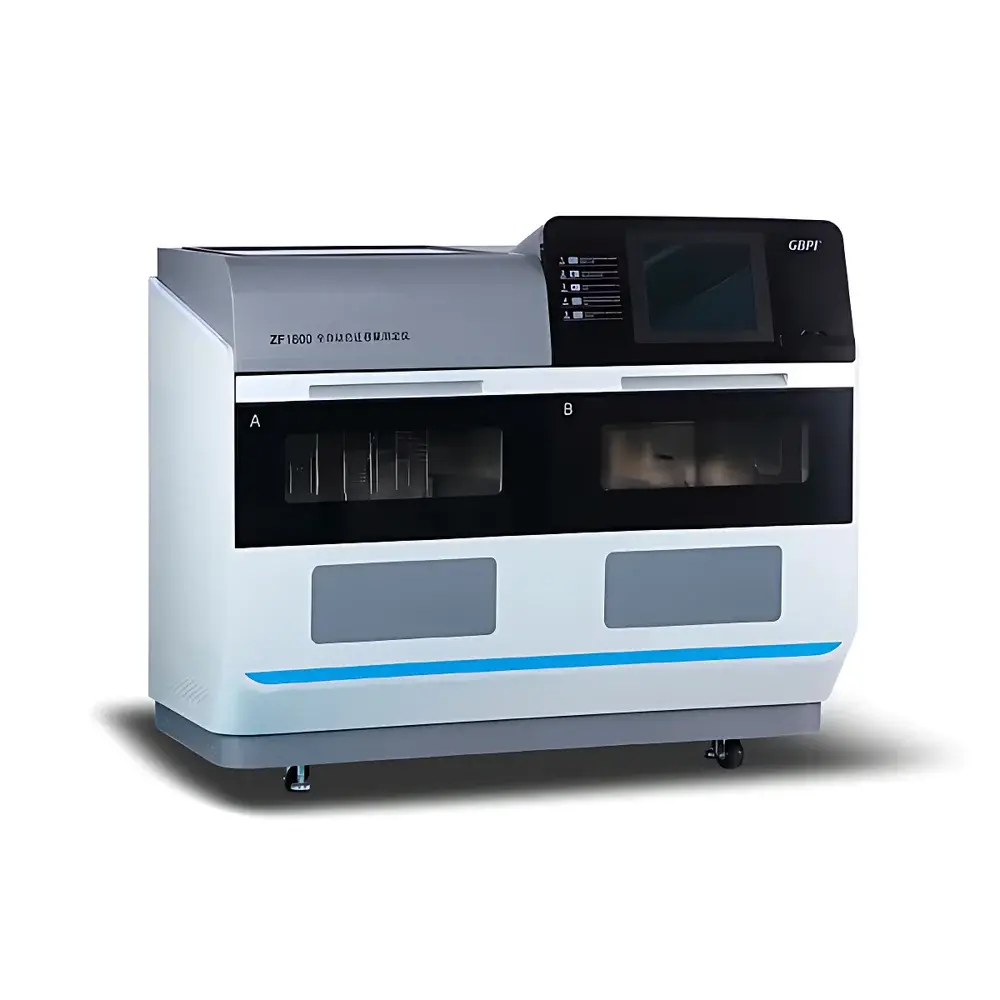
GBPI ZF1800-F Total Migration Tester
| Brand | GBPI |
|---|---|
| Model | ZF1800-F |
| Origin | Guangdong, China |
| Manufacturer Type | Manufacturer |
| Category | Other General Analytical Instruments |
| Measurement Range | 0.2–167,000 mg/dm² |
| Resolution | 0.0001 g/dm² |
| Balance Capacity | 0–200 g |
| Balance Resolution | 0.1 mg |
| Water Bath Temp Control | RT–100 °C |
| Heating Chamber Temp Control | RT–117.9 °C |
| Cooling Chamber Temp Control | 10–35 °C |
| Temperature Uniformity | ±5 °C |
| Sample Capacity | 1–18 independent test positions |
| Evaporating Dish Volume | 0–200 mL |
| Dimensions (Tester) | 178 × 93 × 145 cm (L×W×H) |
| Dimensions (Solvent Recovery Unit) | 120 × 88 × 170 cm (L×W×H) |
| Power Supply | 220 V, 50 Hz |
| Rated Power | 5000 W |
Overview
The GBPI ZF1800-F Total Migration Tester is a fully automated, regulatory-compliant analytical system engineered for precise quantification of total migration from food contact materials (FCMs) into food simulants. It operates on the principle of gravimetric determination: after controlled extraction under standardized conditions (e.g., ISO 10993-12, EN 1186, FDA 21 CFR §170–189), the simulant is evaporated to dryness in a thermally regulated environment; residual mass—representing non-volatile migrants—is measured with high-resolution microbalance technology. The instrument supports testing across the full spectrum of polymer-based FCMs—including polyethylene (PE), polypropylene (PP), polystyrene (PS), and chlorinated polyvinyl chloride (CPVC)—and accommodates all four standard food simulants (A–D) as defined by EU Regulation (EC) No. 10/2011 and ISO 21788. Its architecture integrates thermal conditioning, solvent evaporation, inert atmosphere control, and closed-loop solvent recovery into a single platform, eliminating manual handling errors and ensuring repeatability required for GLP- and GMP-aligned laboratories.
Key Features
- Dual Independent Thermal Chambers: Separated heating (up to 117.9 °C) and cooling (10–35 °C) zones enable simultaneous conditioning of samples and evaporating dishes—reducing cycle time by up to 40% versus sequential systems.
- Integrated Water Bath Evaporation System: Fully automated water level detection, temperature regulation (RT–100 °C), timed evaporation, and drain control eliminate operator intervention; dual safety interlocks prevent dry-run and overtemperature events.
- Closed-Solvent Recovery Architecture: All evaporation occurs within sealed chambers; vapors are condensed and collected via an integrated refrigerated recovery unit, achieving >95% solvent capture efficiency and eliminating ambient exposure to volatile organic compounds (VOCs).
- Nitrogen Purge Capability: Optional inert gas inlet enables accelerated solvent removal under oxygen-free conditions—critical for oxidation-sensitive migrants or low-boiling-point simulants such as ethanol 10% (v/v).
- Negative Pressure Test Chamber: Vacuum-assisted sealing maintains consistent negative pressure during extraction and evaporation, preventing cross-contamination and ensuring uniform simulant contact across heterogeneous sample geometries (e.g., laminated films, molded containers).
- 18-Position Independent Test Stations: Each station features individual temperature monitoring, real-time weight acquisition, and autonomous endpoint detection—enabling parallel analysis of dissimilar materials under distinct test protocols without data crosstalk.
Sample Compatibility & Compliance
The ZF1800-F is validated for use with food contact articles manufactured from thermoplastic polymers, coatings, adhesives, and multilayer laminates. It meets the mechanical and procedural requirements of ISO 21788:2020 (Plastics — Determination of total migration into food simulants), EN 1186-1 to -14 series, and ASTM D5967–22 (Standard Practice for Testing Migration from Plastics into Food Simulants). Its software architecture conforms to Annex 11 of the EU GMP Guidelines and FDA 21 CFR Part 11 for electronic records and signatures—supporting audit-ready operation in regulated environments. All hardware components—including load cells, PT100 sensors, and solenoid valves—are traceably calibrated against NIST-traceable standards, with calibration logs embedded in the audit trail.
Software & Data Management
The embedded ARM-based control system runs proprietary firmware compliant with ICH GCP and EU Annex 11 computerized system validation principles. Access requires role-based authentication (Administrator, Analyst, Reviewer, Observer), with granular permission assignment per module (e.g., method editing, report export, user management). Full audit trail captures timestamped records of all system events—including balance zeroing, method parameter changes, weight readings, alarm triggers, and report generation—with immutable storage in encrypted SQLite databases. Real-time dashboards display live weight trends, migration accumulation curves, chamber temperatures, and solvent recovery status. Reports are exportable in PDF/A-1b (archival), XLSX, and CSV formats, including metadata fields for analyst ID, instrument serial number, calibration certificate IDs, and environmental conditions at time of measurement.
Applications
- Regulatory submission testing for EU Food Contact Material Declarations (DoC)
- QC/QA release testing of packaging films, trays, lids, and pouches prior to commercial distribution
- Migration profiling during polymer formulation development and additive screening
- Stability assessment of coated metal cans and vacuum-sealed barrier layers
- Validation of cleaning protocols for reusable food processing equipment (e.g., gaskets, tubing)
- Investigational studies on temperature-dependent migration kinetics (e.g., microwave heating simulation)
FAQ
What food simulants are supported by the ZF1800-F?
The system accommodates aqueous (simulant A: 3% acetic acid; B: 10% ethanol), fatty (simulant D: vegetable oil or synthetic mixture), and alcoholic (simulant C: 20% ethanol) simulants per EU 10/2011 and ISO 21788.
Does the instrument support method validation per ISO/IEC 17025?
Yes—built-in calibration verification routines, documented uncertainty budgets for balance and temperature subsystems, and traceable reference standards enable full compliance with ISO/IEC 17025:2017 clause 7.7 (Sampling) and 7.8 (Ensuring validity of results).
Can test parameters be modified for non-standard exposure conditions?
Absolutely—the software allows user-defined time/temperature profiles, simulant volume, and evaporation ramp rates, with full version-controlled method archiving and change history.
Is remote monitoring or integration with LIMS possible?
The system provides OPC UA-compliant data export and RESTful API endpoints for bidirectional communication with laboratory information management systems (LIMS) and enterprise quality management systems (QMS).
What maintenance intervals are recommended for solvent recovery components?
Condenser coil inspection and refrigerant charge verification are recommended every 6 months; activated carbon filters in the exhaust path require replacement after 500 operational hours or upon VOC breakthrough detection.





