
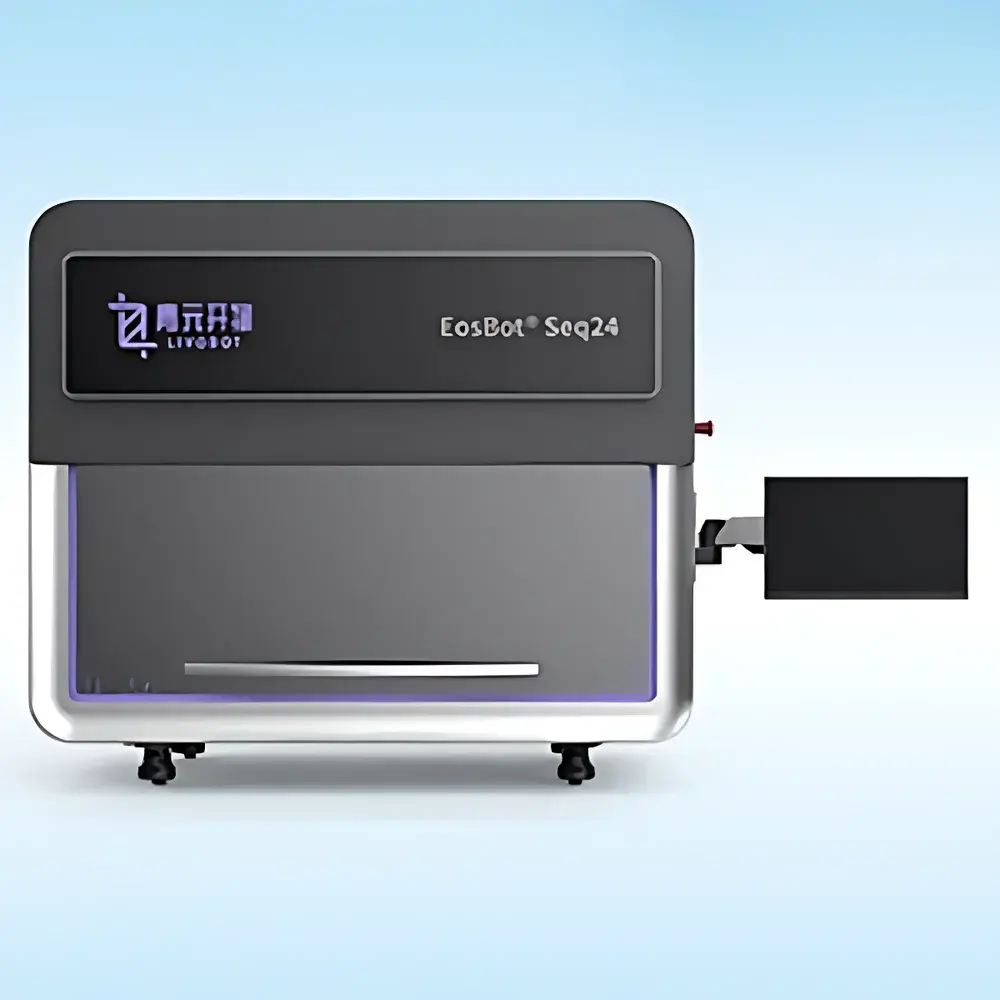
EosBot® Seq24 NGS Library Preparation and QC Integrated Workstation
| Brand | LIVOBOT |
|---|---|
| Origin | Beijing, China |
| Manufacturer | LIVOBOT |
| Type | Domestic |
| Model | EosBot Seq24 |
| Instrument Category | Integrated Library Prep & QC System |
| Library Prep Type | NGS Library Preparation System |
| Supported Plate Format | 96-well |
| Overall Function | Fully Automated Library Construction + On-instrument Quantification & QC |
| Dimensions (W × D × H) | 1200 mm × 850 mm × 1050 mm |
| Weight | 300 kg |
Overview
The EosBot® Seq24 is an integrated, benchtop-scale NGS library preparation and quality control workstation engineered for precision, reproducibility, and operational continuity in molecular genomics laboratories. It implements a modular, closed-system architecture grounded in standardized liquid handling robotics, thermally regulated PCR cycling, magnetic bead-based nucleic acid purification, and on-instrument fluorometric quantification—enabling end-to-end automation of fragmentation, end repair, A-tailing, adapter ligation, size selection, amplification, and post-library QC. Unlike standalone pipetting platforms or fragmented workflow add-ons, the Seq24 unifies these steps within a single instrument footprint while maintaining strict physical separation between pre- and post-amplification zones to mitigate cross-contamination risk. Its design adheres to core principles of GLP-compliant nucleic acid processing: traceable reagent tracking, audit-ready event logging, and hardware-level contamination controls including UV decontamination cycles, HEPA-filtered laminar airflow, and disposable tip-based fluidics.
Key Features
- Integrated dual-function platform: simultaneous library construction and on-board QC (fluorometric quantification + fragment size analysis via integrated capillary electrophoresis or optional microfluidic chip reader)
- High-precision liquid handling system with adjustable pipetting range (0.5–200 µL), calibrated per ISO 8655 and validated for low-volume DNA input (≥1 ng genomic DNA)
- Motorized, height-adjustable magnetic rack enabling consistent bead pelleting across variable plate heights and protocol stages (e.g., cleanup vs. size selection)
- Dedicated thermal cycler module compliant with Illumina TruSeq, MGI DNBSEQ, PacBio SMRTbell, and Oxford Nanopore rapid kit thermal profiles—including touchdown, gradient, and fast-cycling modes
- Expandable sample throughput: native 1–24 sample processing per run; scalable to 96 samples via optional multi-deck configuration without protocol redesign
- Reagent-agnostic compatibility: validated with commercial kits from Vazyme, Thermo Fisher, Illumina, and MGI—no firmware adaptation or custom script development required
- Modular deck layout with ≥12 programmable deck positions supporting simultaneous library prep, hybridization capture, and post-capture clean-up workflows
Sample Compatibility & Compliance
The EosBot® Seq24 supports diverse nucleic acid inputs including double-stranded DNA (genomic, FFPE, cfDNA), single-stranded DNA, and RNA (with optional reverse transcription module). It maintains full compatibility with standard 96-well PCR plates, skirted and semi-skirted formats, and tube racks for low-throughput validation runs. All wetware interfaces conform to ANSI/SLAS standards for plate geometry and barcode symbology (Code 128, DataMatrix). The system meets ISO 13485:2016 requirements for in vitro diagnostic device manufacturing environments and includes built-in features supporting FDA 21 CFR Part 11 compliance—including electronic signatures, role-based user access, and immutable audit trails for all protocol executions and calibration events.
Software & Data Management
Controlled via LIVOBOT’s proprietary SeqControl™ software, the Seq24 provides a graphical protocol builder with drag-and-drop module sequencing, real-time run monitoring, and automated error recovery logic (e.g., tip clog detection, volume verification, temperature deviation alerts). All protocols are exportable as XML-based SOPs for inter-lab transfer and version-controlled using Git-integrated repository support. Raw QC data (e.g., concentration, DV200, fragment distribution) are auto-exported in CSV and .qcc format compatible with Illumina BaseSpace, QIAGEN CLC Genomics Workbench, and custom Python/R pipelines. Audit logs record timestamped operator actions, environmental sensor readings (temperature/humidity), and hardware diagnostics—retained for ≥10 years per configurable retention policy.
Applications
- Whole-genome sequencing (WGS) library prep with uniform coverage and minimized GC bias
- Targeted panel sequencing (e.g., oncology hotspot panels) including hybridization capture and post-capture amplification
- Single-cell ATAC-seq and ChIP-seq library generation with low-input optimization
- Clinical NGS assay deployment under CAP/CLIA-certified workflows requiring documented process consistency
- Reference material characterization and QC in certified reference labs (ISO/IEC 17025 accredited)
- High-throughput biomarker discovery studies requiring >1000-sample annual throughput with ≤5% CV in library yield
FAQ
Does the EosBot® Seq24 require external QC instrumentation for final library validation?
No—integrated fluorometric quantification and fragment analysis eliminate the need for separate Qubit or Bioanalyzer systems for routine release testing.
Can existing manual NGS protocols be directly ported to the Seq24?
Yes—protocol conversion services include step-by-step mapping of manual steps to robotic modules, reagent placement optimization, and empirical volume calibration for each kit.
Is remote monitoring and troubleshooting supported?
Yes—the system supports secure TLS-encrypted remote access via LIVOBOT’s CloudLink™ portal, enabling real-time status dashboards and technician-assisted diagnostics without on-site intervention.
What maintenance intervals are recommended for long-term reliability?
Preventive maintenance is scheduled every 6 months, including pipette calibration verification, magnetic rack positional accuracy testing, thermal block uniformity validation, and UV lamp output measurement—all documented per ISO/IEC 17025 traceability requirements.





