GBPI GBB-F4 Heat Sealing Tester
| Brand | GBPI |
|---|---|
| Origin | Guangdong, China |
| Manufacturer Type | Direct Manufacturer |
| Country of Origin | China |
| Model | GBB-F4 |
| Price Range | USD 4,200 – 7,000 |
| Temperature Range | Ambient to 300 °C |
| Temperature Control Accuracy | ±1 °C |
| Sealing Time Range | 0.01 s to 99.99 h |
| Sealing Pressure Range | 0.05–0.8 MPa |
| Sealing Surface Dimensions | Upper Jaw — Five 35 mm × 10 mm Segments |
| Heating Method | Dual Independent Heating (Upper & Lower Jaws) |
| Actuation | Pneumatic (Compressed Air, 0.5–0.8 MPa) |
| Dimensions (W×D×H) | 700 × 400 × 540 mm |
| Weight | 55 kg |
| Power Consumption | 2000 W |
| Electrical Supply | AC 220 V, 50 Hz |
| Compliant Standards | QB/T 2358–1998, ASTM F2029–2016, YBB 00122003–2015 |
Overview
The GBPI GBB-F4 Heat Sealing Tester is an engineered precision instrument designed for quantitative evaluation of heat seal integrity in flexible packaging materials. It operates on the principle of controlled thermal, mechanical, and temporal energy delivery to simulate industrial sealing conditions—enabling reproducible determination of optimal sealing parameters including temperature, pressure, and dwell time. The system employs dual independent heating zones (upper jaw and lower bar), each with calibrated thermocouple feedback and PID-based regulation, ensuring high spatial and temporal repeatability across multiple test points. Its pneumatic actuation mechanism delivers consistent force application within a defined pressure envelope, critical for correlating laboratory-scale measurements with production-line performance. The GBB-F4 is purpose-built for laboratories requiring compliance-driven validation in regulated environments—including pharmaceutical primary packaging development, medical device sterile barrier qualification, and food packaging shelf-life studies.
Key Features
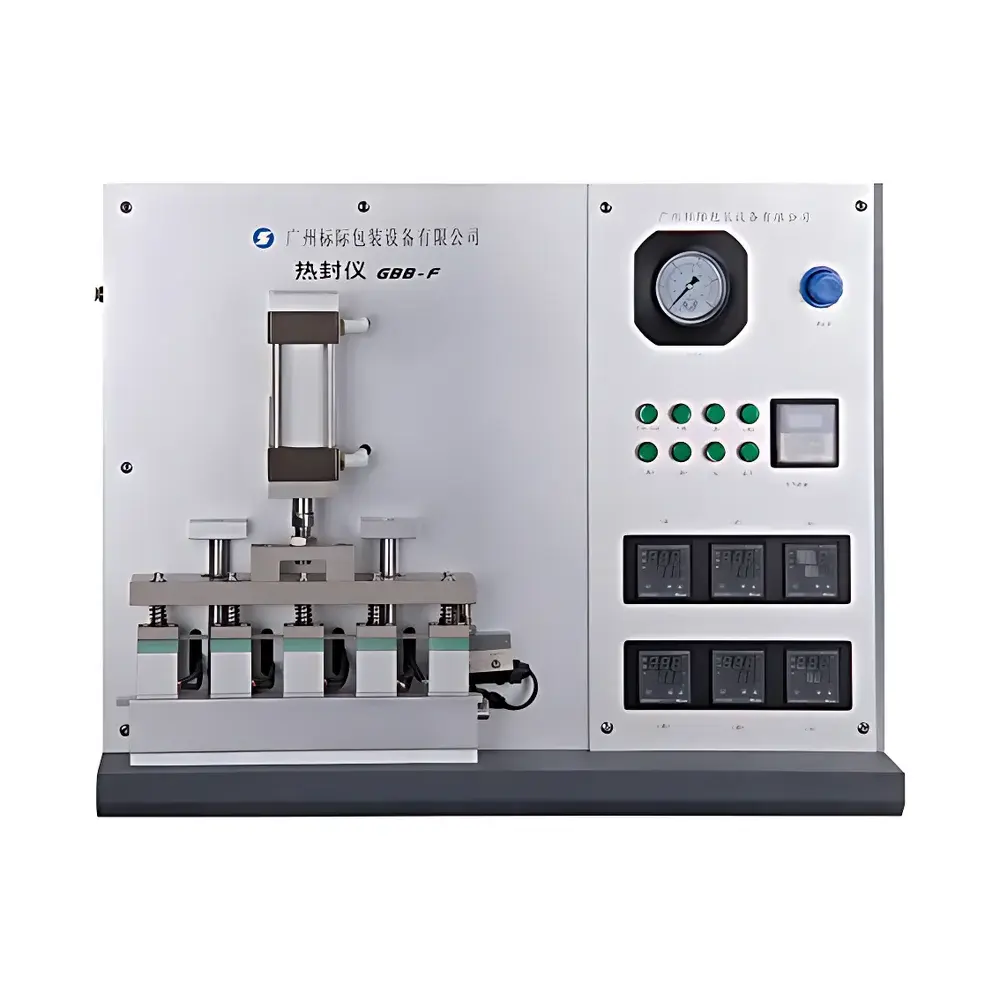
- Five-Point Independent Temperature Control: Five discrete 35 mm × 10 mm upper sealing segments operate at individually programmable temperatures—enabling simultaneous multi-condition evaluation or gradient profiling across a single specimen.
- Dual-Zone Thermal Architecture: Separate PID-controlled heating circuits for upper jaw and lower heated bar ensure thermal decoupling, minimizing cross-talk and enabling precise replication of asymmetric sealing profiles (e.g., film-to-film vs. film-to-lid configurations).
- Pneumatic Force Delivery: Compressed-air-driven actuation (0.5–0.8 MPa supply) provides stable, repeatable sealing pressure without mechanical hysteresis—critical for low-force applications such as ultra-thin barrier films or heat-sensitive laminates.
- Flexible Operation Modes: Supports both automated sequence execution (predefined parameter sets) and manual activation via foot switch—facilitating rapid method development, operator training, and troubleshooting workflows.
- Customizable Sealing Interface: Standard sealing surfaces are machined stainless steel; optional custom geometries (e.g., rounded edges, embossed patterns, non-stick coatings) are available per ISO 11607-2 Annex B requirements for specific material interactions.
- Traceable Calibration Support: Integrated Pt100 RTD sensors allow field verification against NIST-traceable reference standards; calibration certificates and adjustment procedures align with ISO/IEC 17025 documentation expectations.
Sample Compatibility & Compliance
The GBB-F4 accommodates a broad spectrum of thermoplastic packaging substrates—including polyethylene (LDPE, LLDPE), polypropylene (CPP, OPP), polyester (PET), aluminum foil laminates, and peelable medical-grade pouch films. Its modular jaw design supports specimens up to 100 mm wide and accommodates variable thicknesses (12 µm to 500 µm). Regulatory alignment includes full technical conformance with ASTM F2029–2016 (Standard Test Method for Making Heat-Sealed Packages for Use in Integrity Testing), QB/T 2358–1998 (Chinese standard for plastic film heat seal strength), and YBB 00122003–2015 (Chinese pharmaceutical packaging standard). When integrated into validated workflows, the instrument supports IQ/OQ documentation packages required under FDA 21 CFR Part 11 and EU Annex 11 for computerized systems used in GMP environments.
Software & Data Management
While the GBB-F4 operates via intuitive front-panel controls, optional PC-based software enables advanced data capture—including real-time temperature/pressure logging, parameter history archiving, and CSV export for statistical process control (SPC) analysis. All parameter changes are timestamped and user-logged, supporting audit trails compliant with GLP and GMP data integrity principles. Exported datasets include seal time, setpoint deviation, actual pressure trace, and cycle completion status—enabling correlation with downstream peel strength (ASTM F88), burst (ASTM F1140), or leak test (ASTM F2338) results.
Applications
- Optimization of heat seal parameters during packaging line setup and changeover
- Accelerated aging studies linking seal integrity to storage conditions (e.g., humidity, temperature)
- Comparative evaluation of alternative sealant layers or adhesive formulations
- Root cause analysis of seal failures in complaint investigations
- Validation of sterilization-compatible packaging for Class II/III medical devices
- Supporting submissions to regulatory agencies (e.g., FDA 510(k), EMA CEP dossiers) with documented sealing process windows
FAQ
Does the GBB-F4 support automatic data export to LIMS?
Yes—when equipped with the optional communication module (RS-232 or USB virtual COM port), the instrument outputs ASCII-formatted parameter logs compatible with common LIMS ingestion protocols.
Can the sealing jaws be recalibrated in-house?
Yes—temperature sensors are accessible via service ports; calibration routines and tolerance limits are documented in the user manual per ISO/IEC 17025 Clause 6.5 guidelines.
Is compressed air supply included with the instrument?
No—the unit requires an external clean, dry, oil-free compressed air source meeting ISO 8573-1 Class 2:2:2 specifications; a dedicated regulator/filter unit is recommended for stable pressure delivery.
What is the maximum allowable film thickness for reliable sealing?
Testing confirms consistent performance up to 500 µm total thickness for multilayer laminates; thicker substrates may require extended dwell times and pressure optimization—method development support is available from GBPI Applications Engineering.
How does the five-segment upper jaw improve experimental efficiency?
It eliminates sequential testing by enabling five distinct temperature-pressure-time combinations in a single cycle—reducing inter-test variability and accelerating DoE (Design of Experiments) execution for seal parameter mapping.