
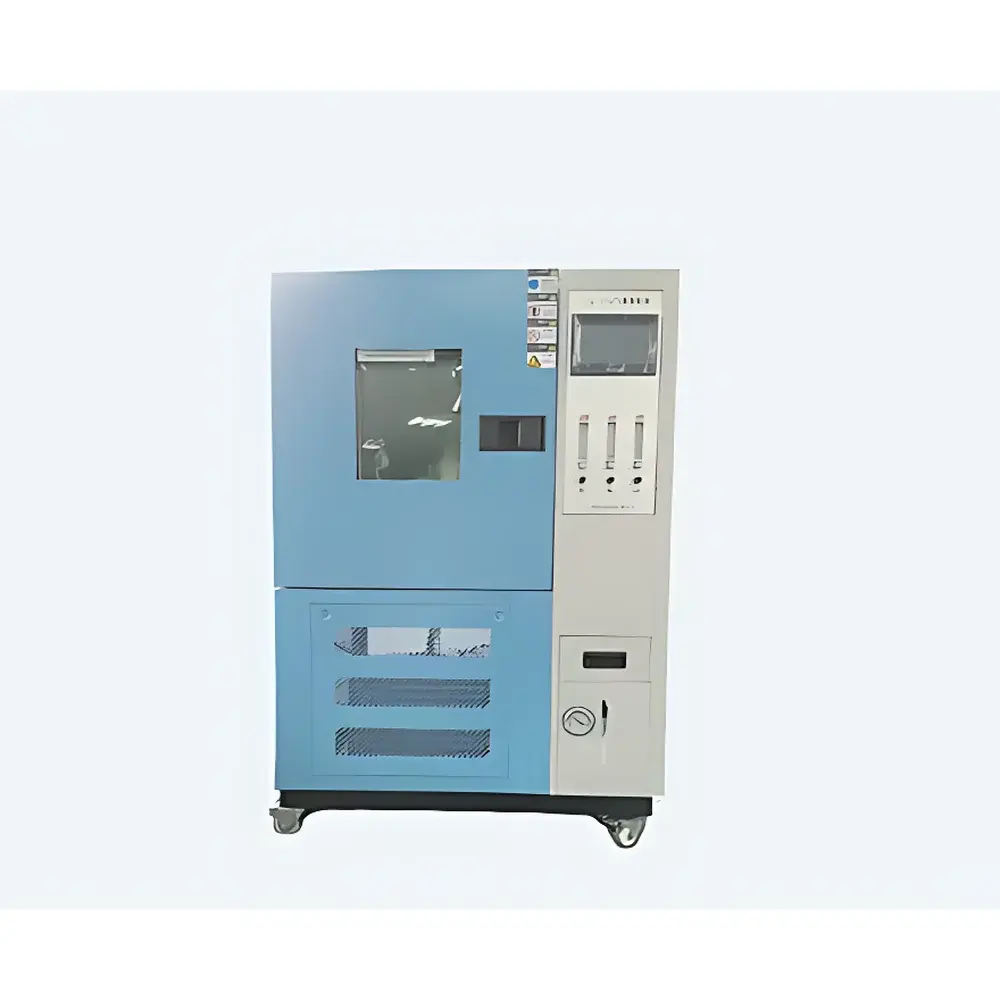
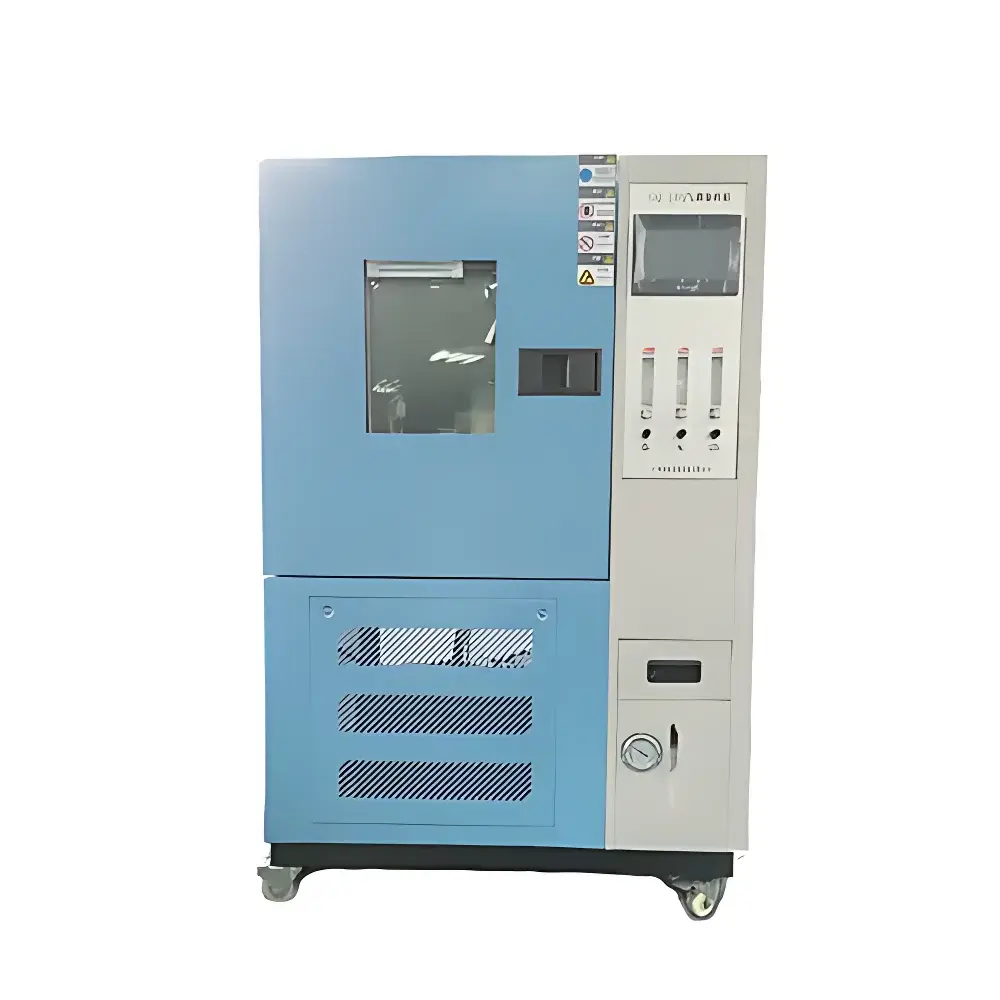
GBPI GQ-160A Controlled Atmosphere Storage Chamber
| Brand | GBPI |
|---|---|
| Model | GQ-160A |
| Origin | Guangdong, China |
| Manufacturer | GBPI Packaging Instruments Co., Ltd. |
| Internal Dimensions | 50 × 50 × 60 cm (W×D×H) |
| External Dimensions | 100 × 100 × 170 cm (W×D×H) |
| Temperature Range | 0–60 °C (3–50 °C with humidification) |
| Temp. Accuracy | ±1 °C |
| Temp. Stability | ±0.1 °C |
| Humidity Range | Ambient–95 %RH |
| Humidity Fluctuation | ±5 %RH |
| O₂ Measurement Range | 0–100 % |
| CO₂ Measurement Range | 0–5 % |
| N₂ Balance | Computed by difference |
| O₂/CO₂ Resolution | 0.01 % |
| Gas Flow Control | O₂/CO₂/N₂: 0–100 mL/min each |
| Mass Flow Controller Resolution | 0.01 mL/min |
| Refrigeration Capacity | 1 HP |
| Total Power Consumption | 2000 W |
| Humidifier Power | 15 W |
| Illumination Power | 100 W |
| Supply Voltage | AC 220 V, 50 Hz |
| Ambient Operating Temp. | 0–40 °C |
| Minimum Gas Purity | ≥99.9 % |
| Standard Accessories | Power cord, #6 & #8 silicone tubing, fittings, hex key, Phillips screwdriver |
| Optional Modules | 3-HP refrigeration kit, ethylene scrubber, UV sterilization unit, on-site nitrogen generator |
Overview
The GBPI GQ-160A Controlled Atmosphere Storage Chamber is a purpose-built environmental test system engineered for rigorous postharvest physiology research and packaging development in the fresh produce supply chain. It operates on the principle of dynamic gas composition regulation—precisely maintaining and modulating oxygen (O₂), carbon dioxide (CO₂), nitrogen (N₂), and trace ethylene levels within a sealed, temperature- and humidity-controlled enclosure. Unlike static storage cabinets, the GQ-160A integrates real-time gas sensing, closed-loop mass flow control, and PID-driven thermal management to replicate and accelerate controlled atmosphere (CA) and modified atmosphere (MA) conditions defined by ISO 22030, ASTM F2097, and Codex Alimentarius standards. Its design supports mechanistic studies of respiration kinetics, enzymatic browning, microbial inhibition thresholds, and shelf-life extension under systematically varied gaseous environments—making it essential for R&D labs validating active packaging films, CA transport containers, or retail-ready MAP trays.
Key Features
- Triple-sensor gas monitoring system with factory-calibrated, OEM-grade electrochemical O₂ and infrared CO₂ sensors—delivering 0.01 % resolution across full 0–100 % O₂ and 0–5 % CO₂ ranges;
- High-stability mass flow controllers (MFCs) for O₂, CO₂, and N₂, each rated to 100 mL/min with 0.01 mL/min minimum increment and <±1 % full-scale repeatability;
- Dual-mode climate control: hermetic refrigeration via low-noise scroll compressor (1 HP), coupled with solid-state relay (SSR)-driven resistive heating and high-frequency ultrasonic humidification (15 W, non-thermal output);
- PID-based temperature regulation with ±0.1 °C setpoint stability over 0–60 °C range (3–50 °C when humidifying), and humidity control from ambient to 95 %RH with ±5 %RH uniformity;
- Modular architecture supporting optional field-installable upgrades—including 3-HP enhanced cooling, catalytic ethylene oxidation module (for climacteric fruit studies), germicidal UV-C irradiation chamber, and integrated membrane-based nitrogen generation;
- Robust stainless-steel inner chamber (50 × 50 × 60 cm) with double-glazed insulated door, LED interior lighting (100 W), and industrial-grade sealing gaskets ensuring <0.5 %/hr air leakage rate.
Sample Compatibility & Compliance
The GQ-160A accommodates whole fruits (e.g., apples, pears, kiwifruit), cut vegetables (lettuce, broccoli florets), berries, mushrooms, and pre-packaged produce units up to 60 L volume. Its internal geometry allows unobstructed airflow distribution and representative sensor placement per ISO 8587:2021 guidelines for sensory and quality testing chambers. All gas delivery components meet FDA-compliant material specifications (USP Class VI elastomers, 316L SS fittings). The system supports GLP-compliant operation through configurable audit trails, user-access logs, and timestamped parameter recording—fully compatible with 21 CFR Part 11–ready data export formats (CSV, XML) when paired with GBPI’s optional LabLink Pro software suite.
Software & Data Management
While the GQ-160A operates autonomously via its embedded touchscreen HMI, it includes RS-485 Modbus RTU and USB-C interfaces for integration into centralized lab networks. Optional LabLink Pro software enables remote configuration, multi-chamber synchronization, automated protocol sequencing (e.g., ramp-and-hold O₂ depletion), and statistical process control (SPC) charting of gas decay rates and respiration quotients (RQ = CO₂/O₂). Raw sensor outputs are time-stamped at 1 Hz and archived with metadata including chamber ID, operator credentials, and calibration certificate expiry dates—ensuring traceability for ISO/IEC 17025-accredited laboratories.
Applications
- Optimization of O₂/CO₂ thresholds for delayed senescence in climacteric vs. non-climacteric produce;
- Validation of barrier performance for multilayer pouches and vacuum-skin packaging under simulated transit conditions;
- Quantification of ethylene production kinetics and efficacy of scavenger sachets or catalytic filters;
- Accelerated shelf-life modeling using Arrhenius-based temperature-gas interaction matrices;
- Teaching modules in food science curricula covering respiration biochemistry, gas diffusion physics, and CA storage engineering principles;
- Regulatory dossier preparation for novel packaging submissions to EFSA, USDA-FSIS, or China’s SAMR.
FAQ
What gas purity is required for stable long-term operation?
Minimum 99.9 % purity is mandatory for all supply gases (O₂, CO₂, N₂) to prevent sensor poisoning and MFC drift; certified medical- or research-grade cylinders with dual-stage regulators are recommended.
Can the chamber operate continuously for 30+ days during extended shelf-life trials?
Yes—the scroll compressor, SSR heating system, and ultrasonic humidifier are rated for continuous duty; preventive maintenance intervals are specified at 500 operational hours per ISO 13374 condition monitoring standards.
Is third-party calibration certification available?
GBPI provides NIST-traceable calibration reports (O₂, CO₂, temperature, humidity) upon request; accredited calibration services via CNAS-certified partners can be arranged separately.
How is ethylene monitored and managed without the optional scrubber?
The base system does not include ethylene sensing; users must integrate external photoacoustic or GC-PID analyzers via the auxiliary gas sampling port (¼” Swagelok)—the scrubber module adds onboard catalytic oxidation and real-time feedback control.
Does the unit comply with electromagnetic compatibility (EMC) directives for EU deployment?
Yes—CE marking per EN 61326-1:2013 (industrial EMC) and EN 61000-6-3:2011 (emission limits) is standard; full technical documentation package available for customs clearance and conformity assessment.






