
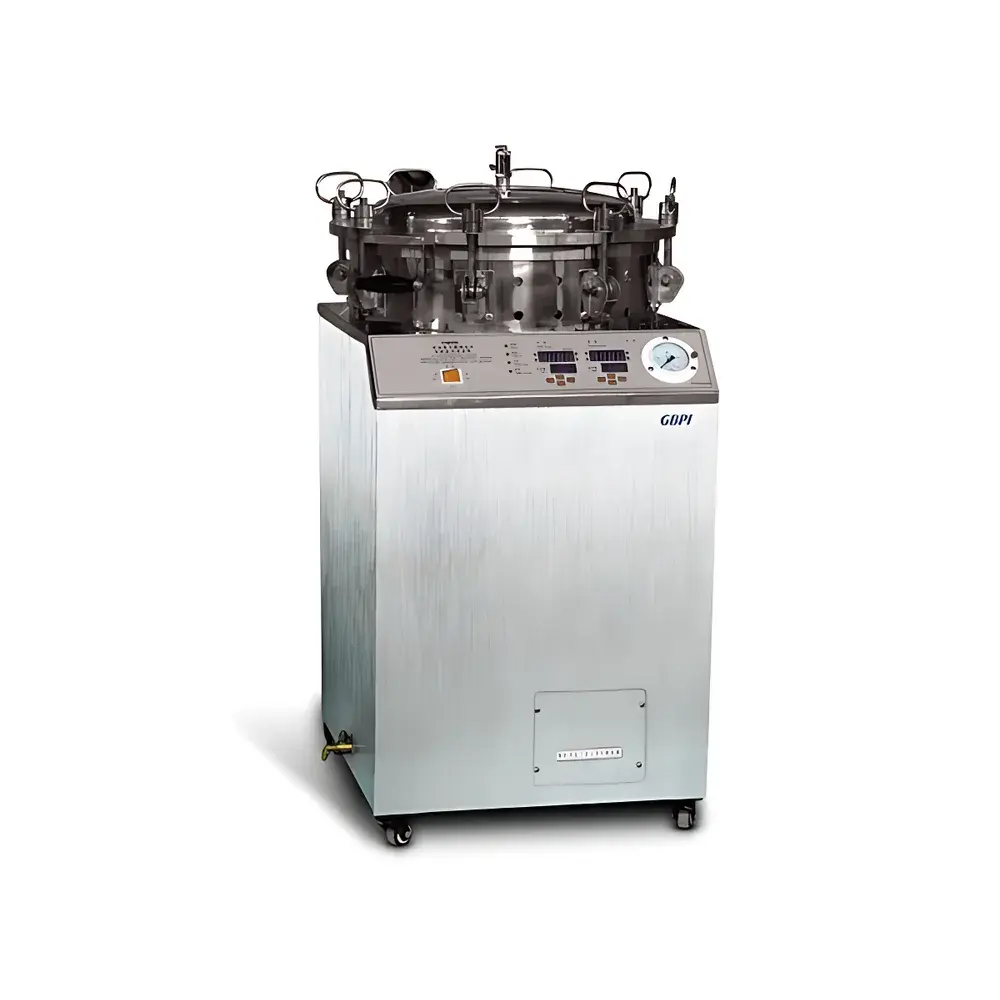
GBPI ZM-100B Vertical Retort Sterilizer with Back-Pressure Control
| Brand | GBPI |
|---|---|
| Origin | Guangdong, China |
| Manufacturer Type | Direct Manufacturer |
| Product Category | Domestic |
| Model | ZM-100B |
| Instrument Type | Vertical |
| Max Temperature | 135 °C |
| Max Pressure | 0–0.22 MPa (Saturated Steam Pressure) |
| Sterilization Chamber Dimensions | Ø400 mm × 500 mm (H) |
| External Dimensions | Ø500 mm × 560 mm (H) |
| Chamber Volume | 50 L |
| Safety Relief Pressure | 0.23 MPa |
| Back-Pressure Range | 0.14–0.165 MPa |
| Time Setting Range | 1–99.59 min |
| Power Supply | AC 220 V, 50 Hz |
| Rated Power | 4.5 kW ±10% |
| Compliance | GB 150.1–2011, GB/T 10004–2008, GB 4793.4–2001, YY 1007–2010 |
Overview
The GBPI ZM-100B Vertical Retort Sterilizer with Back-Pressure Control is an engineered laboratory-grade pressure processing system designed for controlled thermal validation, sterilization, and retort stability testing of heat-sensitive packaged products and biomedical materials. Unlike conventional autoclaves, this unit integrates precise back-pressure regulation to prevent package deformation, delamination, or burst during steam heating and cooling cycles—critical for evaluating the integrity of flexible packaging (e.g., pouches, laminates, blister packs), pharmaceutical formulations, culture media, adhesives, and medical devices under simulated industrial retort conditions. Its operation adheres to the thermodynamic principles of saturated steam sterilization, where temperature is directly governed by applied absolute pressure, enabling accurate reproduction of process parameters defined in ISO 11134, ASTM F1980, and USP . The chamber’s ASME-compliant pressure vessel construction—validated per GB 150.1–2011—ensures structural integrity at sustained operating pressures up to 0.22 MPa.
Key Features
- Automated process sequence: fully programmable control of heating, hold, back-pressure maintenance, cooling (via dual-mode air-cooling or spray-water cooling), and drainage—eliminating manual intervention and reducing operator variability.
- High-contrast LCD interface displaying real-time chamber temperature, elapsed time, setpoint values, and pressure status—including dedicated back-pressure monitoring within the 0.14–0.165 MPa range.
- Dual cooling methodology: configurable selection between forced-air cooling (for rapid temperature ramp-down without condensation-induced package stress) and regulated spray-water cooling (for high-thermal-mass loads requiring accelerated cycle times).
- Robust stainless-steel chamber (304 grade) with seamless interior finish, optimized for corrosion resistance, cleanability, and compliance with GMP cleaning validation protocols.
- Integrated safety architecture: independent overtemperature cutoff (≥137 °C), low-water-level detection with auto-shutdown, pressure interlock on lid closure, and certified mechanical safety relief valve calibrated to 0.23 MPa—fully traceable per YY 1007–2010 requirements.
- Mobile base with four swivel casters (two with locking brakes), facilitating repositioning within shared lab spaces while maintaining stable operational alignment.
Sample Compatibility & Compliance
The ZM-100B accommodates a broad spectrum of sample formats, including sealed flexible packages (stand-up pouches, vacuum-sealed trays), glass vials, stainless-steel canisters, and polymer-based medical device trays. Its 50 L chamber volume supports batch testing of up to 12 standard 250 mL pouches or equivalent surface-area loads without compromising thermal uniformity. All operational parameters are traceable and auditable in accordance with GLP and GMP documentation standards. The system complies with national and industry-specific regulatory frameworks: GB/T 10004–2008 for plastic composite packaging retort resistance; YY 1007–2010 for medical sterilization equipment safety; GB 4793.4–2001 (IEC 61010-1) for electrical safety in laboratory environments; and GB 150.1–2011 for design, fabrication, and inspection of steel pressure vessels. Optional calibration certificates (NIST-traceable thermocouples and pressure transducers) support ISO/IEC 17025 accreditation readiness.
Software & Data Management
While the ZM-100B operates via embedded microcontroller logic (no external PC dependency), its control firmware supports audit-ready data logging: timestamped records of temperature, pressure, and cycle phase transitions are stored internally for ≥1,000 cycles. USB export functionality enables transfer of raw CSV-formatted logs for integration into LIMS or statistical process control (SPC) platforms. All parameter changes, alarm events, and safety interventions are automatically timestamped and retained—satisfying FDA 21 CFR Part 11 requirements for electronic record integrity when paired with user-defined access controls and electronic signatures (via optional GBPI LabSuite software module). Firmware updates are performed via secure USB protocol with version rollback capability and checksum verification.
Applications
- Retort stability assessment of food and pharmaceutical packaging per ASTM F2054 and ISO 11607–2.
- Validation of terminal sterilization processes for parenteral drug products and medical device kits.
- Accelerated aging studies simulating shelf-life exposure to elevated temperature/pressure conditions.
- Quality assurance testing of adhesive bond strength, ink adhesion, and laminate delamination resistance post-thermal challenge.
- Microbiological challenge testing using biological indicators (e.g., Geobacillus stearothermophilus spores) under precisely controlled F0 conditions.
- Research into thermal degradation kinetics of polymers, hydrogels, and biologics under saturated steam environments.
FAQ
What distinguishes back-pressure control from standard autoclave operation?
Back-pressure control actively maintains a defined non-atmospheric pressure during cooling to counteract internal vapor expansion in sealed packages—preventing bulging, seal failure, or paneling. Standard autoclaves vent to ambient pressure, inducing rapid pressure differentials that compromise package integrity.
Is the ZM-100B suitable for sterilizing liquids in open containers?
No—it is engineered for sealed-package testing and pressurized sterilization. Open-container liquid sterilization requires gravity-displacement or prevacuum autoclaves with dedicated liquid-cycle programming and boil-over safeguards.
Can process parameters be exported for regulatory submission?
Yes. Full-cycle temperature/pressure/time logs are exportable via USB in CSV format, supporting inclusion in FDA eCTD modules, EU Annex 1 submissions, or MHRA audit packages when accompanied by instrument qualification documentation.
What maintenance intervals are recommended for long-term reliability?
Quarterly verification of pressure transducer accuracy and safety valve setpoint (per YY 1007–2010), semiannual inspection of door gasket integrity and steam trap function, and annual recalibration of all critical sensors using NIST-traceable references.



