
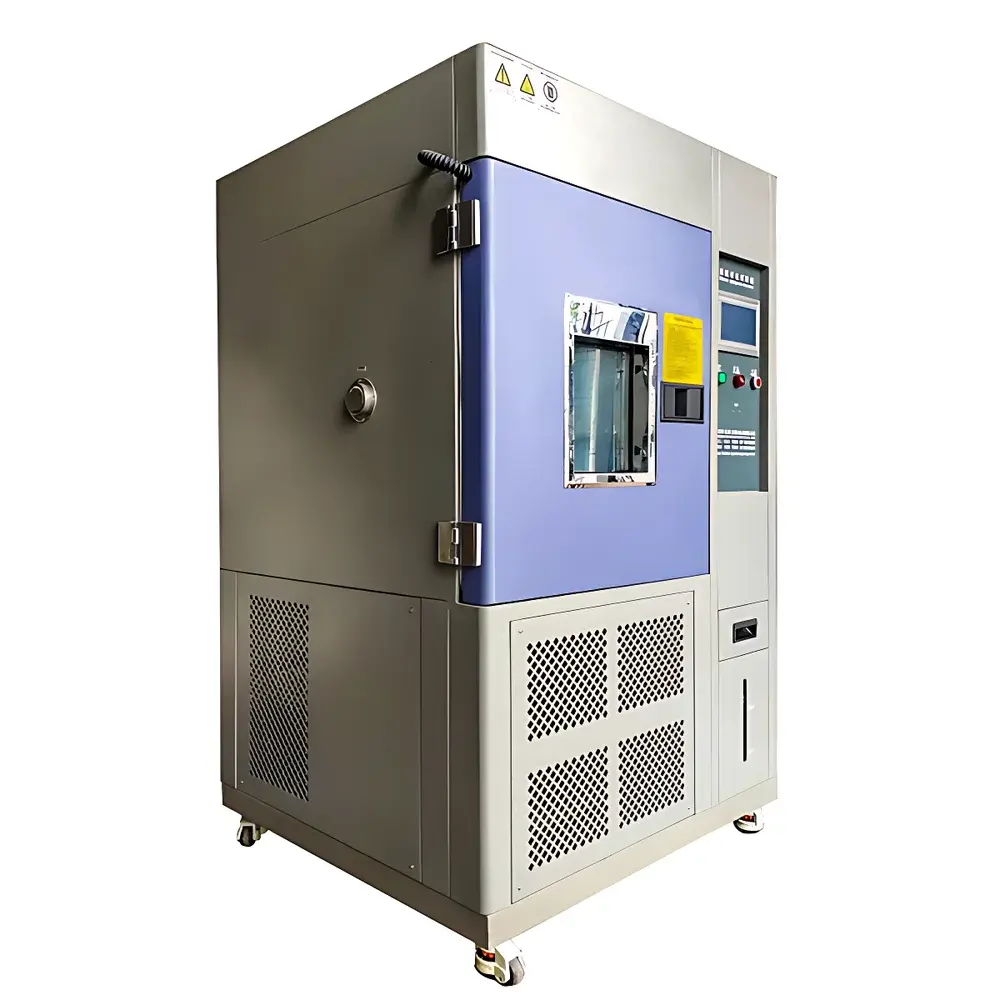
GBPI OCY-150J Static Ozone Aging Test Chamber
| Brand | GBPI |
|---|---|
| Origin | Guangdong, China |
| Manufacturer Type | Direct Manufacturer |
| Country of Origin | China |
| Model | OCY-150J |
| Pricing | Upon Request |
Overview
The GBPI OCY-150J Static Ozone Aging Test Chamber is an engineered environmental simulation system designed specifically for evaluating the ozone resistance of elastomeric materials—particularly vulcanized rubber and thermoplastic elastomers—under controlled static tensile conditions. Unlike dynamic ozone testing systems that subject specimens to cyclic mechanical strain during exposure, the OCY-150J maintains samples in a fixed, pre-stretched state throughout the test duration, aligning with standardized static aging protocols defined in ISO 1431-1, ASTM D1149, and GB/T 7762–2003. The chamber generates and precisely regulates ozone concentrations (50–1000 pphm) via silent corona discharge technology, while maintaining temperature stability (0–60 °C) and uniform gas flow (12–16 mm/s) across the test volume. Its robust stainless-steel construction (SUS304 inner chamber), high-efficiency refrigeration system, and closed-loop PID-controlled thermal management ensure repeatability and compliance with GLP-aligned laboratory practices.
Key Features
- Integrated ozone generation using high-reliability silent discharge tubes with real-time feedback control via electrochemical ozone sensors
- Dual-stage refrigeration system featuring a hermetic Tecumseh (France) compressor, finned evaporator with automatic capacity modulation, and R404A eco-friendly refrigerant (ODP = 0)
- PID-controlled ceramic heating system with DIN PT-100 platinum resistance temperature sensors (±0.1 °C + 1 digit accuracy)
- 7-inch full-color touchscreen HMI controller developed in-house by GBPI, supporting bilingual (English/Chinese) operation, graphical program editing, and real-time curve visualization
- Programmable test sequences: up to 96 independent patterns, 9999 cycles per pattern, segment durations from 0.1 seconds to 540 hours 59 minutes
- Comprehensive safety architecture including compressor overheat & high-pressure cutouts, heater surface overtemperature protection, motor thermal overload relays, and dual-layer silicone door seals with anti-condensation heating
- Structural integrity ensured by nitrogen-purged brazing, double-stage rotary vane vacuum pumping, and integrated condensate drainage via rear-mounted outlet
Sample Compatibility & Compliance
The OCY-150J accommodates standard static tensile specimens conforming to ISO 1431-1 Type A dumbbell shapes or GB/T 7762–2003 geometry requirements. Internal dimensions (W500 × H600 × D500 mm) support multi-specimen racks with unobstructed airflow distribution. All operational parameters—including ozone concentration deviation (±10%), temperature uniformity (±2.0 °C), and thermal stability (±0.5 °C) —are validated against national and international calibration traceability frameworks. The system supports audit-ready documentation workflows compatible with ISO/IEC 17025-accredited laboratories and meets essential requirements for FDA-regulated material qualification under 21 CFR Part 11 when paired with GBPI’s optional electronic signature and audit trail software module.
Software & Data Management
The embedded controller firmware enables full data logging at user-defined intervals (minimum 1-second resolution), storing temperature, ozone concentration, elapsed time, cycle count, and fault event timestamps in non-volatile memory. Historical datasets are exportable via USB interface in CSV format for post-processing in MATLAB, Excel, or LIMS platforms. Graphical trend displays include overlay-capable multi-curve views, programmable alarm thresholds, and automatic fault diagnosis with contextual remediation guidance. Firmware supports scheduled power-on/off, password-protected parameter locking, screen brightness scheduling, and configurable display timeout—all critical for unattended overnight testing in regulated environments.
Applications
This chamber serves as a primary tool for quality assurance and R&D laboratories in rubber compounding, automotive sealing systems, wire & cable insulation development, medical tubing formulation, and aerospace elastomer qualification. Typical use cases include comparative screening of antiozonant additives (e.g., p-phenylenediamine derivatives), shelf-life modeling of rubber components exposed to ambient ozone, validation of curing process effects on ozone resistance, and regulatory submission testing for UL, CSA, and CCC certification programs. Its design also supports accelerated aging correlation studies when combined with Arrhenius-based temperature acceleration models.
FAQ
What standards does the OCY-150J comply with for static ozone testing?
It conforms to GB/T 7762–2003, GB/T 2951.21–2008, GB/T 11206–2009, ISO 1431-1, and ASTM D1149.
Can the chamber operate continuously for extended durations (e.g., 72+ hours)?
Yes—its industrial-grade refrigeration architecture, redundant safety interlocks, and uninterruptible program resume function after power recovery enable stable long-term operation.
Is ozone exhaust routing included in the standard configuration?
The unit integrates an internal exhaust fan and dedicated duct interface for external venting; external ductwork and ozone destruct units must be specified separately.
Does the controller support remote monitoring or network connectivity?
Standard configuration includes local USB data export; Ethernet or RS485 interfaces are available as factory-installed options upon request.
What maintenance intervals are recommended for the ozone generator and sensor?
Ozone tubes require replacement every 12–18 months under typical usage; electrochemical sensors should be calibrated quarterly using certified zero air and span gas standards.






