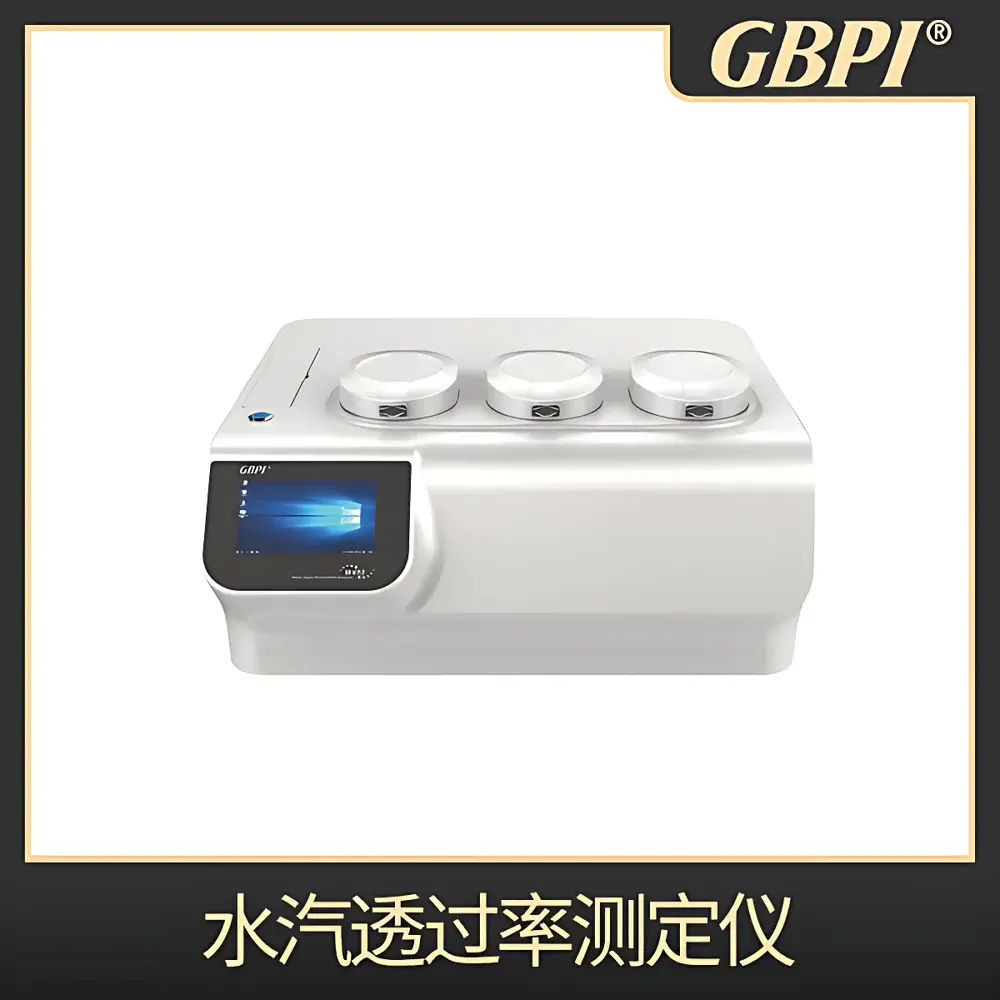
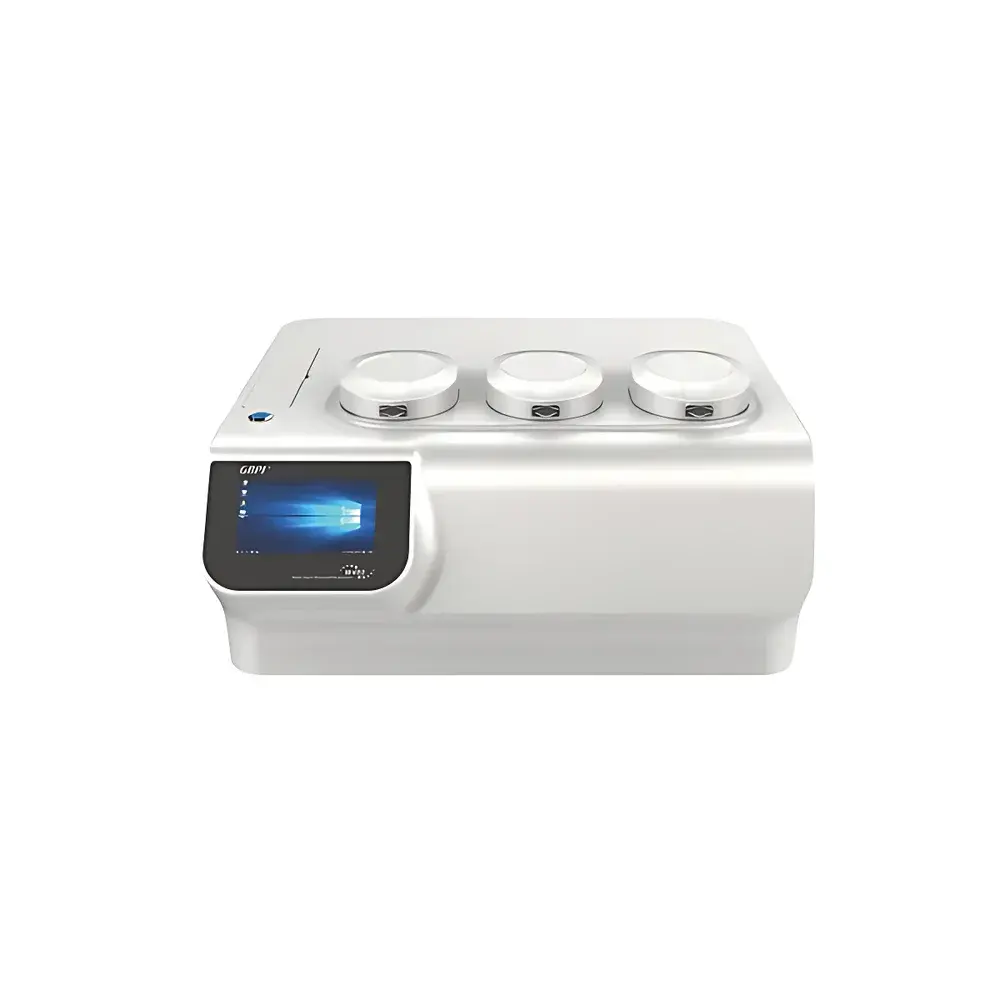
GBPI W413T Infrared-Based Water Vapor Transmission Rate (WVTR) Analyzer
| Brand | GBPI |
|---|---|
| Origin | Guangdong, China |
| Manufacturer Type | Direct Manufacturer |
| Country of Origin | China |
| Model | W413T |
| Price Range | USD 42,000 – 70,000 |
| Test Principle | Infrared Detection of Moisture Permeation |
| Standards Compliance | GB/T 26253-2010, YBB 00092003-2015, ASTM F1249-2013, ISO 15106-2:2005, JIS K7129-2008 |
| Measurement Range | 0.002–500 g/(m²·24h) |
| Resolution | 0.001 g/(m²·24h) |
| Temperature Control Range | 15–45 °C |
| Temperature Accuracy | ±0.1 °C |
| Humidity Control Range | 0% RH (dry gas), 30–90% RH, and 100% RH |
| Humidity Accuracy | ±1% RH |
| Test Area | 50.24 cm² |
| Specimen Diameter | Φ100 mm |
| Max Specimen Thickness | ≤3 mm |
| Sample Capacity | 3 specimens per cycle |
| Carrier Gas | 99.999% high-purity N₂ (user-supplied) |
| Carrier Gas Pressure | ≥0.1 MPa |
| Carrier Gas Flow Rate | 5–100 mL/min |
| Pneumatic Clamping Pressure | ≥0.3 MPa |
| Power Consumption | 750 W |
| Input Power | AC 220 V, 50 Hz |
Overview
The GBPI W413T Infrared-Based Water Vapor Transmission Rate (WVTR) Analyzer is an engineered solution for precise, traceable, and regulatory-compliant measurement of water vapor permeation through packaging and functional barrier materials. It operates on the principle of infrared (IR) spectroscopic detection of moisture molecules transported across a test specimen under controlled temperature and humidity gradients. Unlike gravimetric or coulometric methods, the IR-based approach delivers real-time, non-destructive quantification with high signal-to-noise ratio and minimal baseline drift—critical for evaluating ultra-high-barrier substrates such as aluminum foil, SiOx-coated PET, and multilayer pharmaceutical blister films. Designed in strict accordance with GB/T 26253-2010 and harmonized international standards—including ASTM F1249, ISO 15106-2, and JIS K7129—the instrument meets the metrological rigor required for quality control laboratories operating under GLP, GMP, and FDA 21 CFR Part 11 frameworks.
Key Features
- Infrared moisture sensor architecture: High-stability dual-beam IR detector calibrated against GBW(E)130543/4 certified reference materials, ensuring measurement traceability to national metrological standards.
- Integrated environmental control: Electromagnetic programmable stepwise temperature regulation (15–45 °C, ±0.1 °C) and dual-stream humidity generation (0–100% RH, ±1% RH), eliminating external climatic chambers and reducing thermal lag.
- Automated pneumatic clamping system: Consistent 0.3 MPa clamping pressure ensures uniform sealing across specimens up to 3 mm thickness and Φ100 mm diameter—minimizing edge leakage and operator variability.
- Standalone operation: 7-inch color capacitive touchscreen interface with embedded real-time plotting of five concurrent parameters (temperature, RH, WVTR, carrier gas flow, supply voltage); no external PC required for routine testing.
- GMP-aligned software architecture: Role-based user permissions, electronic signatures, audit trail logging (per 21 CFR Part 11 §11.10 and Annex 11), and immutable database storage with timestamped revision history.
- Modular hardware design: Sensor modules, gas manifolds, and environmental control units are physically and logically decoupled—enabling rapid field replacement and minimizing downtime during preventive maintenance.
Sample Compatibility & Compliance
The W413T accommodates a broad spectrum of planar and rigid specimens: flexible polymer films (e.g., LDPE, EVOH, PVDC), metallized laminates, ceramic-coated substrates, pharmaceutical blister foils, solar backsheet composites, and medical transdermal patch membranes. Its 50.24 cm² test area and triple-specimen capacity support statistically robust replicate analysis per ISO 5725-2. All operational parameters comply with pharmacopoeial requirements outlined in YBB 00092003-2015 and USP <671>, while its humidity control fidelity satisfies the stability testing conditions specified in ICH Q1A(R2). The system is validated for use in regulated environments where data integrity, repeatability (RSD < 2.5% at 0.01 g/m²·24h), and inter-laboratory comparability are mandated.
Software & Data Management
GBPI’s proprietary WinWVTR v3.2 software provides full lifecycle data governance—from method definition and instrument qualification (IQ/OQ/PQ templates included) to report generation and long-term archival. Raw sensor output, environmental logs, and user actions are stored in encrypted SQLite databases with SHA-256 hashing. Reports conform to ISO/IEC 17025:2017 clause 7.8.2 and include metadata such as calibration certificate numbers, uncertainty budgets (k=2), and traceable instrument ID tags. PDF export supports digital signatures, watermarking, and hierarchical approval workflows—fully compatible with LIMS integration via RESTful API endpoints.
Applications
- Barrier performance validation of pharmaceutical blister packaging and sachets per FDA guidance on container closure integrity.
- Accelerated aging studies for flexible OLED encapsulation films and perovskite solar cell moisture barriers.
- QC release testing of food-grade laminates used in retort pouches and vacuum-sealed trays.
- Development of hydrophobic breathable membranes for medical wound dressings and wearable biosensors.
- Comparative evaluation of nanocomposite coatings (e.g., graphene oxide, cellulose nanocrystals) for enhanced moisture resistance.
FAQ
Does the W413T require external calibration gases or consumables beyond nitrogen?
No. The IR sensor is factory-calibrated using NIST-traceable moisture standards and requires only high-purity (99.999%) nitrogen as carrier gas. No secondary calibration gases, desiccants, or electrolytic cells are needed.
Can the system be qualified for 21 CFR Part 11 compliance?
Yes. Software includes configurable electronic signature workflows, audit trail export (CSV/XML), and password-protected role assignments aligned with Part 11 Subpart B requirements.
What is the minimum detectable WVTR for aluminum foil testing?
With resolution of 0.001 g/(m²·24h) and noise floor optimization, the W413T reliably quantifies WVTR values down to 0.002 g/(m²·24h)—validated using certified low-permeability reference films per ASTM F1249 Annex A1.
Is remote monitoring supported?
Yes. Optional Ethernet/Wi-Fi module enables secure web-based access to live sensor data, alarm status, and historical trends via TLS 1.2-encrypted HTTPS interface.
How often does the IR sensor require recalibration?
Annual verification using GBW(E)130543/4 certified reference material is recommended; sensor stability is monitored continuously via built-in zero-drift compensation algorithms.
Related Products