
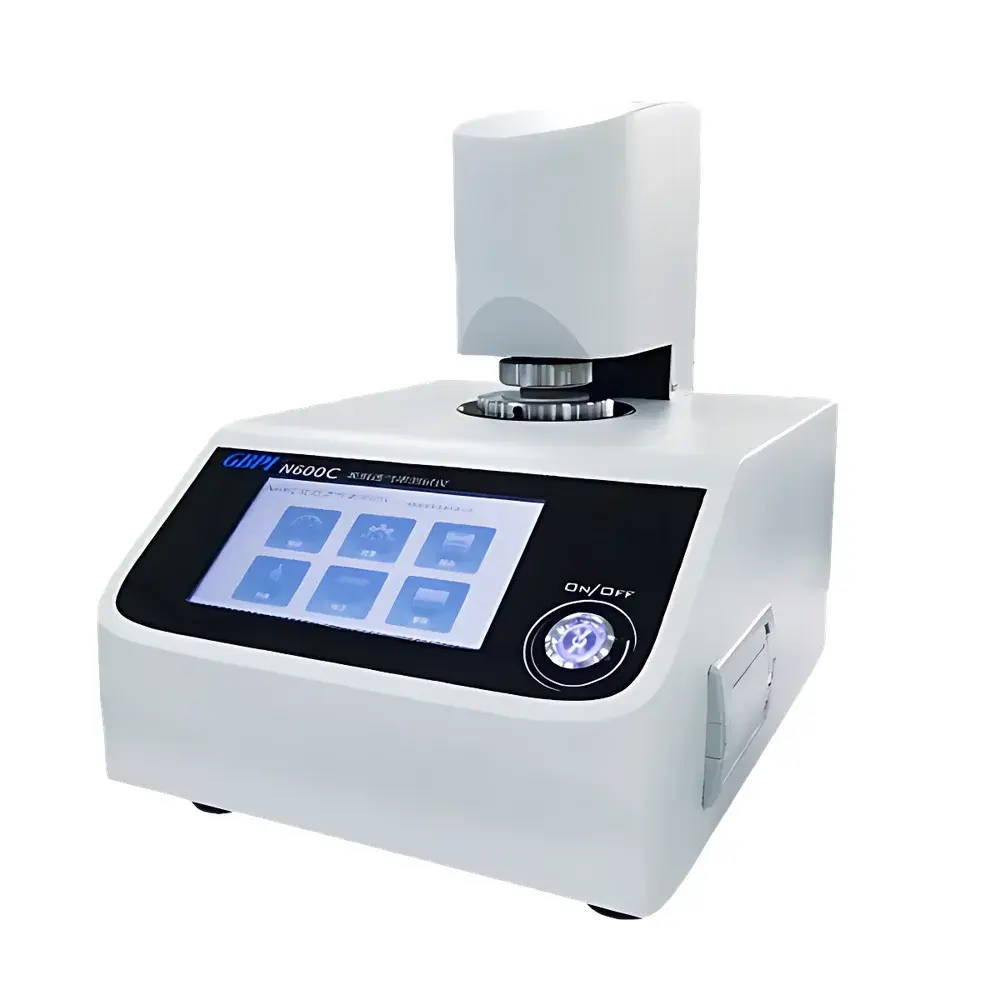
GBPI N600C-2 Gas Permeability Tester for Carbon Paper
| Brand | GBPI |
|---|---|
| Origin | Guangdong, China |
| Manufacturer Type | Direct Manufacturer |
| Origin Category | Domestic (China) |
| Model | N600C-2 |
| Quotation | Upon Request |
| Test Principle | Differential Pressure Method (ASTM D1434 / ISO 5636-5 compliant architecture) |
| Test Range | 0–200,000 mL·mm/(cm²·h·mmHg) |
| Resolution | 0.1 mL·mm/(cm²·h·mmHg) |
| Pressure Range | 0–500 Pa (customizable) |
| Pressure Resolution | 0.1 Pa |
| Pressure Accuracy | ±0.1% FS |
| Flow Range | 0–50 L/min (customizable) |
| Flow Resolution | 1 mL/min |
| Flow Accuracy | ±1% FS |
| Test Area | 16 cm² |
| Dimensions | 410 × 295 × 365 mm |
| Power Consumption | 100 W |
| Supply Voltage | 110–250 VAC, 50–60 Hz |
Overview
The GBPI N600C-2 Gas Permeability Tester is a precision-engineered instrument designed specifically for the quantitative evaluation of gas permeability in carbon paper substrates used in proton exchange membrane fuel cells (PEMFCs). It operates on the differential pressure (or “pressure gradient”) method—fully aligned with the physical principles defined in ISO 5636-5 and ASTM D1434—and implements the test protocol specified in GB/T 20042.7–2014, the national standard governing performance characterization of PEMFC gas diffusion layers (GDLs). In this method, a conditioned carbon paper specimen is clamped between two sealed chambers; a precisely controlled pressure differential is established across the sample, driving gas flow from the high-pressure side to the low-pressure side. The volumetric flow rate, combined with known geometric parameters—including effective test area (16 cm²), sample thickness (user-measured), and applied pressure gradient—is used to calculate permeability in standardized units: mL·mm/(cm²·h·mmHg) or equivalently mL·mm/(cm²·hr·mmAq). This metric directly reflects the intrinsic through-plane gas transport capability critical to cathode mass transfer efficiency and overall cell polarization behavior.
Key Features
- High-precision differential pressure control system with 0–500 Pa adjustable range and ±0.1% full-scale accuracy—enabling repeatable testing under low-pressure conditions representative of actual PEMFC operating environments.
- Integrated mass flow measurement with ±1% FS accuracy and 1 mL/min resolution, supporting both standard and custom flow calibration protocols.
- Self-contained operation via 7-inch color capacitive touchscreen interface—no external PC required for routine testing, data display, or report generation.
- Built-in thermal printer for immediate hardcopy output of test reports, including date/time stamp, operator ID, sample ID, pressure differential, flow rate, calculated permeability, and pass/fail status against user-defined limits.
- Optional GMP-compliant software module developed in accordance with Annex 11 (Computerized Systems) of the EU GMP Guidelines and FDA 21 CFR Part 11—providing role-based access control, electronic signatures, audit trail logging, and data integrity safeguards for regulated QC laboratories.
Sample Compatibility & Compliance
The N600C-2 is optimized for rigid, porous, non-woven carbon paper substrates ranging from 100–300 µm in thickness and with nominal densities of 0.5–1.2 g/cm³. Its standardized 16 cm² test fixture ensures uniform clamping force distribution and eliminates edge leakage—a common source of error in low-permeability materials. The instrument complies with mechanical and metrological requirements outlined in GB/T 20042.7–2014 and supports traceable calibration per ISO/IEC 17025 when paired with accredited reference standards. Optional fixtures (e.g., 5 cm², 25 cm²) allow adaptation to R&D samples or thin-film composites without compromising measurement repeatability (RSD < 2.5% across n=6 replicates under controlled humidity and temperature).
Software & Data Management
The optional upper-level software provides comprehensive data lifecycle management: raw sensor logs (pressure, flow, temperature), derived permeability values, statistical summaries (mean, SD, CV%), and trend analysis over time. All data entries are immutable once saved; modifications require dual authorization and generate timestamped audit records. Electronic signatures adhere to ALCOA+ principles (Attributable, Legible, Contemporaneous, Original, Accurate, Complete, Consistent, Enduring, Available) and support GLP/GMP validation documentation packages. Export formats include CSV, PDF/A-2, and XML for integration into LIMS or ELN platforms.
Applications
- Quality control of carbon paper batches prior to GDL fabrication and stack assembly.
- Comparative screening of hydrophobic/hydrophilic treatments (e.g., PTFE loading) on oxygen transport resistance.
- Correlation studies between permeability, porosity, and in-situ fuel cell performance metrics (e.g., limiting current density).
- Process development support for roll-to-roll coating, hot-pressing, and thermal treatment optimization.
- Third-party verification testing for ISO 9001-certified suppliers and OEM qualification programs.
FAQ
Does the N600C-2 comply with international standards beyond GB/T 20042.7–2014?
Yes—the underlying measurement architecture conforms to ISO 5636-5 (determination of air permeance of paper and board) and ASTM D1434 (standard test method for determining gas permeability of plastics film and sheeting), enabling cross-laboratory comparability.
Can the instrument be calibrated using certified reference materials?
Yes—calibration can be performed using NIST-traceable laminar flow elements and pressure transducers; GBPI provides optional ISO/IEC 17025-accredited calibration certificates upon request.
Is environmental conditioning (temperature/humidity control) integrated into the system?
The base model operates at ambient lab conditions (23 ± 2°C, 50 ± 5% RH); optional environmental chamber integration is available for controlled-condition testing per ASTM E104 or ISO 187.
What safety certifications does the instrument carry?
It meets CE marking requirements under the Low Voltage Directive (2014/35/EU) and Electromagnetic Compatibility Directive (2014/30/EU); UL/CSA certification is available upon special order.
How is data backup and long-term archival handled?
Internal storage retains ≥10,000 test records; USB export and network-enabled remote backup (via optional Ethernet/Wi-Fi module) ensure compliance with 21 CFR Part 11 retention mandates (minimum 2 years for non-GMP, indefinite for GMP-regulated data).





