
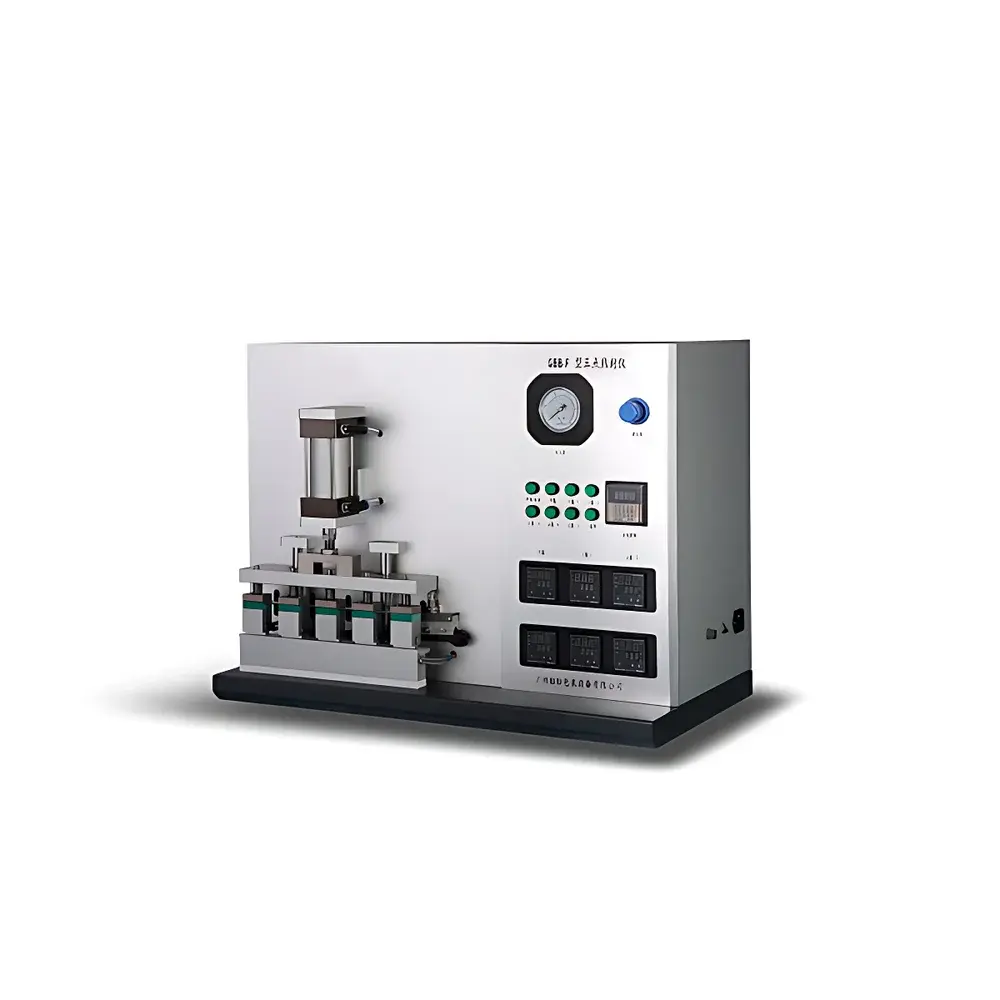
GBPI GBB-F2E Five-Point Heat Sealing Tester
| Brand | GBPI |
|---|---|
| Origin | Guangdong, China |
| Manufacturer | GBPI Packaging Equipment Co., Ltd. |
| Model | GBB-F2E |
| Temperature Range | Ambient to 250 °C |
| Temperature Control Accuracy | ±1 °C |
| Sealing Time | 0.1–999.9 s |
| Sealing Pressure | 0.1–0.8 MPa |
| Sealing Surface | Five independent 35 mm × 10 mm upper sealing blades (heated) + silicone-padded lower sealing bar |
| Heating Method | Electric resistance heating with dual auto/manual control modes |
| Actuation | Pneumatic (compressed air required) |
| Power Supply | AC 220 V, 50 Hz |
| Rated Power | 2000 W |
| Dimensions (L×W×H) | 730 × 400 × 535 mm |
| Weight | 35.6 kg |
Overview
The GBPI GBB-F2E Five-Point Heat Sealing Tester is an engineered laboratory instrument designed for precise, repeatable evaluation of heat seal integrity in flexible packaging materials. It operates on the principle of controlled thermal energy transfer under defined pressure and dwell time—mimicking real-world packaging line conditions—to determine optimal sealing parameters for thermoplastic films, laminates, and pouch structures. Unlike single-point testers, the GBB-F2E features five independently controlled heating zones along the upper sealing blade assembly, enabling simultaneous assessment of seal strength across a gradient of temperatures on a single sample strip. This capability supports systematic optimization of sealing windows (temperature–pressure–time interdependence) per ASTM F2029-2016 and QB/T 2358-1998, making it essential for QC laboratories in food, pharmaceutical, medical device, and consumer goods packaging development.
Key Features
- Five independent temperature-controlled sealing zones (35 mm × 10 mm each), allowing parallel thermal profiling across one specimen.
- Individual PID-based temperature regulation for each upper blade and the lower silicone-padded sealing bar—ensuring thermal uniformity and repeatability within ±1 °C.
- Pneumatic actuation system driven by external compressed air (recommended supply: ≥8 bar, 2.5 HP compressor), delivering consistent, low-vibration sealing force from 0.1 to 0.8 MPa.
- Dual operational modes: fully automated programmable sequence or manual foot-switch-triggered sealing—ideal for rapid method development and operator training.
- Modular sealing tooling architecture: upper blades and lower bar accept custom geometries (e.g., rounded edges, embossed patterns, anti-adhesion coatings) per user-specified mechanical or surface finish requirements.
- Integrated calibration access: PT100 sensors are field-serviceable and traceable via standard reference thermometers; no disassembly required for routine verification.
- Rugged steel frame construction with ESD-safe enclosure, CE-compliant electrical design, and integrated air filtration interface (compatible with coalescing + desiccant filters).
Sample Compatibility & Compliance
The GBB-F2E accommodates flat specimens up to 100 mm wide and 300 mm long—including monolayer PE/PP films, aluminum-laminated pouches, retort-grade nylon composites, and peelable medical packaging substrates. Its five-zone configuration enables direct correlation between localized seal temperature and resulting hot-tack strength or ultimate seal strength (measured off-line via tensile tester per ASTM F88/F904). The instrument complies with test method requirements of QB/T 2358-1998 (Chinese national standard for plastic film heat seal strength), ASTM F2029-2016 (Standard Test Method for Making Heat Seal Joints for Determination of Heat Sealability of Flexible Webs), and YBB 00122003-2015 (Chinese pharmaceutical packaging standard). While not a standalone data-integrity system, its analog control architecture supports integration into GLP/GMP environments when paired with validated SOPs and external audit-trail documentation.
Software & Data Management
The GBB-F2E operates via front-panel membrane keypad with real-time LCD display of setpoints and actual values (temperature, pressure, elapsed time). All parameter inputs—including zone-specific temperatures, dwell duration, and pneumatic pressure—are manually entered and retained in non-volatile memory for up to 99 user-defined methods. No embedded software or network connectivity is included; however, test logs (date/time, method ID, operator code) can be recorded externally using LIMS-compatible spreadsheets or ELN platforms. For regulated environments, GBPI provides optional NIST-traceable calibration certificates (ISO/IEC 17025 accredited) and supports IQ/OQ documentation packages upon request. Air supply monitoring (pressure decay, moisture content) must be managed externally using inline gauges and coalescing filters per ISO 8573-1 Class 3 requirements.
Applications
- Establishing thermal sealing windows during new packaging material qualification (e.g., evaluating seal initiation temperature and degradation onset for barrier laminates).
- Validating heat seal robustness of sterile barrier systems (SBS) used in Class II/III medical devices per ISO 11607-2.
- Optimizing vertical form-fill-seal (VFFS) and horizontal form-fill-seal (HFFS) machine settings prior to production ramp-up.
- Investigating cold seal failure mechanisms in frozen food packaging exposed to thermal cycling.
- Supporting root-cause analysis of delamination or channel leaks in multi-layer pouches subjected to retort sterilization.
- Teaching thermal kinetics and polymer melt behavior in university packaging engineering laboratories.
FAQ
What compressed air specifications are required for reliable operation?
A minimum supply pressure of 8 bar (116 psi) and flow rate of 120 L/min at source is recommended. Use a three-stage filter (particulate, oil, water) upstream of the instrument’s inlet to prevent pneumatic valve clogging.
Can the five sealing zones be programmed with different dwell times?
No—the dwell time is synchronized across all five zones. Independent timing would require discrete actuation hardware not supported by the GBB-F2E architecture.
Is the lower sealing bar heated?
No—the lower bar remains unheated and is fitted with replaceable silicone elastomer padding to ensure uniform pressure distribution and thermal isolation.
Does GBPI provide installation qualification (IQ) support?
Yes—custom IQ protocols, including dimensional verification, power stability testing, and air supply validation checklists, are available as part of extended service agreements.
How often should temperature sensors be recalibrated?
Annual calibration is recommended for routine QC use; more frequent verification (e.g., quarterly) is advised in high-throughput or regulated environments where seal parameter drift may impact product release decisions.





