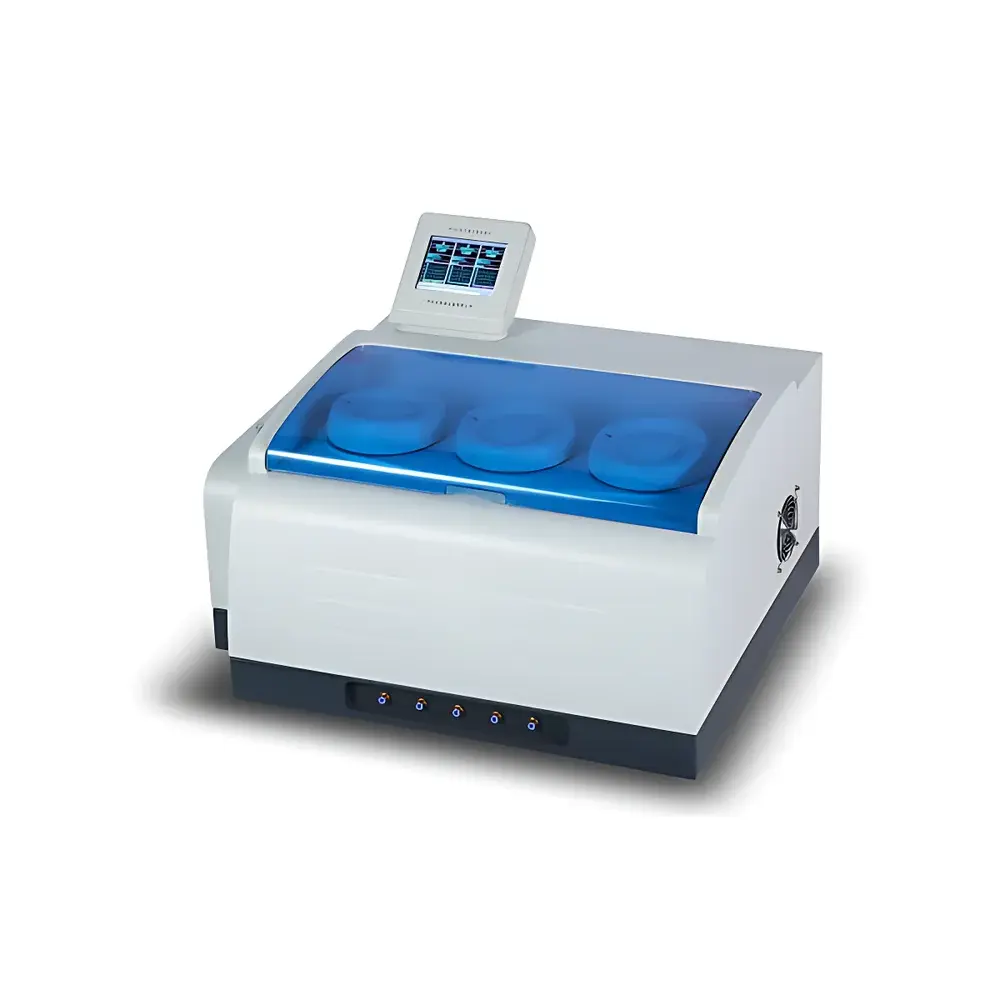
GBPI W405WE Infrared Water Vapor Transmission Rate (WVTR) Tester
| Brand | GBPI |
|---|---|
| Origin | Guangdong, China |
| Manufacturer Type | Manufacturer |
| Country of Origin | China |
| Model | W405WE |
| Price Range | USD 42,000 – 70,000 |
| Test Range | 0.005–500 g/(m²·24h) |
| Test Accuracy | 0.001 g/(m²·24h) |
| Temperature Control Range | 15–45 °C (optional up to 60 °C) |
| Temperature Stability | ±0.1 °C |
| Humidity Control Range | 0% RH (dry N₂), 30–90% RH, 100% RH |
| Humidity Stability | ±1% RH |
| Permeation Area | 50.24 cm² (down to 0.785 cm² with optional fixture) |
| Specimen Diameter | Φ100 mm |
| Max Specimen Thickness | ≤3 mm |
| Sample Capacity | 1–3 independent test chambers |
| Carrier Gas | ≥99.999% N₂, pressure ≥0.1 MPa, flow rate 5–120 mL/min |
| Gas Interface | 1/8″ stainless steel tubing |
| Dimensions | 610 × 550 × 400 mm |
| Weight | 57.1 kg |
| Power | 1000 W, AC 220 V, 50 Hz (110 V optional) |
Overview
The GBPI W405WE Infrared Water Vapor Transmission Rate (WVTR) Tester is a precision gravimetric-free instrument engineered for quantitative measurement of water vapor permeation through polymeric films, laminates, foils, rigid containers, and functional barrier materials. It operates on the principle of infrared detection of water vapor molecules transported across a test specimen under controlled humidity and temperature gradients—specifically employing the dynamic dual-chamber method defined in ISO 15106-2 and ASTM F1249. In this configuration, conditioned compressed air flows over the upstream (high-humidity) side of the specimen, while ultra-dry nitrogen sweeps the downstream side. Water vapor diffusing through the material is carried by the dry carrier gas stream into a high-sensitivity infrared absorption sensor, where its concentration is quantified in real time. The resulting signal is converted into mass flux (g/m²·24h) using calibrated flow rates, temperature, and humidity inputs. As designated the arbitration method in China’s 2015 Pharmacopoeia Packaging Materials Standards (YBB 00092003-2015), the W405WE delivers metrologically traceable results compliant with GLP, GMP, and FDA 21 CFR Part 11 requirements when operated within validated software protocols.
Key Features
- Triple independent test chambers enable parallel evaluation of up to three specimens—identical or dissimilar—with fully autonomous start/stop, data logging, and report generation per chamber.
- High-resolution infrared detection system with auto-range protection ensures long-term sensor stability and eliminates saturation-induced drift during high-flux or low-flux measurements.
- Electromagnetic programmable step-control thermal regulation achieves ±0.1 °C uniformity across the entire test zone; humidity is precisely maintained via dual-stream mixing (dry + humidified N₂), delivering ±1% RH accuracy from 0% to 100% RH.
- Embedded ARM-based controller supports stand-alone operation—no external PC required for routine testing. Integrated 7-inch color touchscreen displays real-time curves for temperature, relative humidity, vapor concentration, and cumulative WVTR.
- Modular hardware architecture simplifies maintenance: sensor modules, gas manifolds, and environmental control units are field-replaceable without recalibration.
- GMP-compliant software architecture includes role-based user access (Administrator, Operator, Reviewer), full audit trail (system, method, and run-level), electronic signatures, and immutable data storage with timestamped revision history.
Sample Compatibility & Compliance
The W405WE accommodates flat specimens up to 3 mm thick and Φ100 mm in diameter—including monolayer plastics (PET, PE, PP), metallized films (AlOx, SiOx), aluminum foil, rubber sheets, ceramic substrates, and pharmaceutical blister lidding. Optional fixtures extend capability to 3D packaging forms: bottles, pouches, trays, and cups (per ASTM F2622). All configurations comply with GB/T 26253-2010, YBB 00092003-2015, ISO 15106-2:2005, ASTM F1249-2013, and JIS K7129-2008. Instrument calibration is traceable to certified reference standards (GBW(E)130543/4), issued by the State Administration for Market Regulation (SAMR), ensuring inter-laboratory comparability and regulatory acceptance in drug product registration dossiers.
Software & Data Management
The proprietary GBPI TestSuite v4.2 software provides full lifecycle data governance. Test methods—including ramp profiles, dwell times, endpoint criteria, and pass/fail thresholds—are saved as encrypted templates. All raw sensor outputs, environmental parameters, and calculated WVTR values are stored in an embedded SQLite database with SHA-256 hashing. Reports export natively to PDF, Excel (.xlsx), and CSV formats, embedding metadata (operator ID, instrument serial number, calibration date, environmental logs). Audit trails record every action: login/logout, parameter modification, result override, report generation, and data export—each with IP address, timestamp, and user context. Data integrity is further enforced via write-once-read-many (WORM) archive mode and optional network backup to secure NAS endpoints.
Applications
This instrument serves critical quality control and R&D functions across regulated and industrial sectors. In pharmaceutical manufacturing, it validates moisture barrier integrity of primary packaging (e.g., PTP blisters, HDPE bottles, sachets) per ICH Q5C stability guidelines. Food producers use it to optimize shelf-life models for snack bags, coffee pouches, and frozen meal trays. Electronics manufacturers assess encapsulation performance of OLED backplanes and flexible display films. Medical device firms evaluate breathability and occlusion metrics for transdermal patches and wound dressings. Solar energy labs quantify moisture ingress resistance in PV module backsheets (IEC 61215-2 MQT18). Academic researchers apply it to novel nanocomposite membranes and bio-based polymers under accelerated aging conditions.
FAQ
What carrier gas is required, and why must it be ≥99.999% pure nitrogen?
Ultra-high-purity nitrogen (N₂ ≥99.999%) is mandatory to eliminate interference from ambient moisture, CO₂, and hydrocarbons that could saturate or poison the IR sensor. Impurities compromise baseline stability and introduce systematic bias above 0.01 g/m²·24h.
Can the W405WE test rigid containers such as glass vials or plastic bottles?
Yes—when equipped with the optional container test fixture (sold separately), the system seals and pressurizes headspace to simulate real-world storage conditions. Testing follows ASTM F2622 methodology with gravimetric verification capability.
Is third-party calibration and IQ/OQ/PQ documentation available?
GBPI provides factory-issued calibration certificates traceable to NIM (National Institute of Metrology, China). Full validation packages—including Installation Qualification (IQ), Operational Qualification (OQ), and Performance Qualification (PQ) protocols—are available upon request for GMP-regulated environments.
How does the system handle high-barrier materials like aluminum foil or SiOx-coated PET?
The instrument’s sub-milligram sensitivity (0.001 g/m²·24h) and adaptive integration algorithms allow reliable measurement of ultra-low-permeation samples. Low-flow mode (5–20 mL/min) extends residence time in the detection cell, improving signal-to-noise ratio without compromising response linearity.
Does the software support 21 CFR Part 11 compliance out-of-the-box?
Yes—the software implements electronic signatures, audit trail retention (>10 years), role-based permissions, and data encryption at rest and in transit. A formal Part 11 readiness assessment report is included with each system delivery.