
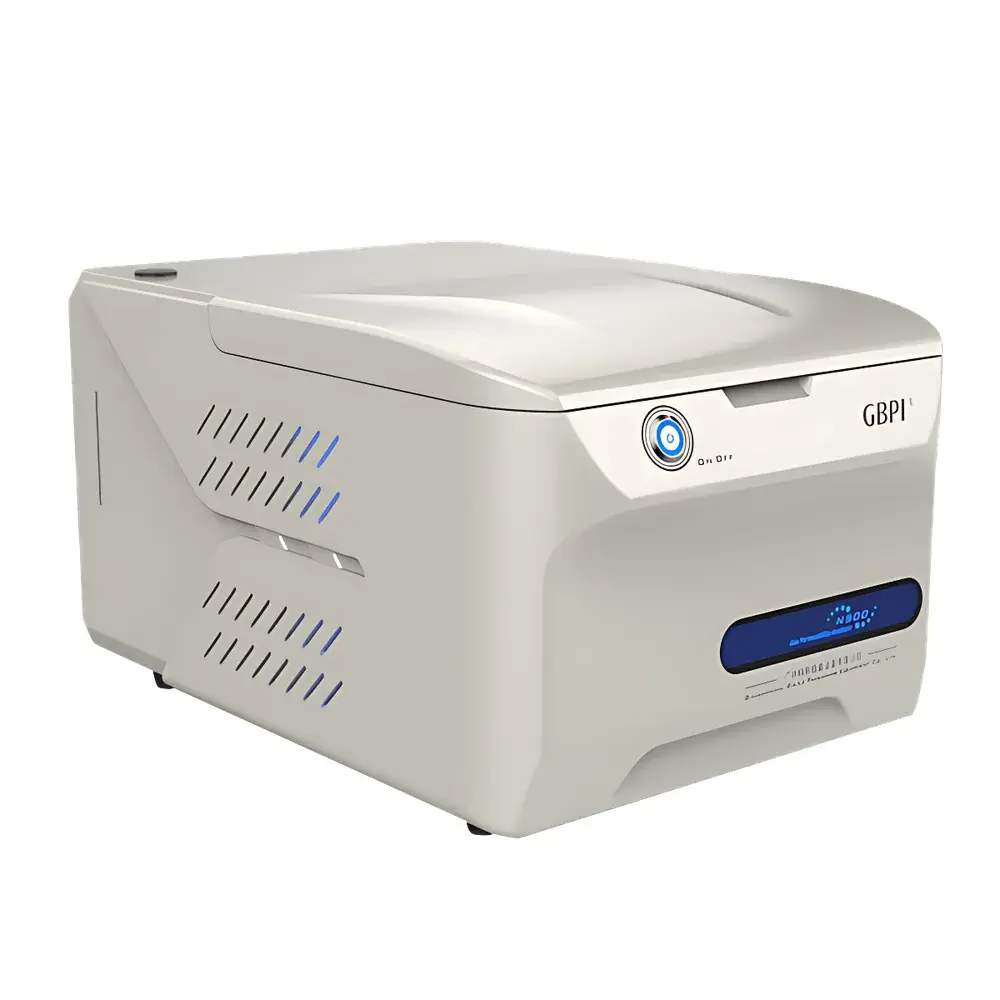
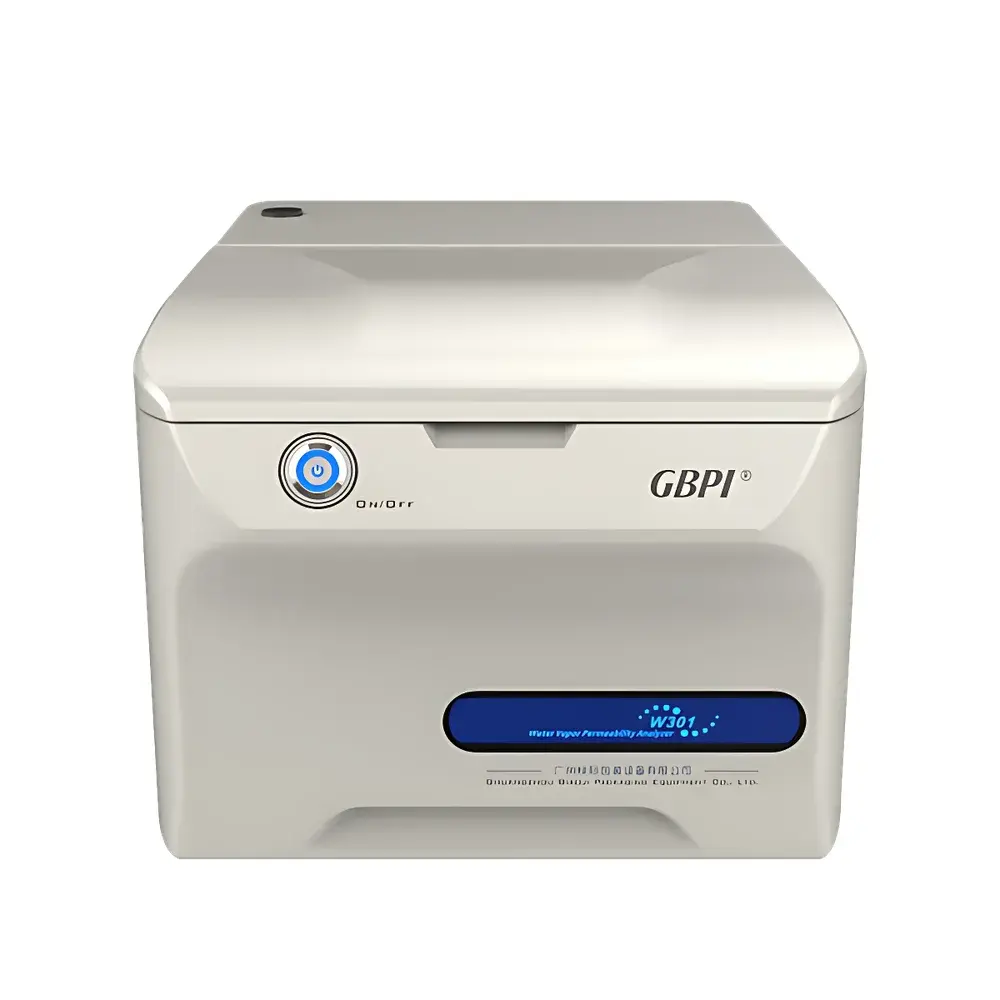
GBPI N500 2.0 Gas Permeability Tester (Differential Pressure Method)
| Brand | GBPI |
|---|---|
| Origin | Guangdong, China |
| Manufacturer Type | Direct Manufacturer |
| Model | N500 2.0 |
| Test Range | 0.02–50,000 cm³/(m²·24 h·0.1 MPa) |
| Resolution | 0.001 cm³/(m²·24 h·0.1 MPa) |
| Temperature Control Range | 15–60 °C |
| Temperature Stability | ±0.1 °C |
| Vacuum Level | <20 Pa |
| Vacuum Resolution | 0.01 Pa |
| Test Pressure | 0.1 MPa |
| Test Gases | O₂, CO₂, N₂, air, He |
| Sample Area | 50.24 cm² |
| Sample Diameter | Φ110 mm |
| Max Sample Thickness | 2 mm |
| Power | 450 W |
| Supply | AC 220 V, 50 Hz |
Overview
The GBPI N500 2.0 Gas Permeability Tester is an engineered solution for precise, reproducible measurement of gas transmission rates (GTR) through packaging and barrier materials using the differential pressure (manometric) method. It operates in strict compliance with internationally recognized standards—including ISO 2556, ISO 15105-1, ASTM D1434, JIS K7126-1, GB/T 1038, and YBB 00082003—ensuring data integrity for regulatory submissions and quality control workflows. The instrument applies a controlled pressure gradient across a sealed test specimen: the upper chamber is pressurized to 0.1 MPa with the selected test gas (e.g., O₂, CO₂, or N₂), while the lower chamber is maintained under high vacuum (<20 Pa). As gas permeates through the sample, the resulting pressure rise in the lower chamber is monitored in real time via a high-stability, 0.01 Pa-resolution absolute pressure transducer. This raw signal is converted into standardized gas permeability values (cm³/(m²·24 h·0.1 MPa)) using thermodynamic correction algorithms embedded in the firmware.
Key Features
- Patented automatic pressure-difference maintenance system: dynamically regulates and sustains the specified transmembrane pressure differential (adjustable from 0.01 to 0.1 MPa) without manual intervention, ensuring consistent driving force throughout the test duration.
- High-precision vacuum subsystem: equipped with a certified imported oil-free vacuum pump capable of reaching ≤0.1 Pa ultimate vacuum, enabling accurate low-flux measurements down to 0.02 cm³/(m²·24 h·0.1 MPa) with minimal background drift.
- Active water-cooled temperature control: integrated Peltier-based thermal management with calibrated platinum RTD sensors (±0.1 °C accuracy) and PID-controlled circulation ensures uniform, stable chamber temperature across the full 15–60 °C operating range.
- Modular test cavity design: single-chamber configuration optimized for film, sheet, paperboard, and coated substrates; optional accessories enable testing of rigid and flexible packaging formats including bottles, pouches, cups, and blister packs.
- Real-time multi-parameter visualization: synchronized plotting of five time-series curves—permeation rate vs. time, chamber temperature vs. time, upper/lower chamber pressure vs. time, and differential pressure vs. time—with on-screen toggle, zoom, and export functionality.
Sample Compatibility & Compliance
The N500 2.0 accommodates flat, non-porous, and semi-crystalline specimens up to 2 mm thick and 110 mm in diameter, including polymeric films (PET, PE, PP, BOPP, CPP, PVC), laminates (aluminum foil composites, metallized PET), biodegradable substrates (PLA, PBAT), pharmaceutical foils (PVC/PP/PTP), coated papers, rubber sheets, medical patches, and hygiene product layers. Its validated methodology supports testing under ambient, accelerated, or conditioned humidity environments when paired with external RH control systems. All hardware and software components comply with GLP and GMP requirements per Annex 11 (EU) and FDA 21 CFR Part 11, including role-based user access control, electronic signature capability, full audit trail (system events, parameter changes, test execution logs), and tamper-evident data storage.
Software & Data Management
The proprietary GBPI SmartTest OS is built on a modular, GUI-driven architecture aligned with ICH Q9 and ISO/IEC 17025 principles. Users configure test protocols—including gas type, temperature setpoint, equilibration time, and pass/fail criteria—via intuitive graphical menus. Raw sensor data are stored in encrypted binary format with embedded metadata (operator ID, timestamp, calibration status, environmental conditions). Statistical analysis tools compute mean, standard deviation, RSD%, and confidence intervals across replicate runs. Reports conform to ISO 17025-compliant templates and support PDF, Excel, and CSV exports; optional integration with enterprise LIMS platforms is enabled via OPC UA and RESTful API interfaces. Firmware updates and diagnostic logs can be remotely accessed through the GBPI CloudLink IoT platform, which also hosts training videos, SOPs, and technical documentation.
Applications
- Quality assurance of primary and secondary packaging for pharmaceuticals, sterile devices, and active pharmaceutical ingredients (APIs) per USP & Ph. Eur. monographs.
- Evaluation of shelf-life modeling inputs for food packaging—particularly oxygen-sensitive products (snacks, coffee, dairy) and modified-atmosphere packaging (MAP) systems.
- Development and validation of barrier coatings, nanocomposite films, and vapor-deposited layers in R&D laboratories.
- Regulatory submission support for FDA 510(k), CE marking, and NMPA registration dossiers requiring traceable, auditable permeability data.
- Comparative assessment of sustainable alternatives—including compostable films, cellulose derivatives, and bio-based laminates—against conventional petrochemical barriers.
FAQ
What gases can be tested with the N500 2.0?
The system is validated for O₂, CO₂, N₂, air, and He. Custom calibration and gas-specific diffusion coefficient compensation are available upon request for other inert or reactive gases.
Is the instrument suitable for testing filled packages such as bottles or pouches?
Yes—when used with optional package-specific fixtures (e.g., bottle adapters, pouch clamps), the N500 2.0 supports direct measurement of whole-package permeation, provided internal headspace volume and seal integrity meet ASTM F2622 requirements.
How is traceability ensured for regulatory audits?
Each unit ships with NIM-certified reference standards (GBW(E)130541/130542), full metrological traceability documentation, and factory calibration certificates. Audit trails record every user action, parameter change, and test result with immutable timestamps and digital signatures.
Does the system require external humidity control?
No—humidity conditioning is not integrated but can be implemented externally using climate chambers or desiccant-controlled enclosures upstream of the test cavity. Relative humidity effects on permeability must be reported separately per ISO 15105-2.
Can test data be exported to third-party statistical or ERP systems?
Yes—via configurable CSV/Excel export, ODBC connectivity, or secure API integration. Validation documentation for LIMS interfacing is available upon request.




