
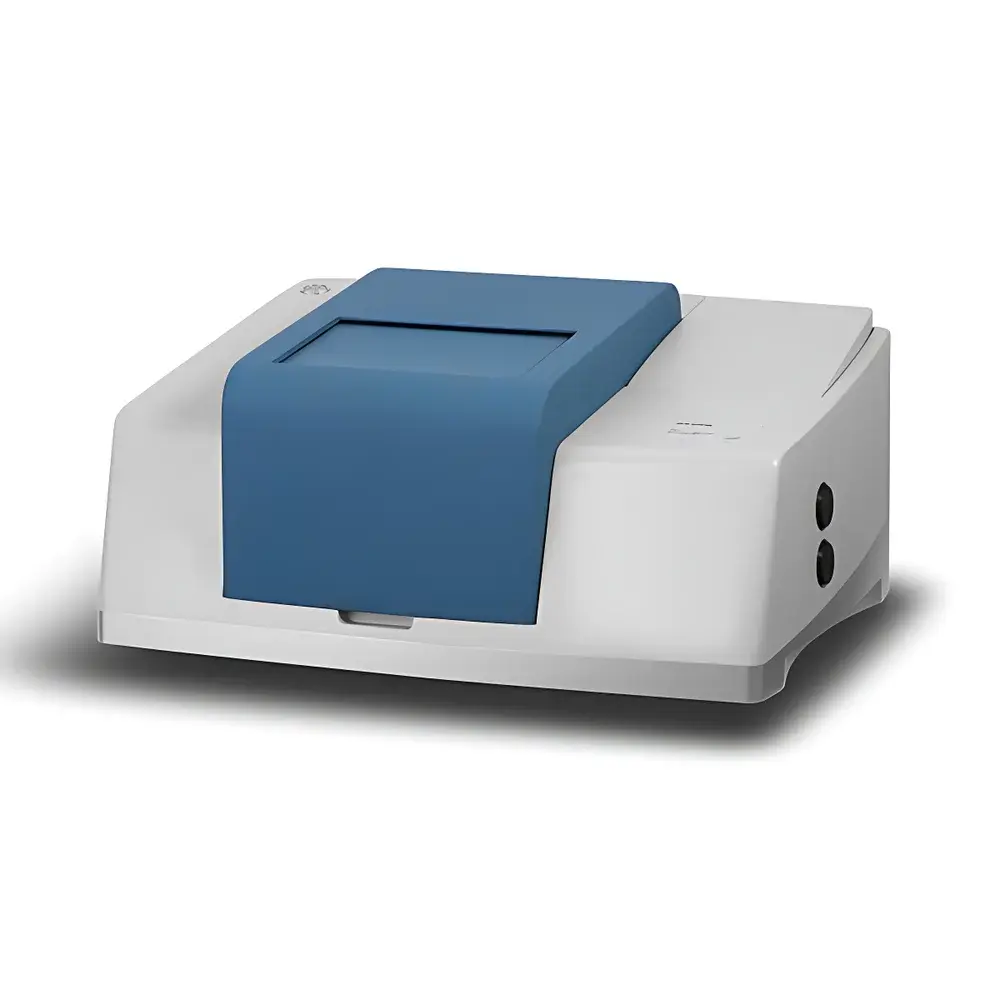
GBPI BFH-960 Fourier Transform Infrared (FTIR) Spectrometer
| Brand | GBPI |
|---|---|
| Origin | Guangdong, China |
| Manufacturer Type | Original Equipment Manufacturer (OEM) |
| Regional Classification | Domestic (PRC) |
| Model | BFH-960-aa |
| Pricing | Available Upon Request |
| Spectral Range | 7800–350 cm⁻¹ |
| Resolution | <1.0 cm⁻¹ |
| Signal-to-Noise Ratio | >15,000:1 (4 cm⁻¹, 1-min scan) / >30,000:1 (4 cm⁻¹, 1-min scan) |
| Beamsplitter | Ge-coated KBr substrate |
| Detector | Imported high-sensitivity deuterated triglycine sulfate (DLaTGS) |
| Source | Imported long-life, air-cooled high-intensity IR source |
| Wavenumber Accuracy | ±0.01 cm⁻¹ |
| Transmittance Precision | ±0.5%T |
| Interferometer | Sealed 30°-incidence Michelson interferometer with built-in auto-alignment optics |
| Laser | VCSEL-based He–Ne equivalent reference laser (≥10-year lifetime) |
| A/D Conversion | 24-bit, 500 kHz |
| Interface | USB 2.0 (backward/forward compatible with USB 3.0) |
| Operating Temperature | 15–35 °C |
| Dimensions | 450 × 350 × 235 mm (L×W×H) |
| Weight | 14 kg |
Overview
The GBPI BFH-960 Fourier Transform Infrared (FTIR) Spectrometer is a research-grade analytical instrument engineered for precise molecular identification and quantitative analysis across pharmaceutical, environmental, polymer, food safety, and forensic laboratories. It operates on the fundamental principle of interferometric spectroscopy: infrared radiation from a broadband thermal source is split, recombined after differential path-length modulation in a sealed Michelson interferometer, and detected as an interferogram. A real-time fast Fourier transform (FFT) algorithm reconstructs the intensity-vs-wavenumber spectrum, delivering high-fidelity spectral data with inherent wavelength calibration traceable to the internal VCSEL reference laser. Designed for compliance with ISO 17025-accredited testing environments, the BFH-960 supports method validation under USP , EP 2.2.24, and ASTM E1421–22, making it suitable for GLP/GMP-regulated workflows where spectral reproducibility and long-term baseline stability are critical.
Key Features
- Hermetically sealed interferometer: Features a 30°-incidence design with gold-coated corner-cube retroreflectors, auto-optical alignment, and integrated desiccant chamber with 5× extended moisture resistance versus industry benchmarks—enabled by Ge-coated KBr beamsplitter and anti-humidity membrane.
- Low-power, high-stability optical architecture: Consumes <30 W during operation; employs a ceramic IR source (80% radiant efficiency), DLaTGS detector with thermoelectric cooling, and precision diamond-turned optical mounts ensuring mechanical and thermal consistency over time.
- Ergonomic sample compartment: Large-volume, front-access chamber with tilt-adjusted humidity indicator window (7° forward inclination) and push-pull door mechanism minimizes ambient CO₂/H₂O intrusion during ATR, transmission, or gas-cell measurements.
- Plug-and-play modularity: Tool-free, pin-aligned optical assembly enables rapid field maintenance without realignment; supports optional accessories including liquid cells, gas cells, micro-ATR, and specular reflectance stages.
- High-fidelity data acquisition: 24-bit, 500 kHz analog-to-digital conversion synchronized to laser fringe counting ensures sub-pixel wavenumber registration accuracy (±0.01 cm⁻¹) and robust signal averaging even at rapid scan rates.
Sample Compatibility & Compliance
The BFH-960 accommodates solid, liquid, paste, and gaseous samples via standardized sampling interfaces—including KBr pellet press compatibility, demountable liquid cells (CaF₂ or BaF₂ windows), and modular ATR accessories (ZnSe, diamond, or Si crystals). Its spectral range (7800–350 cm⁻¹) covers fundamental vibrational modes of organic functional groups (e.g., C=O stretch at 1700 cm⁻¹, O–H bend at 1400 cm⁻¹), inorganic anions (e.g., NO₃⁻ at 1380 cm⁻¹), and polymer backbone signatures (e.g., C–F at 1200 cm⁻¹). The system meets ISO/IEC 17025 requirements for calibration traceability, supports FDA 21 CFR Part 11-compliant audit trails when paired with validated software modules, and conforms to ICH Q5A(R2) guidelines for biopharmaceutical identity testing. CNAS-accredited GBPI Calibration Certificate (No. CNAS LXXXXX) is available upon request.
Software & Data Management
Controlled via GBPI SpectraPro™ v4.x (Windows 10/11 compatible), the platform delivers full spectral acquisition, processing, and reporting capabilities—including real-time interferogram preview, automated baseline correction (Rubberband, Concave Rubberband), Savitzky–Golay smoothing, derivative spectroscopy, peak integration (area/height), functional group annotation, and advanced ATR correction algorithms. Integrated spectral libraries comprise >250,000 reference spectra across 12 domains: Chinese Pharmacopoeia, Veterinary Pharmacopoeia, Polymer & Elastomer DB, Inorganic Salts, Food Additives, Flavor & Fragrance Compounds, Coatings & Resins, Forensic Evidence, Proteins/Amino Acids, Solvents, Gases, and Environmental Pollutants. Users may curate private libraries, apply custom search filters (hit quality, similarity threshold), and export results in ASTM E131, JCAMP-DX, or CSV formats for LIMS integration.
Applications
- Pharmaceutical QC: Raw material ID per USP monographs, counterfeit drug screening, polymorph differentiation, excipient compatibility studies.
- Packaging integrity: Quantification of residual solvents (e.g., toluene, ethyl acetate) in laminated films; detection of migration compounds from packaging into food simulants.
- Environmental analysis: Identification of microplastics (PET, PP, PE) in water/sediment extracts; monitoring of VOC emissions from industrial coatings.
- Materials R&D: Crosslink density assessment in rubber vulcanizates; oxidation state mapping in battery electrode binders; filler dispersion analysis in nanocomposites.
- Academic research: Reaction monitoring via time-resolved FTIR; hydrogen-bonding dynamics in protein folding studies; surface adsorption kinetics on catalysts.
FAQ
Is the BFH-960 compliant with regulatory data integrity requirements?
Yes—the instrument supports 21 CFR Part 11-compliant electronic records when deployed with SpectraPro™ Audit Mode, including user authentication, immutable audit trails, and electronic signatures.
What maintenance intervals are recommended for the desiccant system?
The reusable desiccant cartridge requires replacement every 6–12 months depending on ambient humidity; the integrated hygrometer window allows visual verification without opening the interferometer housing.
Can the BFH-960 be integrated into automated lab workflows?
Yes—USB interface enables SCPI command control and API-driven batch acquisition; optional Ethernet module supports remote instrument management via TCP/IP.
Does GBPI provide application-specific method development support?
Yes—GBPI Application Scientists offer on-site or virtual method transfer, SOP drafting, and IQ/OQ/PQ documentation packages aligned with ISO/IEC 17025 and GxP standards.
Is spectral library licensing perpetual or subscription-based?
All core libraries are included with hardware purchase; updates to pharmacopeial and regulatory databases are provided free for 3 years, with optional annual renewal thereafter.
Related Products





