
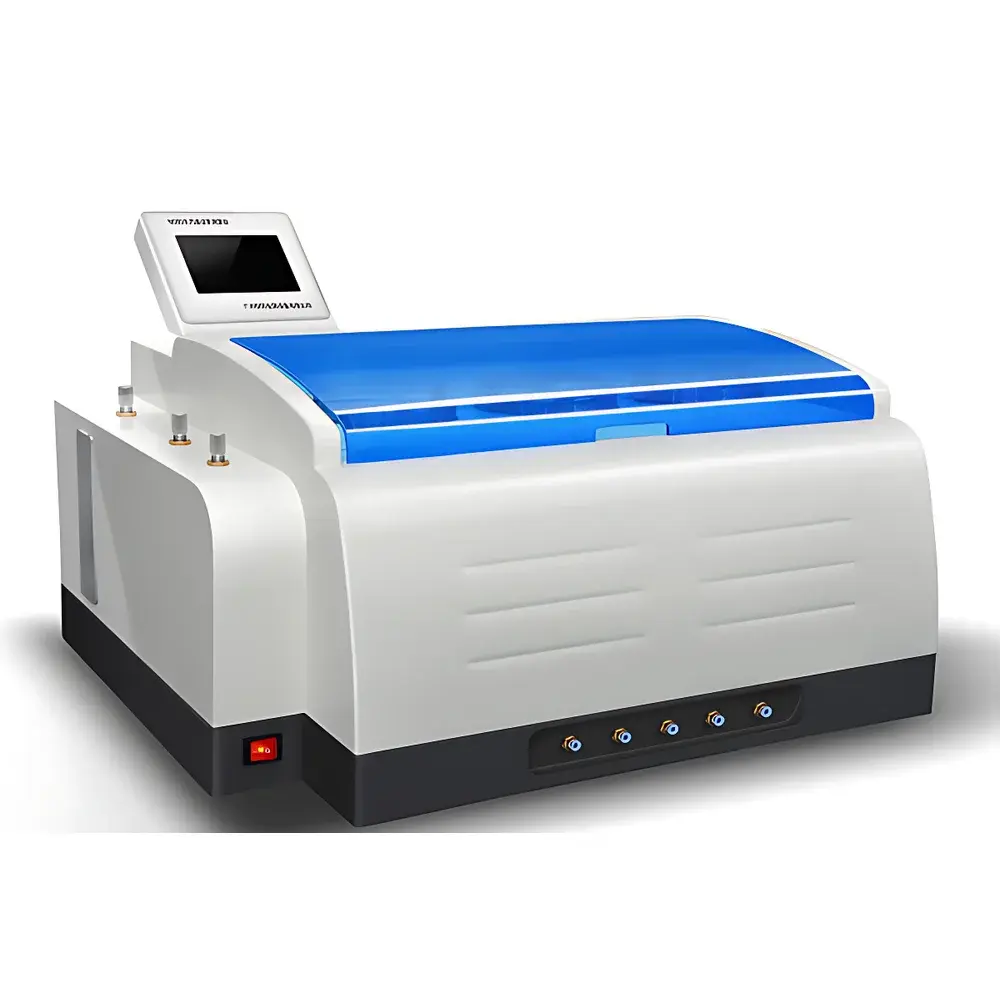
GBPI W405A Water Vapor Transmission Rate (WVTR) Tester
| Brand | GBPI |
|---|---|
| Origin | Guangdong, China |
| Manufacturer Type | Direct Manufacturer |
| Country of Origin | China |
| Model | W405A |
| Test Range | 0.0005–500 g/(m²·24h) |
| Measurement Accuracy | 0.001 g/(m²·24h) |
| Temperature Control Range | 15–45 °C (optional up to 60 °C) |
| Temperature Stability | ±0.1 °C |
| Humidity Control Range | 30–90 %RH (and 100 %RH) |
| Humidity Stability | ±1 %RH |
| Test Area | 50.24 cm² (reducible to 0.785 cm² with optional fixtures) |
| Specimen Diameter | Φ100 mm |
| Max Specimen Thickness | ≤3 mm |
| Sample Capacity | 1–3 independent chambers |
| Carrier Gas | ≥99.999% N₂, pressure ≥0.1 MPa, flow rate 5–120 mL/min |
| Gas Inlet | 1/8″ stainless steel tubing |
| Dimensions | 700 × 560 × 370 mm |
| Weight | 80 kg |
| Power | 750 W |
| Supply | AC 220 V, 50 Hz (110 V optional) |
Overview
The GBPI W405A Water Vapor Transmission Rate (WVTR) Tester is a gravimetric-coupled, dual-chamber, controlled-environment instrument engineered for precise and reproducible measurement of water vapor permeation through packaging materials and functional barriers. It operates on the principle of dynamic humidity gradient generation across a test specimen, using high-purity nitrogen as carrier gas to sweep permeated water vapor from the low-humidity side to an infrared (IR) moisture sensor. This method complies with the fundamental physical basis of ASTM F1249–2013 and ISO 15106-2:2005—both specifying the use of modulated humidity differential and quantitative IR detection for WVTR determination. The system supports both flat-sheet and 3D container testing (e.g., bottles, pouches, trays) via configurable fixtures, enabling direct evaluation of real-world packaging integrity under standardized climatic conditions.
Key Features
- Triple independent test chambers with individual temperature/humidity control and autonomous termination—enabling concurrent analysis of up to three dissimilar specimens with fully decoupled data streams.
- High-resolution IR moisture sensor with automatic over-range protection and long-term baseline stability; validated traceability to national standard reference materials (GBW(E)130543/4) certified by the State Administration for Market Regulation (SAMR), China.
- Dual-stream humidity control architecture: separate dry and saturated gas streams mixed in real time to achieve stable, programmable RH setpoints from 30 %RH to 100 %RH with ±1 %RH accuracy.
- Electromagnetic step-programmed thermal regulation system ensuring ±0.1 °C temperature uniformity across the test zone (15–45 °C standard; 60 °C optional).
- Embedded ARM-based controller with 7-inch color capacitive touchscreen—supports full standalone operation without external PC; real-time plotting of temperature, RH, vapor concentration, and cumulative transmission curves.
- Three-tier barrier mode selection (high/mid/low WVTR) optimized for materials ranging from ultra-high-barrier aluminum foil (≤0.01 g/m²·24h) to highly permeable nonwovens (>100 g/m²·24h).
Sample Compatibility & Compliance
The W405A accommodates rigid and flexible substrates up to 3 mm thick and 100 mm in diameter—including monolayer polymers (PET, PE, PP), metallized films, laminates, ceramics, rubber sheets, and pharmaceutical blister foils. With optional container fixtures, it quantifies WVTR for sealed plastic bottles, aluminum cans, thermoformed trays, and medical pouches per ASTM D3079 and ISO 15106-3. Regulatory alignment includes full support for 21 CFR Part 11-compliant audit trails, role-based user access (administrator/operator/observer), electronic signature capability, and method- and event-level audit logging. All software functions adhere to Annex 11 (EU GMP) and ALCOA+ data integrity principles.
Software & Data Management
GBPI’s proprietary WinWVTR software provides intuitive workflow configuration, automated calibration verification using certified reference films, and real-time deviation alerts during test execution. Raw sensor outputs are stored in encrypted SQLite databases with immutable timestamps and operator metadata. Reports conform to GLP/GMP documentation standards: each export includes instrument ID, environmental logs, raw curve overlays, statistical summaries (mean, SD, RSD), and compliance statements referencing ISO 15106-2, ASTM F1249, and GB/T 26253–2010. Export formats include PDF, Excel (.xlsx), and CSV; all files retain embedded digital signatures and version-controlled method parameters.
Applications
This instrument serves critical quality assurance functions across regulated and industrial sectors: barrier validation of pharmaceutical blister packaging per USP and Ph. Eur. 5.3; shelf-life modeling for food packaging via accelerated moisture ingress studies; qualification of backsheet materials in photovoltaic modules per IEC 61215; performance benchmarking of transdermal drug delivery patches; and R&D screening of OLED encapsulation films and flexible display substrates. Its precision at sub-0.001 g/m²·24h enables reliable differentiation between metallized PET and SiOₓ-coated PET—key for next-generation lightweight packaging development.
FAQ
What carrier gas is required, and what purity specifications must be met?
High-purity nitrogen (≥99.999%) is mandatory. Gas supply must maintain ≥0.1 MPa inlet pressure and deliver stable flow between 5–120 mL/min via 1/8″ stainless steel tubing.
Can the instrument test 3D containers such as bottles or pouches?
Yes—using optional container fixtures (sold separately), the W405A performs headspace-based WVTR measurements on rigid and semi-rigid packages per ASTM F1249 Annex A3 and ISO 15106-3.
Is hardware calibration traceable to national standards?
Yes—GBPI holds SAMR-issued Manufacturing License for Standard Reference Materials (GBW(E)130543/4). Users perform routine calibration using supplied certified reference films; no external metrology lab is required for daily verification.
Does the system meet FDA 21 CFR Part 11 requirements?
Yes—the software implements full electronic record/electronic signature (ERES) functionality, including role-based permissions, audit trail review tools, and immutable data archiving compliant with Part 11 Subpart B.
What environmental conditions are required for optimal operation?
Installation requires vibration-isolated, level benchtop space in climate-controlled labs (23 ± 2 °C ambient, low particulate, no direct sunlight); stable 220 V / 50 Hz AC supply with dedicated grounding is essential for sensor stability.





