
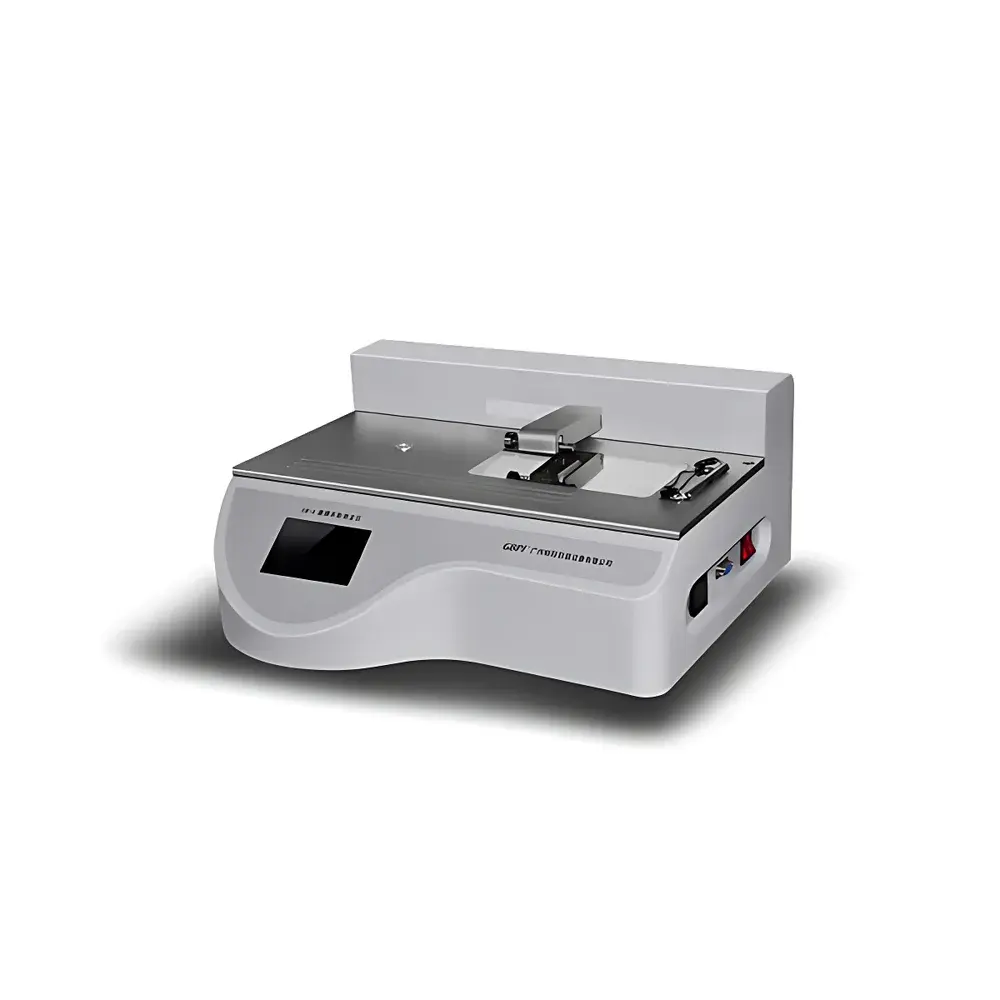
GBPI GM-4Q Coefficient of Friction Tester for Packaging Materials
| Brand | GBPI |
|---|---|
| Model | GM-4Q |
| Origin | Guangdong, China |
| Manufacturer Type | Direct Manufacturer |
| Country of Origin | China |
| Price Range | USD 1,400 – 7,000 |
| Compliance Standards | GB/T 10006–1988, ASTM D1894–2014, ISO 8295–2004, TAPPI T816 |
| CoF Measurement Range | 0.01–0.999 |
| Force Measurement Accuracy | ±2% |
| Load Cell Range | 0–10 N |
| Slider Mass | 200 ± 2 g |
| Slider Dimensions | 63 × 63 mm |
| Test Speed | Adjustable, default 100 mm/min (infinitely variable) |
| Temperature Control Range (optional) | Ambient to 75 °C |
| Specimen Thickness Limit | ≤2 mm |
| Test Platform Size | 200 × 470 mm |
| Overall Dimensions | 470 × 330 × 210 mm |
| Weight | 37 kg |
| Power Supply | AC 220 V ±10%, 50 Hz, 100 W |
Overview
The GBPI GM-4Q Coefficient of Friction Tester is a precision-engineered instrument designed for quantitative evaluation of static and kinetic coefficients of friction (CoF) between packaging materials—including plastic films, laminates, foils, paper, and coated substrates—under controlled mechanical and environmental conditions. It operates on the fundamental principle of horizontal pull testing: a standardized slider is placed atop a stationary specimen; a motor-driven carriage pulls the slider at a defined velocity while a high-stability load cell continuously records the tangential force required to initiate (static) and sustain (kinetic) motion. The resulting force values are normalized against the normal force (i.e., slider weight), yielding dimensionless CoF values compliant with internationally recognized test protocols.
Key Features
- High-reproducibility mechanical architecture featuring a low-backlash timing belt drive and precision-ground linear guide rails for consistent slider displacement and minimal vibration-induced noise.
- Imported strain-gauge-based load cell with full-scale range of 0–10 N and calibrated accuracy of ±2% of reading—traceable to national metrological standards via optional certified calibration kit.
- Dual-mode operation: standalone mode with integrated 4.3-inch TFT LCD display showing real-time CoF curves, numerical static/kinetic values, and test speed; or PC-connected mode via RS-232 interface for advanced data logging and report generation.
- One-touch automated test sequence: automatic start, peak detection for static CoF, sustained-motion capture for kinetic CoF, and programmable auto-stop upon completion—reducing operator dependency and inter-test variability.
- Modular hardware design with field-replaceable functional units (load cell module, motion controller, power supply) enabling rapid diagnostics and maintenance without full-system downtime.
- Overload protection circuitry safeguards the load cell from mechanical shock or excessive force during misalignment or specimen jamming—critical for long-term sensor integrity in high-throughput QC labs.
Sample Compatibility & Compliance
The GM-4Q accommodates flat, flexible specimens up to 2 mm in thickness and 200 × 470 mm in planar dimension, supporting both film-on-film and film-on-metal configurations per standard test geometries. Its slider assembly (63 × 63 mm, 200 ± 2 g) conforms precisely to ASTM D1894 and ISO 8295 requirements. The instrument is validated for use in regulated environments: test reports generated via the optional software include timestamped metadata, operator ID, instrument serial number, calibration status, and raw force-vs.-time datasets—supporting GLP/GMP documentation needs. Optional temperature-controlled test bed (ambient to 75 °C) enables thermal CoF profiling aligned with accelerated shelf-life studies per ICH Q1A(R2) guidelines.
Software & Data Management
The companion Windows-based control software (compatible with Windows 7–11, 64-bit) provides full audit trail functionality compliant with FDA 21 CFR Part 11 requirements when configured with user authentication and electronic signature modules. It captures and stores raw analog force signals at ≥100 Hz sampling rate, displays synchronized dynamic CoF curves with zoom/pan capability, and exports tabular results in CSV and PDF formats. Each test record includes embedded calibration certificate references, environmental condition logs (if temperature option installed), and pass/fail flags based on user-defined CoF specification limits. Data files are stored in a structured local database with version-controlled backups and export-to-LIMS compatibility via ODBC drivers.
Applications
- Quality control of sealant layers and slip additives in food-grade polyolefin films (e.g., CPP, BOPP, LDPE) to ensure optimal machinability on high-speed form-fill-seal lines.
- Validation of anti-blocking performance in pharmaceutical blister lidding foils under humidity-controlled storage simulations.
- R&D evaluation of surface-treated PET films for improved stackability and reduced web tension variation in gravure printing processes.
- Regulatory submission support for packaging dossiers requiring CoF data per USP , ISO 15378, or EU Annex 1 compliance frameworks.
- Root-cause analysis of pouch sealing defects linked to inconsistent coefficient profiles across production batches.
FAQ
What standards does the GM-4Q comply with?
The instrument meets the mechanical and procedural requirements of GB/T 10006–1988, ASTM D1894–2014, ISO 8295–2004, and TAPPI T816 for coefficient of friction measurement of thin flexible materials.
Can the GM-4Q operate without a computer?
Yes—the built-in LCD interface supports fully autonomous testing, real-time CoF calculation, and on-device numeric display of static and kinetic values without external hardware.
Is temperature control included as standard?
No—temperature regulation (ambient to 75 °C) is an optional add-on module, specified separately during ordering.
How is force sensor calibration performed?
Calibration uses a traceable stainless-steel reference weight set (200 g ±0.05 g); the process is guided stepwise via the LCD menu and requires <60 seconds per verification cycle.
What data export formats are supported?
Test reports and raw time-series data can be exported as CSV (for Excel/Statistica), PDF (with embedded signature fields), and XML (for LIMS integration).





