
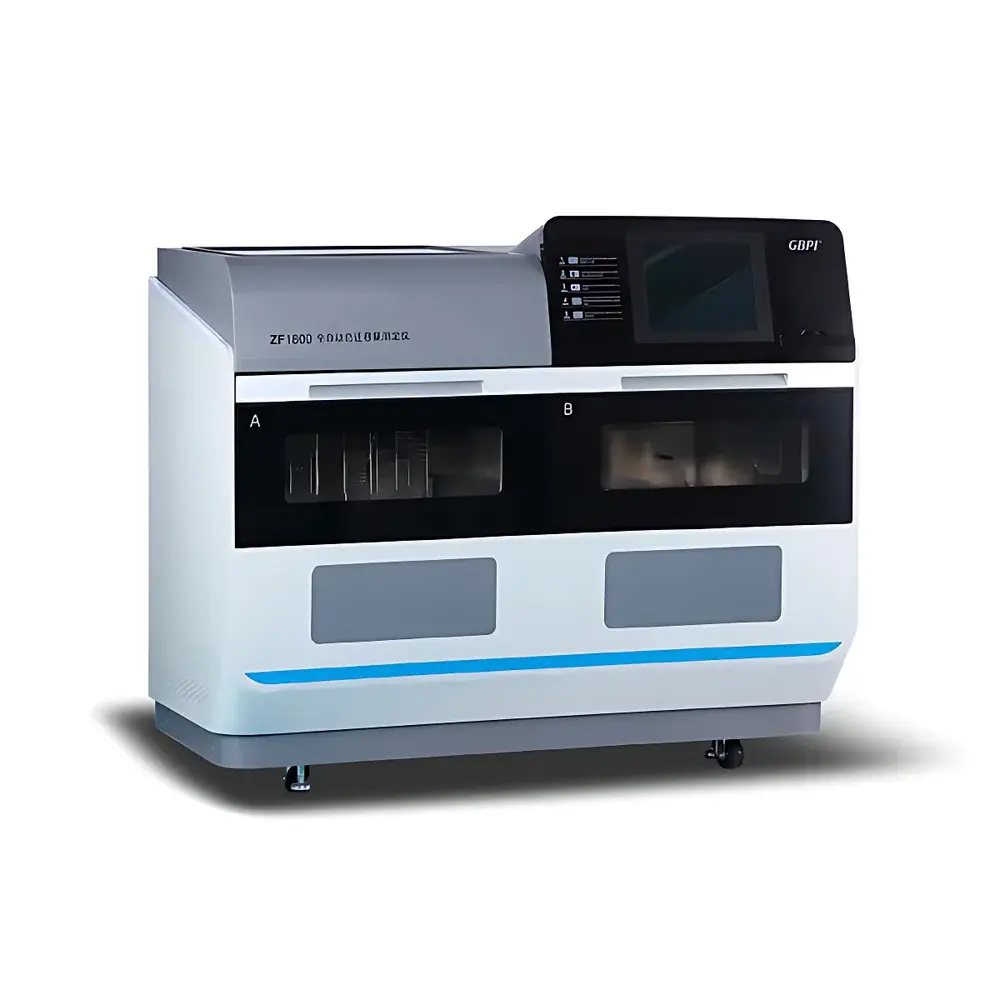
GBPI ZF1800-S Total Migration Tester for Food Contact Materials
| Brand | GBPI |
|---|---|
| Model | ZF1800-S |
| Origin | Guangdong, China |
| Manufacturer Type | Direct Manufacturer |
| Category | Other General Analytical Instruments |
| Measurement Range | 0.2–167,000 mg/dm² |
| Resolution | 0.0001 g/dm² |
| Balance Capacity | 0–200 g |
| Balance Resolution | 0.1 mg |
| Water Bath Temp Control | RT–100 °C |
| Heating Chamber Temp Control | RT–117.9 °C |
| Cooling Chamber Temp Control | 10–35 °C |
| Temperature Uniformity | ±5 °C |
| Sample Capacity | 1–18 independent test positions |
| Evaporating Dish Volume | 0–200 mL |
| Dimensions (Main Unit) | 178 × 93 × 145 cm (L×W×H) |
| Solvent Recovery System Dimensions | 120 × 88 × 170 cm (L×W×H) |
| Power Supply | 220 V, 50 Hz |
| Rated Power | 5000 W |
Overview
The GBPI ZF1800-S Total Migration Tester is a fully automated, regulatory-compliant instrument engineered for precise quantification of total migration from food contact materials (FCMs) into food simulants—per ISO 10993-12, EN 1186, FDA 21 CFR §170–189, and EU Regulation (EC) No. 10/2011. It operates on the principle of gravimetric determination: after controlled extraction in standardized simulants (e.g., 3% acetic acid, 10% ethanol, olive oil), the extract is evaporated under defined thermal conditions, and the non-volatile residue is weighed to calculate migration expressed as mg/dm². The system integrates water bath extraction, solvent evaporation, precision gravimetry, and inert atmosphere handling—enabling reproducible, traceable, and auditable testing across diverse packaging substrates including polyethylene (PE), polypropylene (PP), polystyrene (PS), and chlorinated vinyl polymers.
Key Features
- Independent dual-chamber architecture: Simultaneous heating (up to 117.9 °C) and cooling (10–35 °C) with ±5 °C uniformity—eliminating thermal cross-talk and reducing cycle time between sequential tests.
- Integrated water bath subsystem with auto-fill, level sensing, temperature regulation, timed evaporation, and fail-safe dry-run detection—ensuring consistent simulant exposure without manual intervention.
- Hermetically sealed solvent recovery system: All evaporation occurs within a closed loop; vapors are condensed and collected, preventing environmental release and operator exposure to organic solvents such as ethanol or isooctane.
- Nitrogen purging capability: Optional inert gas flow during evaporation minimizes oxidation of thermally labile residues and improves repeatability for oxygen-sensitive matrices.
- Negative-pressure test chamber: Maintains sub-atmospheric pressure throughout extraction and evaporation phases—suppressing volatile loss, enhancing containment integrity, and complying with OSHA and REACH handling requirements.
- ARM-based embedded control platform with 10.1″ capacitive touchscreen: Unified hardware-software integration enables one-touch workflow execution—including automatic dish taring, multi-step thermal ramping, real-time mass monitoring, endpoint detection via drift-based stabilization criteria, and autonomous shutdown.
Sample Compatibility & Compliance
The ZF1800-S accommodates flat, rigid, and flexible FCMs—such as laminated films, thermoformed trays, injection-molded containers, and coated metal cans—across 18 independent test stations. Each station maintains isolated thermal and gravimetric control, allowing concurrent evaluation of heterogeneous samples (e.g., PP lid vs. PET base vs. aluminum foil liner) under identical or customized simulant protocols. The system meets ISO/IEC 17025 method validation prerequisites and supports full traceability per GLP and GMP Annex 11. Its mechanical design conforms to IEC 61010-1 safety standards for laboratory equipment, while its electrical isolation strategy—external heating elements, no high-voltage components inside evaporation chambers—fulfills stringent risk mitigation requirements for Class II solvent environments.
Software & Data Management
The embedded software complies with FDA 21 CFR Part 11 and EU Annex 11 for computerized systems: role-based access control (administrator, operator, reviewer), mandatory login authentication, configurable permission tiers, and immutable audit trails covering system events, method edits, run executions, and data modifications. Real-time dashboards display live weight curves, migration kinetics, chamber temperatures, and residual mass stabilization status per station. Reports—generated in PDF, Excel, or Word formats—include raw gravimetric data, calibration logs, environmental metadata (RH%, ambient T°), and compliance statements referencing applicable clauses of EN 13130-1 or ISO 21645. All data files are stored with SHA-256 hashing for integrity verification.
Applications
- Regulatory submission testing for EU Declaration of Compliance (DoC) and FDA Food Contact Notification (FCN).
- QC/QA release testing of packaging lines producing multilayer pouches, vacuum-sealed trays, and microwaveable containers.
- Migration stability studies under accelerated aging conditions (e.g., 40 °C/75% RH for 10 days).
- Validation of barrier coatings (SiOₓ, AlOₓ) and nanocomposite additives against migration thresholds.
- Root-cause analysis of non-conformances linked to ink formulation, adhesive migration, or polymer degradation products.
FAQ
Does the ZF1800-S support testing with fatty food simulants such as olive oil or synthetic gastric fluid?
Yes—it accommodates high-boiling-point simulants via its extended heating chamber range (up to 117.9 °C) and inert nitrogen purge option to prevent oxidative artifact formation.
How is measurement uncertainty minimized during gravimetric analysis?
Through active environmental stabilization: integrated cooling chamber maintains constant humidity and temperature during weighing, and the balance (0.1 mg resolution, 200 g capacity) is calibrated automatically before each run using internal reference masses.
Can the system be validated for IQ/OQ/PQ according to pharmaceutical or medical device standards?
Yes—the software includes built-in validation templates aligned with ASTM E2500 and ISPE GAMP 5; documentation packages support qualification under ISO 13485 and ICH Q5C.
Is remote monitoring or integration with LIMS possible?
The instrument features Ethernet and RS-232 interfaces; API-compatible data export enables direct ingestion into enterprise LIMS platforms via HL7 or ASTM E1384 messaging protocols.
What maintenance intervals are recommended for long-term operational reliability?
Water bath descaling every 3 months, condenser coil inspection quarterly, and annual verification of temperature uniformity and balance linearity—documented in the included Preventive Maintenance Logbook.
Related Products






