
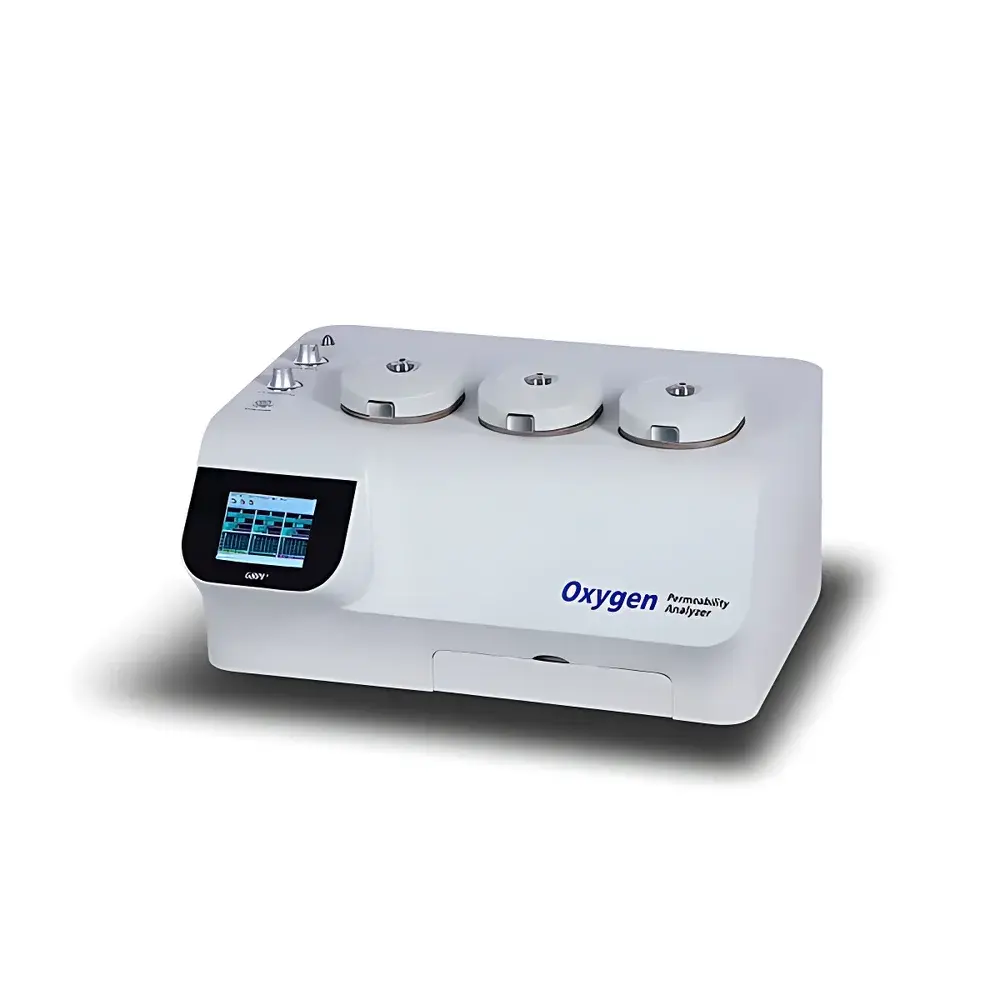
GBPI Y310-A2 Isostatic Triple-Chamber Oxygen Permeability Analyzer
| Brand | GBPI |
|---|---|
| Origin | Guangdong, China |
| Manufacturer Type | OEM/ODM Producer |
| Region | Domestic (China) |
| Model | Y310-A2 |
| Price Range | USD 14,000 – 70,000 |
| Test Principle | Isostatic (Equal-Pressure) Coulometric Detection |
| Standards Compliance | ASTM D3985, ASTM F1927, ASTM F1307, ASTM F2622, ISO 15105-2, GB/T 19789–2005, YBB00082003–2015, DIN 53380-3, JIS K-7126-B |
| Measurement Range | 0.02–16,500 cm³/(m²·24h) (film) |
| O₂ Resolution | 0.001 cm³/(m²·24h) |
| Temp Control | 15–45°C (5–50°C optional) |
| RH Control | 0%, 30–90%, 100% RH |
| Test Area | 50.24 cm² |
| Specimen Size | Φ100 mm |
| Max Thickness | ≤3 mm |
| Sample Capacity | 1–3 independent chambers |
| Carrier Gas Pressure | 0.1–0.2 MPa |
| Gas Interface | 1/8″ stainless steel tubing |
| Dimensions | 700 × 560 × 370 mm |
| Weight | 100 kg |
| Power | 750 W, AC 220 V, 50 Hz |
Overview
The GBPI Y310-A2 Isostatic Triple-Chamber Oxygen Permeability Analyzer is a precision instrument engineered for quantitative determination of oxygen transmission rate (OTR) through flat films, rigid sheets, and packaged containers under controlled temperature and humidity conditions. It operates on the isostatic (equal-pressure) coulometric detection principle: oxygen molecules permeating through a test specimen are carried by a nitrogen purge stream into an electrochemical oxygen sensor, where they undergo a stoichiometric reduction reaction generating a current proportional to O₂ flux. This method ensures high reproducibility, minimal baseline drift, and compliance with internationally recognized transport-based permeation standards—including ASTM D3985 (for film), ASTM F1927 (for flexible packaging), and ISO 15105-2 (differential pressure method equivalence). The triple-chamber architecture enables simultaneous, fully independent testing of three specimens—each with individual environmental control, real-time data acquisition, and autonomous termination—making it suitable for comparative studies, quality conformance batches, and accelerated stability protocols in regulated environments.
Key Features
- Triple independent test chambers with isolated gas flow paths, temperature zones, and humidity regulation—eliminating cross-contamination and enabling heterogeneous sample evaluation (e.g., PET film, aluminum-laminated pouch, medical blister).
- High-resolution coulometric oxygen sensor (detection limit: 0.001 cm³/(m²·24h)), calibrated using NIST-traceable standard reference materials certified by China’s National Institute of Metrology (GBW(E)130497/8).
- Electromagnetic step-programmable temperature control system with ±0.1°C stability across 15–45°C (optional 5–50°C range), ensuring adherence to ISO 2528 and ASTM conditioning requirements.
- Dual-stream humidity generation (dry + saturated N₂ mixing) delivering precise RH setpoints at 0%, 30–90%, and 100% RH with ±1% RH accuracy—critical for evaluating hygroscopic barrier performance (e.g., PVDC-coated films, PVOH laminates).
- ARM-based embedded controller supporting standalone operation; no host PC required for routine measurement cycles.
- Full GMP-aligned software architecture compliant with FDA 21 CFR Part 11 and EU Annex 11: role-based user authentication (administrator, operator, reviewer), audit trails for system events, method changes, and data modifications, electronic signatures, and immutable database logging.
Sample Compatibility & Compliance
The Y310-A2 accommodates planar specimens up to 3 mm thick and Φ100 mm in diameter—including polymer films (LDPE, BOPP, PET), metallized substrates (Al foil, SiOₓ-coated PET), elastomeric sheets (silicone, TPU), ceramic wafers, and rigid thermoplastics (PS, ABS). With optional container adapters and face-mask assemblies, it extends to sealed packages: bottles (HDPE, PETG), pouches (stand-up, vacuum-sealed), trays (aluminum, CPET), and medical device blisters. All hardware and firmware conform to GLP/GMP documentation requirements. Calibration traceability is maintained via dual-path verification—using both certified standard membranes (125 µm LDPE, supplied) and primary-standard gas mixtures (99.999% O₂/N₂)—validating linearity across six orders of magnitude (0.02 to 260,000 cm³/(m²·24h)).
Software & Data Management
The GBPI PermeaControl™ v4.x software provides a Windows-native interface with real-time visualization of OTR, O₂ concentration, chamber temperature, and relative humidity—each plotted as synchronized time-series curves with zoom, pan, overlay, and hide functions. Test methods are configurable per chamber: dwell time, stabilization criteria, endpoint logic (e.g., slope threshold <0.05 cm³/m²/day²), and auto-report generation. Export formats include PDF (with digital signature), XLSX, and CSV. Raw data reside in an encrypted SQLite database with SHA-256 hashing; all modifications trigger timestamped audit entries including user ID, parameter changed, pre-/post-value, and reason code. Backup and restore support network shares and USB drives—ensuring continuity during 21 CFR Part 11 validation.
Applications
- Pharmaceutical packaging: OTR validation of cold-form blisters, child-resistant bottles, and desiccant-containing sachets per USP and YBB00082003–2015.
- Food packaging R&D: Barrier optimization of retort pouches, modified-atmosphere trays, and compostable multilayer films.
- Medical device sterility assurance: Quantifying O₂ ingress through Tyvek® lids, silicone gaskets, and peelable lidding foils per ISO 11607-1.
- Electronics encapsulation: Measuring permeation through backsheet films for photovoltaic modules (IEC 61215) and OLED display barriers.
- Academic research: Structure–property correlation studies of nanocomposite films, biopolymer blends, and atomic-layer-deposited coatings.
FAQ
Does the Y310-A2 comply with FDA 21 CFR Part 11 for electronic records and signatures?
Yes. The embedded software implements full Part 11 controls: role-based access, audit trail with immutable logs, electronic signatures for critical actions (e.g., report approval, calibration), and secure database encryption.
Can the instrument test rigid containers without modification?
No—container testing requires optional accessories: custom sealing fixtures, headspace adapters, and volumetric correction modules. These are validated per ASTM F1307 and ISO 15105-2 Annex C.
What gas supply specifications are mandatory for valid operation?
Two ultra-high-purity gases are required: nitrogen (≥99.999% purity, dew point ≤−70°C) for carrier flow, and oxygen (≥99.999%) for calibration. Both must be delivered via stainless-steel lines with pressure-regulated output (0–0.4 MPa).
Is external PC hardware required for daily use?
Not for basic operation—the ARM controller manages all test execution and local data storage. A Windows PC is only needed for advanced reporting, database backup, or multi-instrument fleet management.
How is sensor longevity ensured under high-permeability testing conditions?
The coulometric sensor includes automatic over-range protection: if O₂ flux exceeds 120% of full-scale, the system halts gas flow and alerts the operator—preventing electrolyte depletion and electrode polarization damage.





