
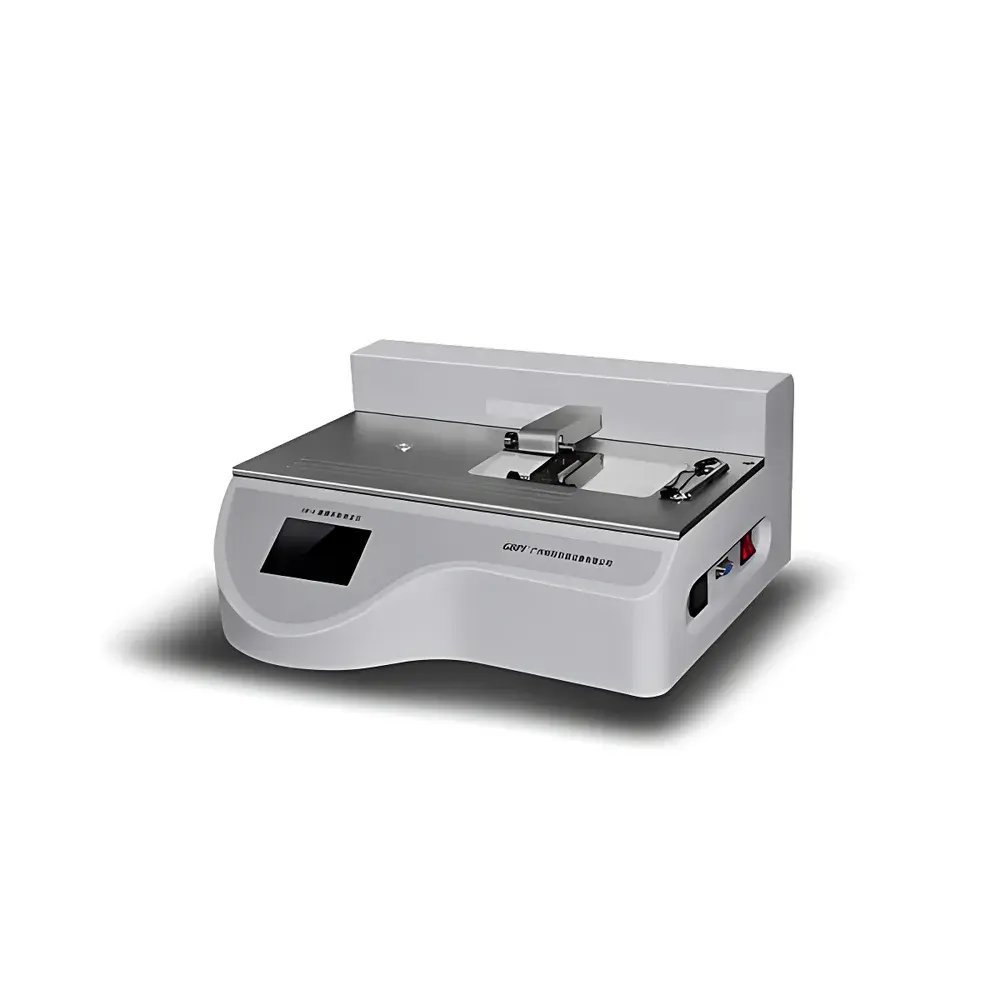
GBPI GM-4T Coefficient of Friction Tester for Flexible Packaging Films
| Brand | GBPI |
|---|---|
| Origin | Guangdong, China |
| Manufacturer Type | Direct Manufacturer |
| Country of Origin | China |
| Model | GM-4T |
| Price Range | USD 1,400 – 7,200 |
| Standard Compliance | GB/T 10006–1988, ASTM D1894–2014, ISO 8295–2004, TAPPI T816 |
| CoF Range | 0.01–0.999 |
| Measurement Accuracy | ±2% |
| Load Cell Range | 0–10 N |
| Slider Dimensions | 63 mm × 63 mm |
| Slider Mass | 200 ± 2 g |
| Test Speed | Adjustable, default 100 mm/min (stepless) |
| Temperature Control | Ambient to 75 °C (optional) |
| Specimen Thickness Limit | ≤2 mm |
| Test Platform Size | 200 mm × 470 mm |
| Overall Dimensions | 470 mm × 330 mm × 210 mm |
| Weight | 37 kg |
| Power | 100 W, AC 220 V ±10%, 50 Hz |
Overview
The GBPI GM-4T Coefficient of Friction Tester is an engineered solution for precise quantification of static and kinetic coefficients of friction (CoF) between flexible packaging materials—including plastic films, laminates, foils, coated papers, and thin sheets—under controlled mechanical and environmental conditions. Designed in accordance with internationally recognized test standards including ASTM D1894–2014, ISO 8295–2004, GB/T 10006–1988, and TAPPI T816, the instrument employs a horizontal sliding configuration based on the classical inclined-plane and pull-force methodology. A calibrated 200 g slider traverses the specimen surface at a defined, reproducible velocity (typically 100 mm/min), while a high-stability load cell continuously measures the tangential force required to initiate motion (static CoF) and sustain uniform sliding (kinetic CoF). The system’s mechanical architecture minimizes lateral drift and vibration, ensuring measurement repeatability across multiple test cycles and operator shifts. Its application scope extends beyond routine QC to method development, material qualification, regulatory submission support, and process validation in regulated environments.
Key Features
- High-accuracy dual-range load cell (0–10 N) with ±2% full-scale measurement uncertainty, traceable via optional certified calibration blocks
- Integrated LCD interface displaying real-time static/kinetic CoF values, test speed, elapsed time, and force curve progression—enabling fully standalone operation without external computing hardware
- Stepless speed control (10–300 mm/min range) ensures compliance with variable standard requirements and empirical protocol optimization
- Modular mechanical design with quick-release components facilitates field maintenance, sensor replacement, and platform reconfiguration
- Overload protection circuitry safeguards the load cell against accidental over-force events during setup or specimen misalignment
- Optional Peltier-based temperature-controlled test stage (ambient to +75 °C) supports thermal sensitivity studies for heat-seal layers, barrier coatings, or cold-chain packaging validation
Sample Compatibility & Compliance
The GM-4T accommodates specimens up to 2 mm in thickness and 470 mm in length, with standardized 63 mm × 63 mm slider contact geometry ensuring consistent pressure distribution (≈5.0 kPa nominal contact stress). It supports both auto-adhesive and clamped mounting configurations for low-tack films, metallized substrates, and embossed surfaces. All test routines are aligned with ISO/IEC 17025–compliant laboratory practices. Data integrity is reinforced through built-in audit trail logging (when used with PC software), supporting GLP and GMP documentation requirements. While the base unit does not include FDA 21 CFR Part 11–compliant electronic signature functionality, its raw data export format (.csv, .txt) enables integration into validated LIMS or ELN platforms for regulated submissions.
Software & Data Management
The optional Windows-based control software provides synchronized acquisition of force-time profiles, automatic CoF calculation per ASTM D1894 Annex A1, and dynamic curve zooming with cursor-assisted peak identification. Test reports include metadata (operator ID, timestamp, ambient conditions, calibration status), statistical summaries (mean, SD, CV%), and pass/fail flagging against user-defined specification limits. Export options include PDF (print-ready), Excel-compatible CSV, and XML for downstream analysis. Software updates are delivered via secure HTTPS download; no cloud dependency or telemetry is implemented. All firmware and software revisions undergo internal verification per IEC 62304 Class B software safety classification guidelines.
Applications
- Quality assurance of food-grade pouches, snack wrappers, and retortable laminates for slip-and-grip performance consistency
- Evaluation of anti-blocking agent efficacy in polyolefin films under accelerated aging or humidity exposure
- Comparative testing of corona-treated vs. plasma-treated PET surfaces prior to gravure printing or adhesive lamination
- Regulatory dossier preparation for USP and Ph. Eur. 2.9.37 compliant packaging qualification
- Root cause analysis of film jamming or misfeeding in high-speed form-fill-seal (FFS) packaging lines
- Research into temperature-dependent friction behavior of biodegradable films (e.g., PLA, PBAT blends) across storage and distribution conditions
FAQ
What standards does the GM-4T comply with?
The instrument is configured to execute test protocols defined in ASTM D1894–2014, ISO 8295–2004, GB/T 10006–1988, and TAPPI T816. Calibration procedures follow ISO/IEC 17025 guidance for force measurement traceability.
Can the tester operate without a computer?
Yes—the integrated LCD panel displays real-time CoF values, test speed, and elapsed time, and stores up to 100 test records internally. Full data export and advanced reporting require the optional PC software.
Is temperature control included as standard?
No—thermal regulation (ambient to +75 °C) is available as a factory-installed option and requires separate ordering. The base model operates at ambient laboratory conditions.
How is force calibration performed?
A dedicated set of NIST-traceable stainless-steel calibration weights (200 g ±0.1 g) is supplied for periodic verification. The instrument supports one-point zero and span adjustment directly via front-panel menu navigation.
What sample preparation requirements apply?
Specimens must be flat, clean, and free of dust or static charge. Minimum dimensions are 100 mm × 100 mm; thickness must not exceed 2 mm. Conditioning per ASTM D618 (23 °C / 50% RH, 48 h) is recommended for comparative studies.






