
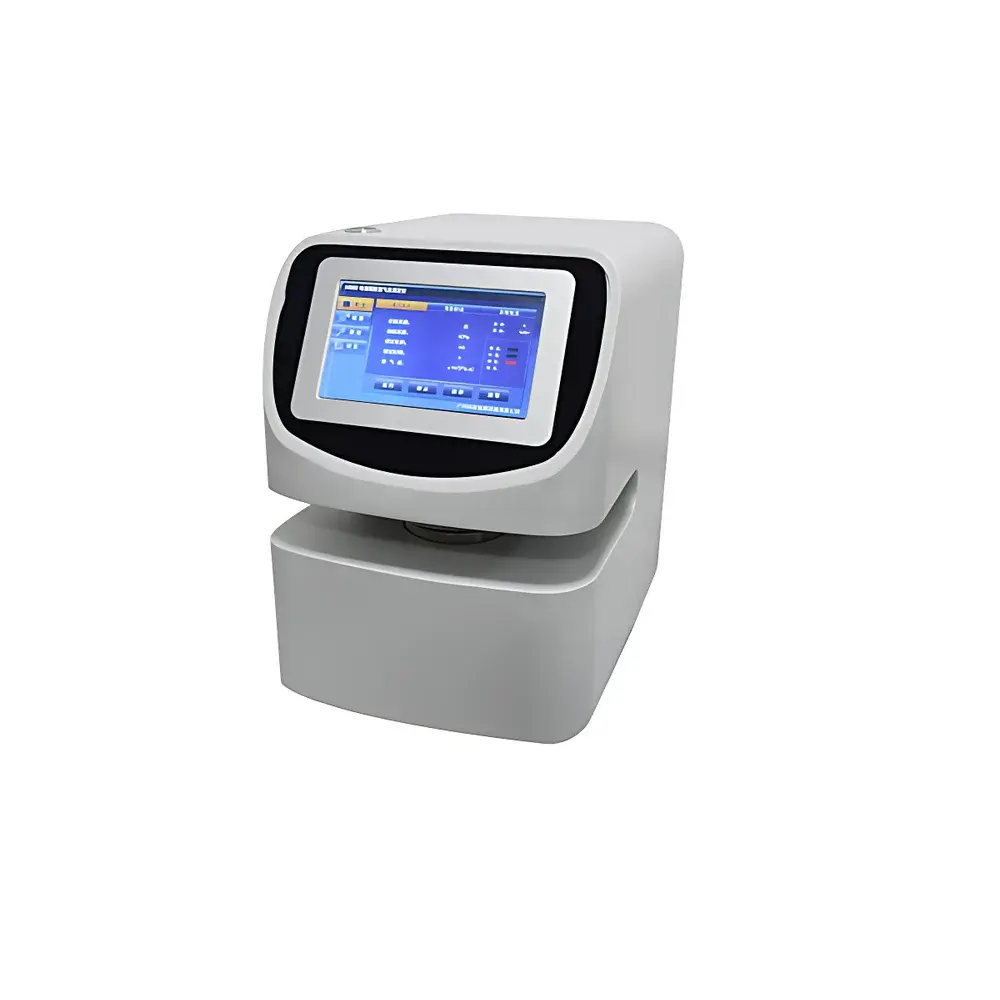
GBPI N600-1 Battery Separator Air Permeability Tester (Compliant with SJ/T 10171-2016, GB/T 458-2008 & GB/T 36363-2018)
| Brand | GBPI |
|---|---|
| Origin | Guangdong, China |
| Manufacturer Type | Direct Manufacturer |
| Model | N600-1 |
| Test Methods | Gurley, Schopper-Riegler, Bendtsen |
| Permeability Range | 0.01–2.5 µm/(Pa·s) |
| Air Flow Rate | 0.01–120 mL/min (custom ranges available) |
| Resolution | 0.001 µm/(Pa·s) |
| Differential Pressure Range | 0–3 kPa |
| Pressure Accuracy | ±0.01 kPa |
| Standard Test Pressures | 1.23 kPa ±0.01 kPa (Gurley), 1.00 kPa ±0.01 kPa or 2.50 kPa ±0.01 kPa (Schopper-Riegler), 1.47 kPa ±0.02 kPa (Bendtsen) |
| Test Duration | 10–6000.0 s |
| Sample Area Options | 6.42 cm² (50 mm × 50 mm) or 10.0 ±0.2 cm² (60 mm × 100 mm or 50 mm × 50 mm) |
| Chamber Temperature & RH Monitoring | Integrated sensor |
| Seal Integrity | ≤1.0 mL/h leakage |
| Dimensions (L×W×H) | 500 × 400 × 300 mm |
| Power | 100 W |
| Voltage/Frequency | 220 V, 50 Hz |
| Sample Conditioning | Pre-conditioning at <40 °C and 10–35 %RH for 24 h |
Overview
The GBPI N600-1 Battery Separator Air Permeability Tester is a precision-engineered instrument designed specifically for the quantitative evaluation of air permeability in microporous polymer separators used in alkaline and lithium-ion batteries. It operates on three internationally recognized pneumatic resistance principles—Gurley, Schopper-Riegler, and Bendtsen—each standardized for distinct material classes and application requirements. The device measures the time required for a defined volume of air (e.g., 100 mL) to pass through a fixed sample area under a precisely controlled differential pressure, yielding permeability values expressed in µm/(Pa·s)—a unit directly traceable to ISO 5636-5 and ASTM D726. Its core function supports R&D validation, incoming QC, and process control in battery separator manufacturing, where pore structure uniformity, tortuosity, and interconnectivity critically influence ionic conductivity, dendrite suppression, and thermal shutdown performance.
Key Features
- Triple-method integration: Fully compliant execution of Gurley (SJ/T 10171-2016, GB/T 458-2008), Schopper-Riegler (GB/T 36363-2018), and Bendtsen test protocols within a single platform.
- High-precision pressure regulation: Digital closed-loop control delivers differential pressures from 0 to 3 kPa with ±0.01 kPa accuracy—meeting the tight tolerances specified for all three methods (1.23 kPa, 1.00/2.50 kPa, and 1.47 kPa).
- Modular sample area configuration: Interchangeable masks enable rapid switching between 6.42 cm² (standard Gurley) and 10.0 ±0.2 cm² (Schopper-Riegler/Bendtsen), eliminating manual re-calibration.
- Integrated environmental monitoring: Real-time temperature and relative humidity sensing inside the test chamber ensures compliance with conditioning requirements per SJ/T 10171-2016 Clause 5.2 and ISO 187.
- Robust sealing architecture: Leak rate ≤1.0 mL/h verified per ISO 5636-1 Annex B, ensuring measurement integrity during extended-duration tests (up to 6000 s).
- Dual-mode operation: Standalone testing via 7-inch capacitive touchscreen interface or synchronized data acquisition and analysis using Windows-based GBPI PermeaSoft™ v3.2 with audit trail logging.
Sample Compatibility & Compliance
The N600-1 accommodates standard separator formats including polyolefin (PP/PE) monolayer and trilayer films, ceramic-coated membranes, and nonwoven composites, with thicknesses up to 50 µm. Sample dimensions are supported for both 50 mm × 50 mm (Gurley/Bendtsen) and 60 mm × 100 mm (Schopper-Riegler) configurations. All test procedures align with regulatory and industry benchmarks: SJ/T 10171-2016 (Alkaline Battery Separator Performance Testing), GB/T 458-2008 (Paper & Board Air Permeance), and GB/T 36363-2018 (Li-ion Battery Polyolefin Separator Technical Specifications). Instrument design supports GLP-compliant workflows, with optional 21 CFR Part 11–enabled software modules for electronic signatures, user access controls, and immutable test record archiving.
Software & Data Management
GBPI PermeaSoft™ provides comprehensive test sequencing, real-time curve visualization (flow vs. time), automatic calculation of Gurley seconds, Schopper-Riegler units (SRU), and Bendtsen air flow (mL/min), plus derived metrics such as specific airflow (mL/min·cm²) and normalized permeability (µm/(Pa·s)). Raw data exports to CSV, Excel, and PDF formats include full metadata: operator ID, timestamp, environmental conditions, pressure setpoint, actual measured pressure, elapsed time, and pass/fail status against method-defined acceptance criteria. Audit logs capture all parameter changes, test initiations, and result modifications—essential for internal quality audits and third-party certification (e.g., IATF 16949, ISO 9001:2015).
Applications
- Quality assurance of battery separator batches prior to electrode lamination.
- Correlation studies between permeability and electrochemical impedance spectroscopy (EIS) results.
- Process optimization of stretching and quenching parameters in dry/wet-process PP/PE film lines.
- Comparative evaluation of ceramic coating density and pore-filling efficiency.
- Stability assessment of separators under accelerated aging (e.g., 85 °C/85 %RH for 168 h) per UL 1642 Annex A.
- Supporting technical documentation for UN 38.3 cell-level safety certification submissions.
FAQ
Which international standards does the N600-1 directly support?
It is fully aligned with SJ/T 10171-2016 (Chinese national standard for alkaline battery separators), GB/T 458-2008 (air permeance of paper/board), and GB/T 36363-2018 (Li-ion separator specifications). Its pressure control and timing resolution also satisfy the metrological requirements of ISO 5636-5 and ASTM D726.
Can the instrument be validated for GMP environments?
Yes—when equipped with PermeaSoft™ Part 11 Edition, it supports electronic signatures, role-based permissions, and full audit trails meeting FDA 21 CFR Part 11 and EU Annex 11 expectations for regulated laboratories.
Is calibration traceable to national standards?
All pressure transducers are calibrated using NIST-traceable deadweight testers; flow sensors are verified against primary volumetric standards accredited to ISO/IEC 17025 by CNAS-certified labs.
What sample preconditioning is required before testing?
Per SJ/T 10171-2016 Section 5.2, samples must be conditioned at <40 °C and 10–35 %RH for ≥24 h, followed by mass stabilization checks (≤0.25 % variation over 1 h) prior to clamping.
Does the system require external compressed air?
An oil-free air source (≥0.6 MPa, clean and dry) is mandatory; GBPI offers an optional integrated 10 L/min oil-free compressor with moisture trap and pressure regulator to ensure stable supply.




