
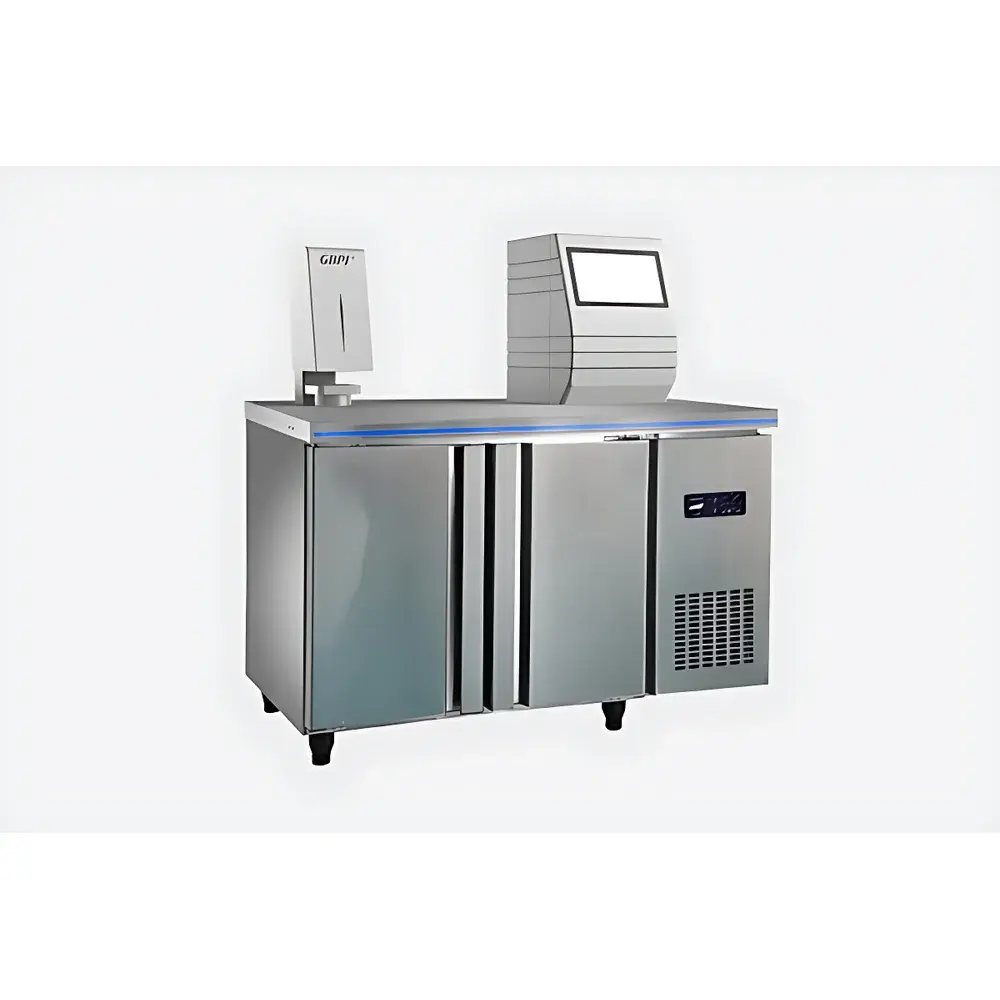
GBPI YQ-300 Particle Filtration Efficiency Tester for Respiratory Protective Devices
| Brand | GBPI |
|---|---|
| Origin | Guangdong, China |
| Manufacturer Type | Direct Manufacturer |
| Model | YQ-300Q |
| Filtration Efficiency Range | 0–99.999% |
| Aerosol Flow Rate | 10–100 L/min (Accuracy Class 2.5) |
| Sampling Frequency | 1–9999 cycles/min (adjustable) |
| Aerosol Concentration | 20–30 mg/m³ |
| Count Median Diameter (CMD) | NaCl aerosol (0.075 ± 0.02) µm |
| Geometric Standard Deviation (GSD) | NaCl ≤1.86 |
| Dynamic Concentration Range | 0.001–100 mg/m³ (±1% accuracy) |
| Differential Pressure Sensor Range | 0–500 Pa |
| Dimensions | 460 mm × 525 mm × 1430 mm |
| Power Supply | AC 220 V, 50 Hz |
| Environmental Operating Conditions | 25 °C ± 5 °C, 30 %RH ± 10 %RH |
Overview
The GBPI YQ-300 Particle Filtration Efficiency Tester is a fully integrated, laboratory-grade instrumentation platform engineered for standardized quantitative assessment of particulate filtration performance in respiratory protective equipment—including surgical masks, medical face masks, N95/N99 respirators, and industrial particulate-filtering fabrics. It operates on the principle of controlled aerosol challenge under constant-flow conditions, measuring upstream and downstream particle number or mass concentration to compute filtration efficiency (%) via the fundamental equation: FE = [1 − (Cdown/Cup)] × 100. The system complies with core regulatory and consensus standards governing personal protective equipment (PPE) evaluation, including GB/T 32610–2016 (Daily Protective Masks), GB 2626–2006 (Respiratory Protection—Non-powered Air-purifying Particulate Respirators), GB 19082–2009 (Medical Protective Gowns), GB 19083–2010 (Medical Protective Masks), GB 24539–2009 (Chemical Protective Clothing), and YY 0469–2011 (Surgical Masks). Its architecture supports both salt (NaCl) and oil (paraffin/oil-based) aerosol challenges—enabling dual-mode testing aligned with international classification systems for filter classification (e.g., N/R/P series per NIOSH 42 CFR Part 84).
Key Features
- Dual independent aerosol generation modules: Cold-generation NaCl aerosol generator and oil aerosol generator, each calibrated to deliver stable, monodisperse or narrowly distributed challenge particles meeting CMD and GSD specifications per GB and ISO protocols.
- Integrated electrostatic neutralization stage using 85Kr or soft X-ray sources to condition aerosols to Boltzmann equilibrium charge distribution—ensuring measurement repeatability and eliminating electrostatic bias in filtration assessment.
- High-fidelity real-time aerosol monitoring via calibrated PM2.5 optical sensors and optional laser particle counters (e.g., 0.3–10 µm channel resolution), synchronized with differential pressure transducers (0–500 Pa, ±0.5 Pa resolution) for simultaneous airflow resistance characterization.
- Hermetically sealed aerosol pathway with leak-tight gasketed sample holders and negative-pressure containment—designed to meet ISO 15195:2018 requirements for operator safety during high-concentration aerosol exposure.
- Pneumatic clamping mechanism with mechanical interlock and force-limiting actuation—ensuring consistent specimen loading pressure (typically 20–50 kPa) while preventing over-compression of delicate nonwovens.
- Onboard environmental monitoring: Digital temperature and relative humidity sensors (±0.5 °C, ±3 %RH) continuously logged and displayed, with automated pass/fail flagging if ambient conditions deviate beyond GB-specified tolerances (25 °C ± 5 °C, 30 %RH ± 10 %RH).
- Modular flow control architecture featuring precision glass rotameters and vacuum-regulated mass flow controllers, supporting stable operation across the full 10–100 L/min range at Class 2.5 accuracy per JJG 257–2019.
Sample Compatibility & Compliance
The YQ-300 accommodates flat-sheet specimens up to 100 mm diameter (standard test area per GB/T 32610 and YY 0469) and supports edge-sealed mounting for multi-layer composite masks. It is validated for use with woven and nonwoven textiles, melt-blown polypropylene media, electrospun nanofibers, and coated filtration substrates. All hardware and software components are designed to support GLP-compliant data integrity: audit trails, user authentication, electronic signatures, and raw-data immutability align with FDA 21 CFR Part 11 requirements when operated with validated software configurations. Test reports generated include full metadata (operator ID, timestamp, environmental logs, calibration certificates, instrument serial numbers) and are exportable in CSV, PDF, and XML formats suitable for regulatory submission.
Software & Data Management
The dedicated GBPI TestSuite v4.x software provides full automation of test sequences—including aerosol stabilization, pre-test baseline acquisition, dynamic sampling, post-test purge, and auto-calculation of filtration efficiency, pressure drop, and quality factor (QF = −ln(1−FE)/ΔP). Data is stored in an embedded SQL database with configurable retention policies and role-based access control (RBAC). Software validation documentation (IQ/OQ/PQ protocols) is available upon request. Exported datasets retain traceability to NIST-traceable calibration records for flow meters, pressure sensors, and aerosol concentration monitors. Remote diagnostics and firmware updates are supported via secure HTTPS interface.
Applications
- Regulatory conformance testing for PPE certification bodies (e.g., CNAS-accredited labs, NMPA-designated inspection centers)
- R&D screening of novel filtration media—including electret-charged polymers, graphene-enhanced composites, and antimicrobial-functionalized nonwovens
- Batch release testing in mask manufacturing facilities operating under ISO 13485 and GMP frameworks
- Comparative analysis of aging effects (thermal, UV, humidity exposure) on filtration stability
- Validation of fit-test correlation models linking material-level filtration data to manikin-based total inward leakage (TIL) measurements
- Supporting ISO/TC 94/SC 15 working group activities on harmonizing global respirator test methodologies
FAQ
Does the YQ-300 comply with ISO 16890 or EN 1822 for HVAC filter testing?
No—the YQ-300 is specifically configured for respiratory protection applications per Chinese national standards and NIOSH-aligned protocols. It does not meet the upstream uniformity, scanning probe, or fractional efficiency requirements of ISO 16890 or EN 1822.
Can the system be upgraded to support TSI 8130 or Palas MFP3000 aerosol generators?
Yes—GBPI offers OEM integration kits for third-party aerosol generators, subject to mechanical interface verification and metrological revalidation per ISO/IEC 17025.
Is the software compliant with FDA 21 CFR Part 11 for electronic records?
When deployed with validated configuration (including Windows OS hardening, time-server synchronization, and signed digital certificates), the TestSuite v4.x meets predicate rules for Part 11 compliance; formal validation support packages are available.
What calibration intervals are recommended for the differential pressure sensor and flow meters?
Annual calibration against NIST-traceable references is recommended; GBPI provides accredited calibration services with ISO/IEC 17025-certified certificates.
Does the instrument support automated calculation of Quality Factor (QF) and penetration vs. pressure drop curves?
Yes—QF is computed in real time; multi-point ΔP sweeps at fixed flow rates can be programmed to generate resistance-efficiency trade-off plots per ASTM F2299 Annex A1.






