
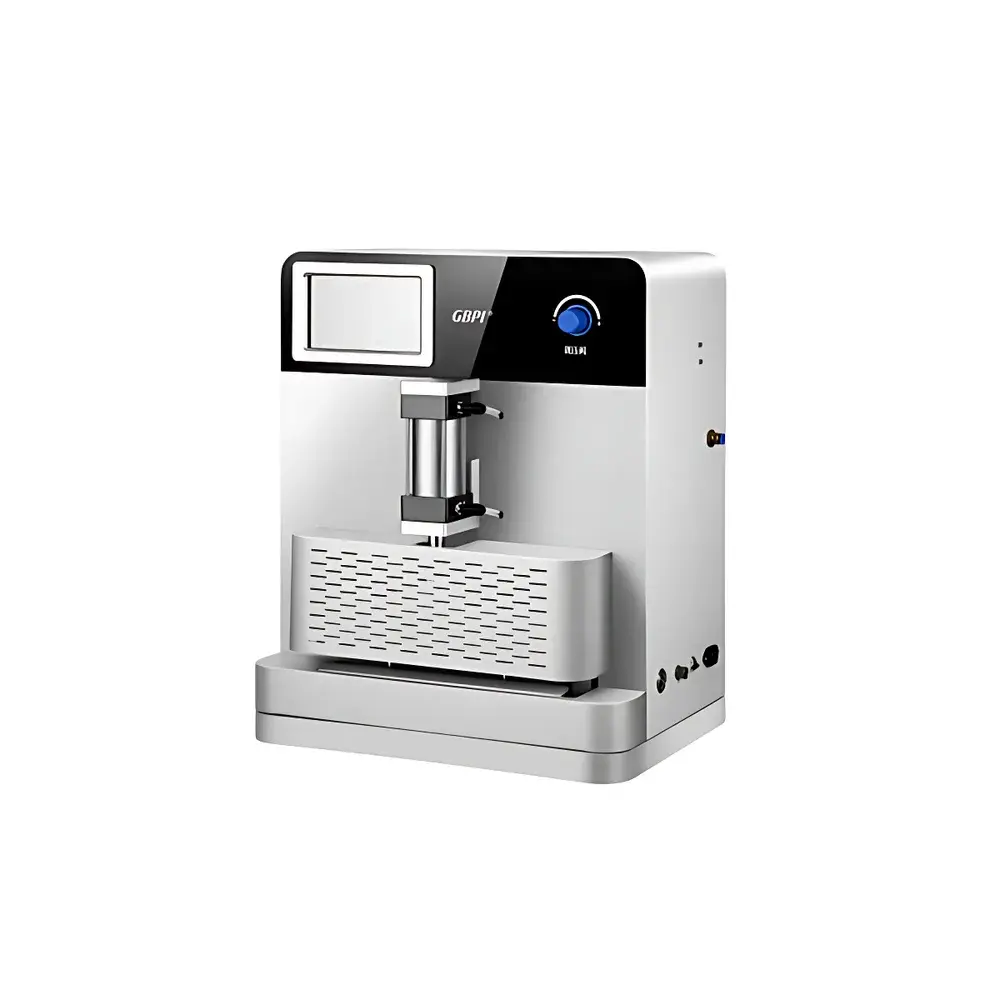
GBPI GBB-A1 Advanced Electronic Heat Sealing Tester
| Brand | GBPI |
|---|---|
| Origin | Guangdong, China |
| Manufacturer Type | OEM/ODM Manufacturer |
| Country of Origin | China |
| Model | GBB-A1-aa |
| Price Range | USD 4,200 – 7,000 |
| Sealing Temperature Range | Ambient to 250 °C |
| Temperature Control Accuracy | ±0.2 °C |
| Sealing Time Range | 0.01 s to 99.99 h |
| Sealing Pressure Range | 0.1–0.8 MPa |
| Sealing Surface Dimensions | 300 mm × 5.5 mm (smooth lower sealing bar with silicone pad) |
| Heating Method | Dual-zone independent resistive heating |
| Control Mode | Manual & Automatic (pneumatic actuation, external dual-cylinder synchronized circuit) |
| Display | Touchscreen interface showing real-time upper/lower jaw temperature, set sealing temperature, pressure, and time |
| Temperature Control Algorithm | Digital PID |
| Data Interface | RS232 serial port |
| Power Supply | AC 220 V, 50 Hz |
| Net Weight | 30 kg |
| Dimensions (L×W×H) | 500 mm × 330 mm × 570 mm |
Overview
The GBPI GBB-A1 Advanced Electronic Heat Sealing Tester is a precision-engineered laboratory instrument designed for quantitative evaluation of heat seal integrity in flexible packaging materials. It operates on the principle of controlled thermal compression—applying calibrated temperature, pressure, and dwell time to replicate industrial sealing conditions under repeatable, traceable parameters. This enables users to determine the optimal sealing window (temperature–pressure–time envelope) for thermoplastic films, laminates, coated papers, aluminum foils, and multilayer composites used in food, pharmaceutical, medical device, and consumer goods packaging. The system supports both R&D validation and routine QC testing, delivering metrologically sound data aligned with internationally recognized packaging performance standards.
Key Features
- Dual independent temperature control zones for upper and lower sealing jaws—each equipped with aluminum-encapsulated, uniform-heating resistance elements and high-stability Pt100 sensors calibrated per ISO/IEC 17025 traceable procedures.
- Pneumatic actuation via externally mounted, synchronized dual-cylinder circuit ensuring consistent force application and eliminating mechanical hysteresis across repeated cycles.
- Touchscreen HMI with real-time display of actual and setpoint values for sealing temperature (upper/lower), applied pressure, and dwell time—supporting immediate parameter verification and operator intervention.
- Digital PID temperature regulation delivering ±0.2 °C stability over the full 25–250 °C operating range, critical for identifying narrow thermal transition windows in coextruded or metallized substrates.
- Configurable sealing surface geometry: standard 300 mm × 5.5 mm smooth bar with integrated silicone cushion; optional custom profiles (e.g., embossed, stepped, or patterned) available for specialized applications including peel-seal validation or child-resistant packaging development.
- RS232 serial interface compliant with ASTM E1447 and ISO/IEC 17025 data integrity requirements—enabling direct export of timestamped test logs to LIMS or statistical process control (SPC) platforms.
- Two operational modes: fully automated sequence execution (with programmable multi-step protocols) and manual/foot-pedal–activated single-cycle operation for rapid prototyping or troubleshooting.
Sample Compatibility & Compliance
The GBB-A1 accommodates a broad spectrum of heat-sealable substrates—including polyethylene (LDPE, HDPE, LLDPE), polypropylene (CPP, BOPP), polyester (PET), nylon (PA6, PA66), ethylene-vinyl acetate (EVA), ionomer resins, and metallized or barrier-coated variants. Its design conforms to key regulatory and industry-standard test methods: QB/T 2358–1998 (China), ASTM F2029–22 (Standard Test Method for Measuring Heat Seal Strength of Thermoplastic Flexible Barrier Materials), and YBB00122003–2015 (Chinese Pharmacopoeia packaging material specification). The instrument’s architecture supports GLP-compliant workflows through audit-trail-capable parameter logging, user-access-level controls, and calibration documentation management—facilitating FDA 21 CFR Part 11 readiness when integrated with validated software environments.
Software & Data Management
While the GBB-A1 operates as a standalone hardware platform, its RS232 interface enables seamless integration with third-party data acquisition systems or GBPI’s optional PC-based analysis suite (sold separately). Exported datasets include test ID, date/time stamp, operator ID, sealing parameters (Tset, Tactual, P, t), and pass/fail flags against user-defined limits. All numerical outputs adhere to SI unit conventions and are formatted for direct import into Excel, JMP, or Minitab. Calibration records—including sensor offset verification and pressure transducer linearity checks—are stored locally and may be exported as PDF reports meeting ISO/IEC 17025 clause 7.7 documentation requirements.
Applications
- Determination of minimum seal initiation temperature (MSIT) and hot tack onset point for extrusion coating lines.
- Validation of seal strength vs. aging conditions (e.g., post-seal dwell time, ambient humidity exposure).
- Comparative assessment of seal integrity across different adhesive layers (e.g., EAA, ADMER, tie-layer resins) in multilayer laminates.
- Supporting shelf-life studies by correlating seal robustness with package leak test outcomes (e.g., ASTM F2338 vacuum decay or ASTM D3078 bubble emission).
- Teaching laboratories: demonstration of polymer melt behavior, interfacial adhesion kinetics, and thermal degradation thresholds in packaging science curricula.
FAQ
What standards does the GBB-A1 comply with for regulatory submissions?
The instrument implements test methodologies referenced in QB/T 2358–1998, ASTM F2029–22, and YBB00122003–2015—making it suitable for generating data intended for NMPA, FDA, or EMA regulatory dossiers when operated within an established quality system.
Can the sealing jaw configuration be modified for non-standard pouch geometries?
Yes. GBPI offers custom machining of sealing bars—including variable width, curvature, or surface texture—to match end-product package formats such as stand-up pouches, sachets, or medical blister lidding.
Is pressure calibration traceable to national standards?
Each unit ships with a factory calibration certificate referencing NIST-traceable pressure standards; field recalibration kits and certified service are available through GBPI’s global support network.
Does the system support multi-step thermal ramping profiles?
No—the GBB-A1 executes isothermal sealing cycles only. For dynamic thermal profiling (e.g., ramp-hold-cool sequences), users should consider the GBPI GBB-B2 series or consult application engineering for hybrid setup options.
How frequently must temperature sensors be recalibrated?
Per ISO/IEC 17025 recommendations, annual verification is advised; however, daily pre-test verification using a calibrated reference thermometer (e.g., Fluke 1523) is strongly recommended for critical QC environments.






