
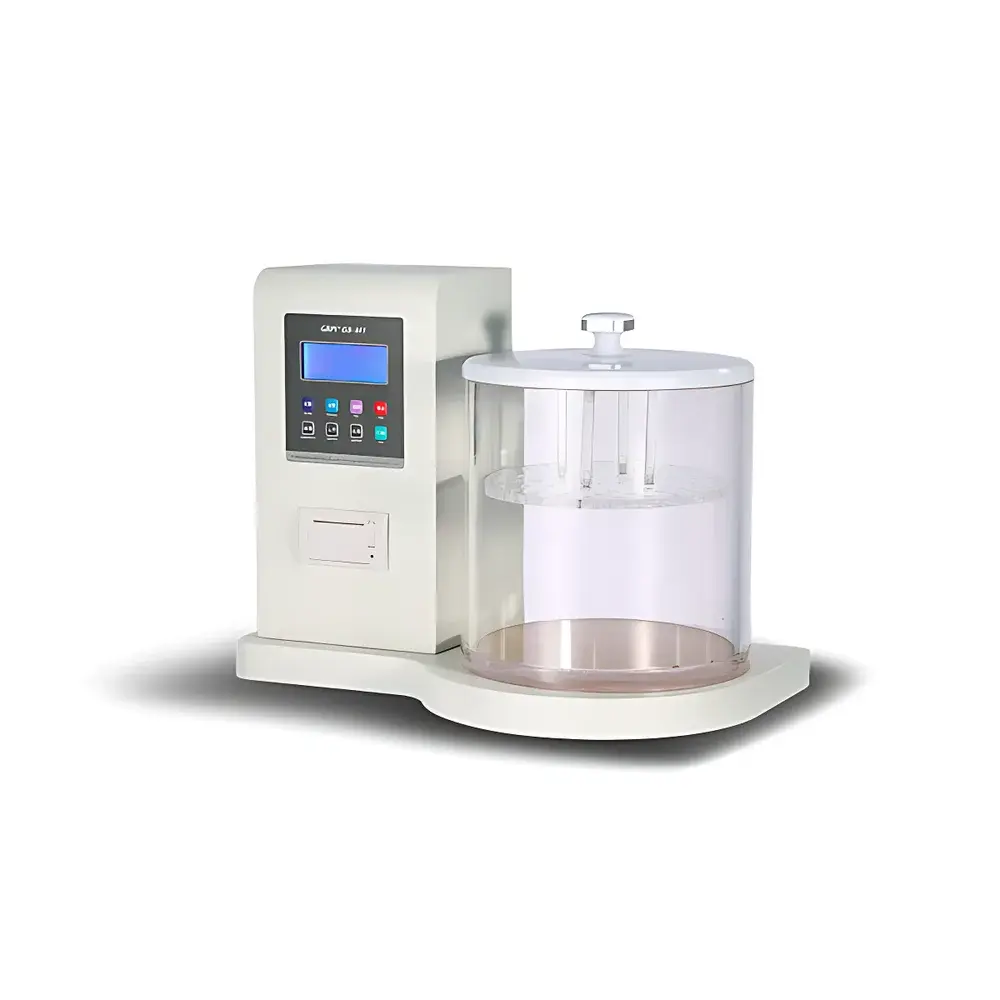
GBPI GB-M1Y Seal Integrity Tester for Flexible Packaging
| Brand | GBPI |
|---|---|
| Origin | Guangdong, China |
| Manufacturer Type | Direct Manufacturer |
| Country of Origin | China |
| Model | GB-M1Y |
| Price Range | USD 1,400 – 4,200 |
| Vacuum Range | 0 to −90 kPa |
| Vacuum Accuracy | ±1 kPa |
| Vacuum Hold Time | 0.1–9999.9 s |
| Test Chamber Dimensions | Ø270 × 270 mm (effective) |
| Vacuum Chamber (Standard) | Ø300 × 300 mm (customizable) |
| Compressed Air Supply | 0.6–0.8 MPa |
| Air Consumption | 20 L/min |
| Power Supply | 220 V AC, 50 Hz |
| Control Unit Dimensions | 580 × 350 × 440 mm (L×W×H) |
| Net Weight | 10.2 kg |
| Rated Power | 100 W |
Overview
The GBPI GB-M1Y Seal Integrity Tester is an automated vacuum-decay-based instrument engineered for objective, repeatable assessment of seal integrity in flexible packaging—primarily heat-sealed plastic pouches, blister packs, sachets, and rigid/flexible composite containers. It operates on the principle of controlled vacuum application followed by pressure decay monitoring within a sealed test chamber. A verified seal prevents air ingress; any measurable pressure rise during the hold phase indicates leakage at the seal interface or through micro-defects in the package wall. This method aligns with deterministic physical measurement principles defined in ISO 11607-2, ASTM F2338-22 (Standard Test Method for Nondestructive Detection of Leaks in Packages by Vacuum Decay), and supports validation under FDA 21 CFR Part 11 when paired with compliant software and audit-trail-enabled data handling. The GB-M1Y is not a qualitative bubble-emission tester but a quantitative, process-controlled system suitable for routine QC release testing and stability study support in regulated environments.
Key Features
- Automated vacuum cycle control: fully programmable vacuum level (0 to −90 kPa), hold duration (0.1–9999.9 s), and repressurization sequence;
- Pneumatic actuation via regulated compressed air (0.6–0.8 MPa), eliminating reliance on electric vacuum pumps and enhancing long-term operational stability;
- High-resolution vacuum transducer with ±1 kPa accuracy across full range, traceable to national metrological standards;
- Integrated 4.3-inch TFT LCD interface displaying real-time vacuum curve, setpoints, elapsed time, and status flags;
- Built-in thermal line printer generating time-stamped test reports—including date/time stamp, vacuum parameters, pass/fail verdict, and operator ID field;
- Manual override capability: pause/resume and emergency abort functions accessible during active test cycles;
- Modular vacuum chamber design: standard Ø300 × 300 mm chamber included; optional custom chambers (e.g., cylindrical, rectangular, or extended-height variants) available upon request for non-standard package geometries.
Sample Compatibility & Compliance
The GB-M1Y accommodates flat, semi-rigid, and form-fill-seal packages up to Ø270 mm diameter and 350 mm height. Compatible substrates include polyethylene (PE), polypropylene (PP), polyester (PET), aluminum-laminated films, and Tyvek®-based medical device pouches. It meets the physical test requirements of GB/T 15171–1994 (Chinese standard for soft package seal strength), ASTM D3078–2002 (reapproved 2013) for leak detection in flexible packaging, and serves as a functional equivalent to ASTM F2338–22 for vacuum decay testing. When integrated into a validated laboratory system—including documented IQ/OQ protocols, calibrated air supply, and filtered compressed air (ISO 8573-1 Class 2 particulate/oil/water filtration)—the instrument supports GLP and GMP-compliant packaging validation per ICH Q5C and ISO 11607-1:2019.
Software & Data Management
While the GB-M1Y operates as a standalone unit with embedded firmware, it supports external data capture via RS232 serial output (standard) or optional USB-to-serial adapter. Exported data includes timestamp, vacuum setpoint, actual achieved vacuum, hold time, measured pressure drift (ΔP), and binary pass/fail result. For regulated environments, GBPI offers optional PC-based software (GBPI DataLink v3.x) enabling CSV export, trend charting, user access control (three-tier login), electronic signature fields, and 21 CFR Part 11-compliant audit trails—including immutable record of parameter changes, test initiation, and report generation events. All firmware updates are digitally signed and distributed via secure FTP portal.
Applications
- Final package release testing in pharmaceutical solid-dose manufacturing (e.g., Alu-Alu blisters, sachets for oral powders);
- QC verification of seal strength consistency in food packaging lines (retort pouches, vacuum-sealed meat trays);
- Accelerated aging study support: detecting seal degradation after thermal/humidity stress exposure;
- Supplier qualification audits for contract packaging organizations (CPOs);
- Root cause analysis of seal failures—correlating vacuum decay rate with seal temperature, dwell time, or jaw contamination;
- Compliance documentation for regulatory submissions (e.g., FDA IND/NDA, EU MDR Annex I packaging evidence).
FAQ
Does the GB-M1Y require calibration certification before first use?
Yes. Initial calibration verification—performed using NIST-traceable pressure reference instruments—is required prior to IQ execution. GBPI provides factory calibration certificate (as-delivered condition); users must conduct field verification per SOP before release to production.
Can the instrument detect leaks smaller than 50 µm?
Vacuum decay sensitivity depends on chamber volume, hold time, and allowable ΔP threshold. Under optimized conditions (e.g., 30 s hold, <0.5 kPa drift limit), the system reliably detects leaks ≥100 µm in typical PE pouches. Sub-50 µm detection requires helium mass spectrometry or laser-based tracer gas methods.
Is compressed air filtration mandatory?
Yes. Unfiltered air introduces oil aerosols and particulates that degrade pneumatic valve lifespan and compromise vacuum chamber cleanliness. ISO 8573-1 Class 2 filtration (≤0.1 µm particles, ≤0.01 mg/m³ oil, dew point −40°C) is strongly recommended.
What maintenance intervals apply to the GB-M1Y?
Daily: visual inspection of O-rings and chamber sealing surface; weekly: purge air lines and verify filter element condition; annually: transducer recalibration and solenoid valve function test per GBPI Maintenance Manual Rev. 4.2.
Is the built-in printer compliant with 21 CFR Part 11?
No—the thermal printer generates hardcopy records only. For Part 11 compliance, electronic records must be generated via GBPI DataLink software with audit trail, electronic signatures, and secure storage—printer output serves as supplementary backup, not primary record.




