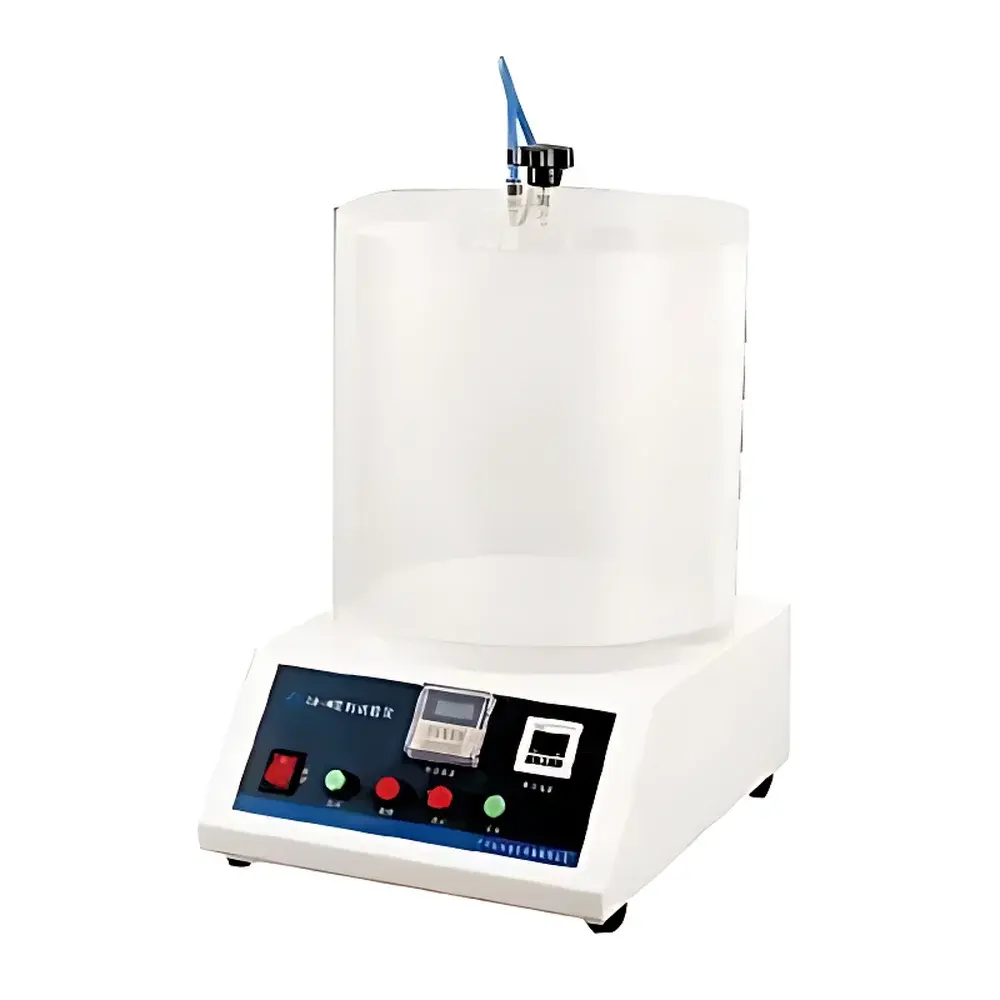
GBPI GB-M Seal Integrity Tester
| Brand | GBPI |
|---|---|
| Origin | Guangdong, China |
| Manufacturer Type | Direct Manufacturer |
| Country of Origin | China |
| Model | GB-M |
| Pricing | Available Upon Request |
| Vacuum Range | 0 to –90 kPa |
| Vacuum Accuracy | ±1% FS |
| Vacuum Hold Time | 0.1–60 min |
| Air Supply Pressure | 0.7–0.8 MPa |
| Vacuum Chamber Dimensions | Ø300 × 350 mm |
| Overall Dimensions | 300 (W) × 430 (D) × 500 (H) mm |
| Compliance Standards | GB/T 15171, ASTM D3078 |
| Control System | Microprocessor-based digital control with programmable vacuum setpoint and dwell time |
| Operation Mode | Automated vacuum generation, timed hold, automatic venting (reverse blow), and cycle termination |
Overview
The GBPI GB-M Seal Integrity Tester is an engineered solution for quantitative assessment of package seal integrity in flexible and semi-rigid packaging systems. It operates on the principle of vacuum decay testing—a non-destructive, deterministic method widely adopted in quality assurance laboratories across food, pharmaceutical, and personal care industries. The instrument utilizes compressed air (user-supplied, 0.7–0.8 MPa) to drive a high-efficiency vacuum generator, rapidly establishing a controlled negative pressure environment within a stainless-steel vacuum chamber (Ø300 × 350 mm). A microprocessor-based controller regulates vacuum level (0 to –90 kPa, ±1% full-scale accuracy) and dwell duration (0.1–60 minutes) with digital precision, enabling repeatable, traceable test sequences. Unlike subjective bubble-emission methods, this system delivers objective pass/fail outcomes based on measurable vacuum stability during the hold phase—directly correlating with leak rate thresholds defined in ISO 11607-2 and aligned with FDA guidance for container-closure integrity testing (CCIT) in sterile product development.
Key Features
- Microprocessor-controlled vacuum generation and timing logic ensures consistent test execution across operators and shifts.
- Digital parameter input for vacuum setpoint and hold time eliminates analog dial inaccuracies and supports SOP-driven workflows.
- Automated test sequence: vacuum ramp → stabilization → timed hold → controlled venting (reverse blow) → cycle completion—minimizing operator intervention and inter-test variability.
- Stainless-steel vacuum chamber with removable acrylic lid facilitates visual observation during testing and accommodates diverse sample geometries (pouches, sachets, bottles, tubes).
- Modular design allows optional customization of internal baffles (e.g., circular partition) to optimize chamber volume distribution for small or irregular samples.
- No internal pump required—relies on external compressed air supply, reducing heat generation, maintenance intervals, and long-term operational cost.
Sample Compatibility & Compliance
The GB-M accommodates a broad range of primary packaging formats including laminated plastic pouches, aluminum foil-sealed trays, HDPE/PP bottles, PET jars, and composite tubes—provided they fit within the chamber envelope and withstand applied vacuum without structural collapse. Its performance and reporting methodology conform to internationally recognized standards: GB/T 15171 (Chinese national standard for soft package seal strength evaluation) and ASTM D3078 (Standard Test Method for Determination of Leaks in Flexible Packaging by Bubble Emission, adapted for vacuum-decay interpretation). While not a direct replacement for probabilistic methods such as helium mass spectrometry, the GB-M serves as a validated screening tool for routine QC release testing under GLP-compliant environments and satisfies baseline requirements for USP Category 1 (deterministic, non-destructive) CCIT when used within its validated operating range.
Software & Data Management
The GB-M operates via embedded firmware with local parameter storage (up to 10 user-defined test profiles). All test logs—including date/time stamp, target vacuum, actual achieved vacuum, hold duration, and pass/fail status—are recorded internally and exportable via USB interface in CSV format for integration into LIMS or electronic batch record systems. Audit trail functionality meets fundamental ALCOA+ principles (Attributable, Legible, Contemporaneous, Original, Accurate), supporting 21 CFR Part 11 readiness when deployed with complementary access controls and electronic signature protocols. Optional RS-232 or Ethernet modules enable remote monitoring and centralized data aggregation in multi-instrument facilities.
Applications
- Verification of heat-seal process validation in form-fill-seal (FFS) lines for snack, dairy, and ready-to-eat meal packaging.
- Batch release testing of blister packs and peelable lidding foils in pharmaceutical manufacturing per ICH Q5C stability protocols.
- Root cause analysis of seal failures following sterilization (autoclave, gamma, EtO) in medical device packaging.
- Comparative evaluation of adhesive sealants, cold-seal coatings, and ultrasonic bonding parameters during R&D.
- Supplier qualification audits requiring documented evidence of seal robustness against mechanical stress and environmental aging.
FAQ
Is an external air compressor required?
Yes. The GB-M requires a clean, dry, oil-free compressed air supply at 0.7–0.8 MPa (100–116 psi). A refrigerated air dryer and particulate filter are recommended upstream to prevent moisture ingress and valve contamination.
Can the instrument detect sub-micron leaks?
No. The GB-M is optimized for gross and medium-level leaks (typically >100 µm equivalent orifice) per ASTM D3078 sensitivity limits. For critical sterile barrier applications requiring detection down to 5 µm, complementary methods such as laser-based headspace analysis or high-vacuum helium leak testing are advised.
What calibration documentation is provided?
Each unit ships with a factory calibration certificate referencing NIST-traceable pressure transducers. Annual recalibration using certified deadweight testers or digital pressure calibrators is recommended to maintain ±1% accuracy.
Does the system support IQ/OQ protocol execution?
Yes. GBPI provides URS-compatible installation and operational qualification templates, including test scripts for vacuum linearity, timer accuracy, chamber leakage rate verification, and software function checks—all aligned with ISO 9001 and Annex 11 expectations.