
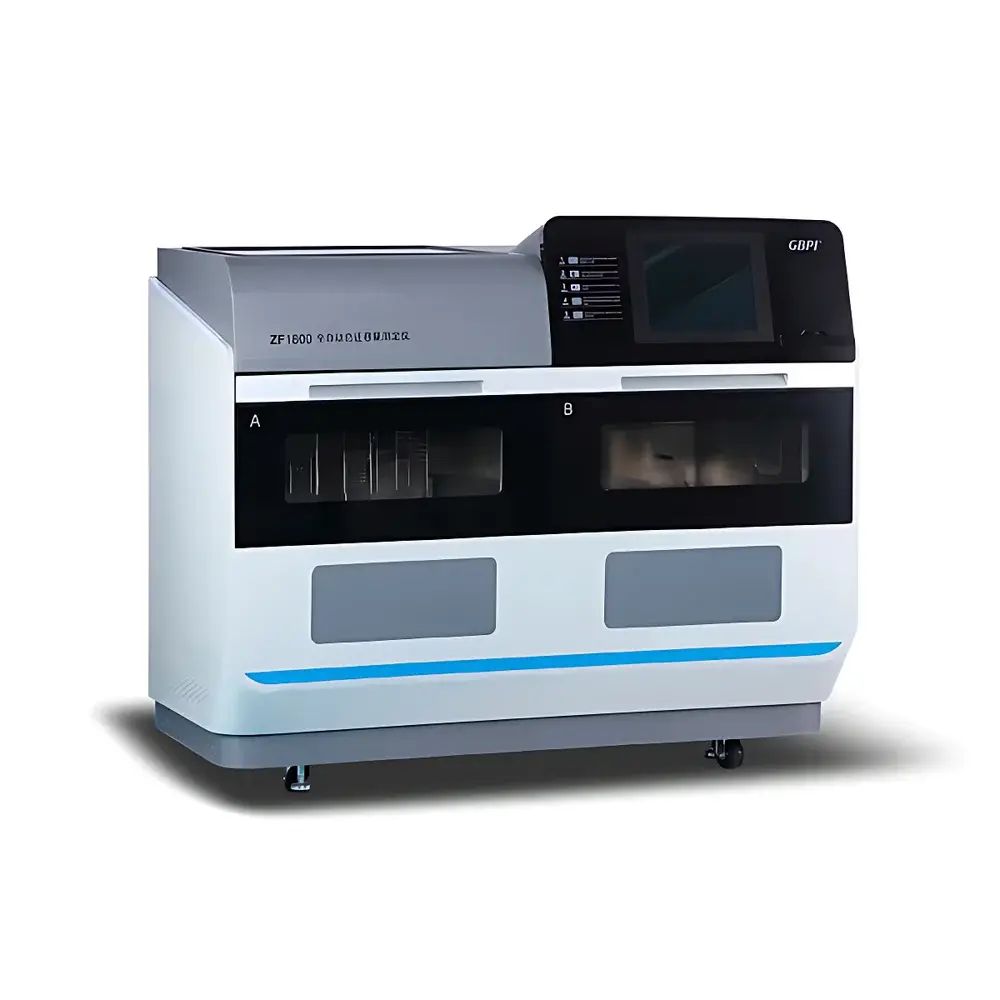
GBPI ZF1800B1 Total Migration Tester & Residue Evaporation Analyzer
| Brand | GBPI |
|---|---|
| Origin | Guangdong, China |
| Manufacturer Type | Direct Manufacturer |
| Country of Origin | China |
| Model | ZF1800B1 |
| Price | Upon Request |
| Measurement Range | 0.2–167,000 mg/dm² |
| Resolution | 0.0001 g/dm² |
| Balance Capacity | 0–200 g |
| Balance Resolution | 0.1 mg |
| Water Bath Temp Control | RT–100 °C |
| Heating Chamber Temp Control | RT–117.9 °C |
| Cooling Chamber Temp Control | 10–35 °C |
| Temperature Uniformity | ±5 °C |
| Sample Capacity | 1–18 independent stations |
| Evaporating Dish Volume | 0–200 mL |
| Dimensions (Main Unit) | 178 × 93 × 145 cm (L×W×H) |
| Solvent Recovery System Dimensions | 120 × 88 × 170 cm (L×W×H) |
| Power Supply | 220 V, 50 Hz |
| Rated Power | 5000 W |
Overview
The GBPI ZF1800B1 Total Migration Tester & Residue Evaporation Analyzer is an integrated, fully automated laboratory instrument engineered for precise quantification of non-volatile residue—commonly referred to as “evaporation residue”—following standardized food contact material (FCM) extraction protocols. It operates on the principle of controlled solvent evaporation under regulated thermal and environmental conditions, followed by gravimetric determination of residual mass per unit surface area (mg/dm²). Designed in strict alignment with ISO 10993-12, EN 1186 series, and FDA 21 CFR §170–189 requirements, the system supports migration testing across diverse food simulants—including aqueous, acidic, alcoholic, and fatty media—used to assess total migration from polyolefins (e.g., PE, PP), polystyrene (PS), PVC, and other polymer-based food packaging and utensils. Its architecture integrates three thermally isolated chambers (water bath, heating chamber, cooling chamber), enabling simultaneous, independent control of evaporation, drying, and conditioning phases—thereby eliminating inter-test environmental variability and ensuring high reproducibility in regulatory-compliant residue analysis.
Key Features
- Tri-chamber thermal management system: Independent water bath (RT–100 °C), heating chamber (RT–117.9 °C), and cooling chamber (10–35 °C), each with ±5 °C uniformity and real-time monitoring.
- Automated water bath subsystem: Includes auto-fill, water level sensing, temperature-regulated evaporation, timed drainage, and dual safety alarms (over-temperature and dry-run detection).
- Hermetically sealed solvent recovery loop: Full containment of volatile organic solvents (e.g., ethanol, isooctane, acetic acid) during evaporation; exhaust gases are condensed and collected without atmospheric release.
- Nitrogen purge capability: Optional inert gas introduction to accelerate solvent removal and prevent oxidation of heat-sensitive residues.
- Negative-pressure test chamber: Maintains sub-atmospheric pressure throughout operation via continuous vacuum regulation, minimizing ambient contamination and enhancing solvent vapor capture efficiency.
- ARM-based embedded control platform: Touchscreen interface enables one-touch execution of customizable test sequences—covering sample loading, solvent addition, evaporation, drying, cooling, and multi-cycle gravimetric constant-weight determination.
- 18 independent test stations: Each station features dedicated weighing, thermal control, and data logging; results are stored with full traceability per sample position.
Sample Compatibility & Compliance
The ZF1800B1 accommodates a broad spectrum of food contact articles—including rigid and flexible packaging films, laminates, containers, cutlery, tubing, and gaskets—regardless of geometry or surface topology. Sample preparation follows ISO 28801 and EN 13130-1 guidelines, with specimen surface area accurately measured prior to immersion in prescribed food simulants (e.g., 3% acetic acid, 10% ethanol, olive oil, or synthetic gastric fluid). The instrument’s validated thermal profiles ensure compliance with EU Regulation (EC) No. 10/2011 Annex IV and Chinese GB 31604.1–2015 for total migration limit verification. All hardware and firmware meet electromagnetic compatibility (EMC) standards per IEC 61326-1 and electrical safety requirements per IEC 61010-1.
Software & Data Management
The onboard software complies with Annex 11 of the EU GMP Guidelines and FDA 21 CFR Part 11 for computerized systems used in regulated environments. Access requires role-based authentication (administrator, operator, reviewer), with granular permission assignment for method editing, result approval, audit log review, and user management. Comprehensive audit trails record all system events—including login/logout timestamps, parameter modifications, weight readings, chamber status changes, and report generation—with immutable timestamps and user identifiers. Real-time dashboards display live weight trends, migration rate curves, and chamber temperature/humidity profiles per station. Reports are exportable in PDF, XLSX, and CSV formats, including metadata such as analyst ID, calibration certificate numbers, environmental conditions, and raw gravimetric values at each weighing interval.
Applications
- Regulatory testing of plastic food packaging under EU, US, and Chinese FCM legislation.
- QC/QA validation of production batches for total migration compliance prior to market release.
- Developmental screening of novel polymer formulations and barrier coatings.
- Migration kinetics studies under accelerated aging conditions (e.g., elevated temperature/time).
- Method transfer and verification between contract laboratories and internal R&D facilities.
- Supporting GLP-compliant toxicological risk assessments per OECD Test Guideline 407.
FAQ
Does the ZF1800B1 support both aqueous and fatty food simulants?
Yes—it accommodates all standard simulants defined in EN 1186-1 and ISO 10993-12, including distilled water, 3% acetic acid, 10% and 20% ethanol, and olive oil or substitute oils (e.g., isooctane) with appropriate temperature and time adjustments.
How is data integrity ensured during long-duration evaporation cycles?
The system performs automatic intermediate weighings at user-defined intervals and applies statistical convergence criteria (e.g., ≤0.1 mg deviation over three consecutive readings) before final reporting; all intermediate values are archived with full audit trail linkage.
Can the instrument be integrated into a LIMS environment?
Yes—via configurable OPC UA or TCP/IP interfaces, supporting structured data exchange (e.g., ASTM E1384-compliant messages) for seamless ingestion into enterprise laboratory information management systems.
What maintenance routines are recommended for sustained accuracy?
Daily chamber cleaning and balance calibration using certified weights; quarterly verification of temperature uniformity across all zones using NIST-traceable PT100 probes; annual preventive maintenance by GBPI-certified engineers including vacuum pump servicing and solvent trap replacement.
Is the nitrogen purge function mandatory for all tests?
No—it is optional and primarily recommended for oxygen-sensitive samples or when rapid evaporation of low-boiling solvents (e.g., hexane) is required to minimize thermal degradation artifacts.
Related Products







