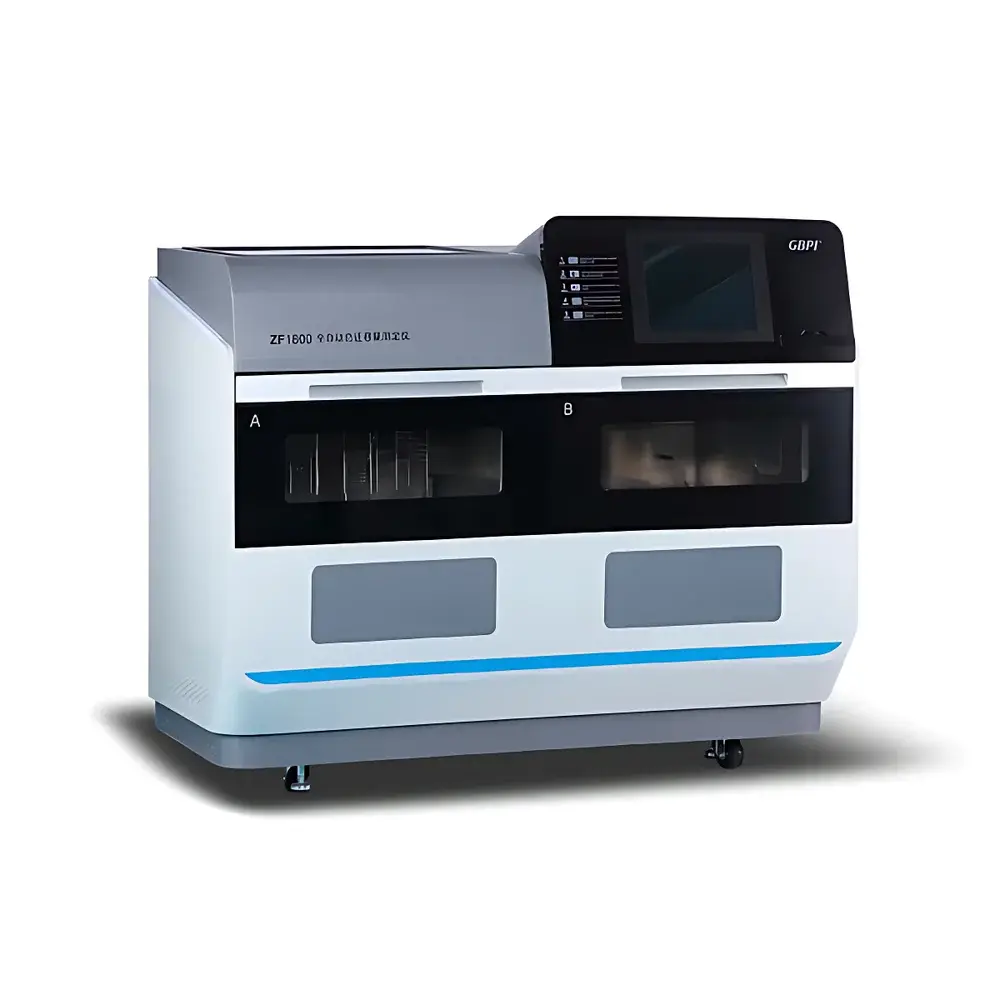
GBPI ZF1800A Total Migration and Non-Volatile Residue Tester for Food Contact Materials
| Brand | GBPI |
|---|---|
| Origin | Guangdong, China |
| Manufacturer Type | Direct Manufacturer |
| Country of Origin | China |
| Model | ZF1800A |
| Pricing | Upon Request |
| Measurement Range | 0.2–167,000 mg/dm² |
| Resolution | 0.0001 g/dm² |
| Balance Capacity | 0–200 g |
| Balance Readability | 0.1 mg |
| Water Bath Temp Control | Ambient to 100 °C |
| Heating Chamber Temp Control | Ambient to 120 °C |
| Cooling Chamber Temp Control | Ambient |
| Temperature Accuracy | ±0.5 °C |
| Chamber Temperature Uniformity | ±5 °C |
| Sample Capacity | 1–18 independent test positions |
| Constant-Weight Duration | 2.5 h (standard) |
| Evaporating Dish Volume | 0–200 mL |
| Dimensions (L×W×H) | 180 cm × 90 cm × 120 cm |
| Power Supply | 220 V, 50 Hz |
| Rated Power | 5000 W |
Overview
The GBPI ZF1800A Total Migration and Non-Volatile Residue Tester is an integrated, fully automated analytical system engineered for regulatory compliance testing of food contact materials (FCMs) in accordance with ISO 10993-12, ISO 21747, EN 1186 series, and national standards including GB 31604.1–2015 and GB 5009.156–2016. It quantifies the total migration level—the sum of all non-volatile substances transferred from packaging or processing equipment into food simulants—by gravimetric determination of evaporative residue after controlled extraction and solvent evaporation. The instrument employs a dual-chamber thermal architecture (independent heating and cooling zones), precision microbalance integration, and closed-loop solvent management to ensure high reproducibility, operator safety, and traceable data integrity across batched and multi-simulant testing protocols.
Key Features
- Dual-Chamber Thermal Architecture: Separate water bath, heating chamber, and ambient cooling chamber operate independently—enabling simultaneous extraction, drying, and conditioning without thermal cross-interference. Each zone maintains temperature stability within ±0.5 °C and uniformity within ±5 °C across the full working volume.
- Automated Water Bath System: Integrated water bath includes auto-fill, real-time water-level sensing, PID-controlled heating (ambient to 100 °C), timed evaporation cycles, and fail-safe dry-run and overtemperature alarms. All fluid handling occurs within sealed pathways to prevent contamination or operator exposure.
- Closed-Solvent Recovery Loop: Solvent vapor generated during evaporation is condensed and collected within a hermetically sealed recovery system. No volatile organic compounds (VOCs) are released into the laboratory environment, meeting OSHA PEL and EU Directive 2004/42/EC requirements for occupational health protection.
- Nitrogen Purge Capability: Optional nitrogen inlet supports inert-atmosphere evaporation—critical for oxygen-sensitive simulants (e.g., ethanol/water mixtures) and thermally labile migrants, minimizing oxidative degradation during residue formation.
- Negative-Pressure Test Chamber: Vacuum-assisted sealing ensures consistent low-pressure conditions throughout extraction and drying phases, reducing boiling point elevation effects and improving residue homogeneity.
- 18-Position Independent Testing: Each of the 18 test stations operates autonomously—supporting parallel analysis of diverse samples (e.g., PET trays, PP lids, epoxy-lined cans) in different food simulants (10% ethanol, 3% acetic acid, olive oil, etc.) with individual weight tracking and migration calculation.
- ARM-Based Embedded Control: Touchscreen interface runs a deterministic real-time OS; no external PC dependency. Predefined method templates allow one-touch initiation of full workflows: simulant dosing → water bath incubation → transfer → drying → cooling → weighing → constant-weight validation → final reporting.
Sample Compatibility & Compliance
The ZF1800A accommodates solid, semi-rigid, and flexible FCMs—including polyolefin films, PS containers, PVC gaskets, lacquered metal cans, silicone tubing, and coated paperboard. It supports all standard food simulants defined in Regulation (EU) No 10/2011 and FDA 21 CFR §170–189: aqueous (10% ethanol, 3% acetic acid), fatty (isooctane, vegetable oil), and dry simulants (ethanol at elevated temperature). Instrument design conforms to GLP principles per OECD Series on Principles of Good Laboratory Practice (ENV/MC/CHEM(98)17), with hardware-level interlocks preventing unauthorized parameter modification. All thermal and mass measurement subsystems are calibrated traceable to NIM (National Institute of Metrology, China) and compatible with ISO/IEC 17025 accredited laboratories.
Software & Data Management
The embedded software complies with Annex 11 of the EU GMP Guidelines and FDA 21 CFR Part 11 for computerized systems. Access control enforces role-based permissions (Administrator, Analyst, Reviewer, Observer), with configurable rights over method editing, data export, audit log viewing, and user management. Comprehensive audit trails record every action—including login/logout timestamps, parameter changes, weight readings, manual overrides, and report generation—with immutable hashing and electronic signature support. Real-time dashboards display live weight curves, migration kinetics per station, chamber temperatures, and residual moisture trends. Reports export natively to PDF/A-1b and Microsoft Excel (.xlsx) formats, embedding raw weight logs, calibration certificates, and environmental metadata required for regulatory submissions.
Applications
- Pre-market validation of plastic, rubber, and composite packaging under EU Regulation (EC) No 1935/2004 and China’s GB 4806 series standards
- Migration profiling of printed inks, adhesives, and barrier coatings used in multi-layer laminates
- Compliance verification for reusable food service ware (e.g., dishwasher-safe polycarbonate trays)
- Stability assessment of antimicrobial additives under repeated-use simulation conditions
- Root-cause analysis of organoleptic defects linked to extractable low-molecular-weight species
- Supporting toxicological risk assessments by providing quantitative input for exposure modeling (e.g., EFSA’s FCM exposure models)
FAQ
What food simulants are supported by the ZF1800A?
The system is validated for use with aqueous simulants (10% ethanol, 3% acetic acid), fatty simulants (isooctane, refined olive oil), and dry simulants (20% ethanol in water at 70 °C), as specified in EN 13130-1 and GB 31604.1.
Does the instrument meet FDA 21 CFR Part 11 requirements?
Yes—the software implements electronic signatures, audit trail retention (>10 years), user authentication, and system validation documentation packages compliant with Part 11 Subpart B.
Can test methods be customized for non-standard simulants or time/temperature profiles?
Absolutely. Users may define custom incubation durations, temperature ramps, drying sequences, and constant-weight criteria via the method editor—subject to administrator-level approval and version-controlled archiving.
Is external calibration of the balance required?
The dual 0–200 g precision balances are factory-calibrated with NIST-traceable 200 g weights (included). Internal calibration routines can be scheduled daily or per-test-sequence; external recalibration is recommended annually by an ISO/IEC 17025-accredited metrology provider.
What maintenance is required for the solvent recovery system?
Condenser coils require quarterly cleaning with isopropanol; activated carbon filters in the exhaust path should be replaced every 6 months or after 500 test cycles—whichever occurs first—to maintain VOC capture efficiency >99.5%.