
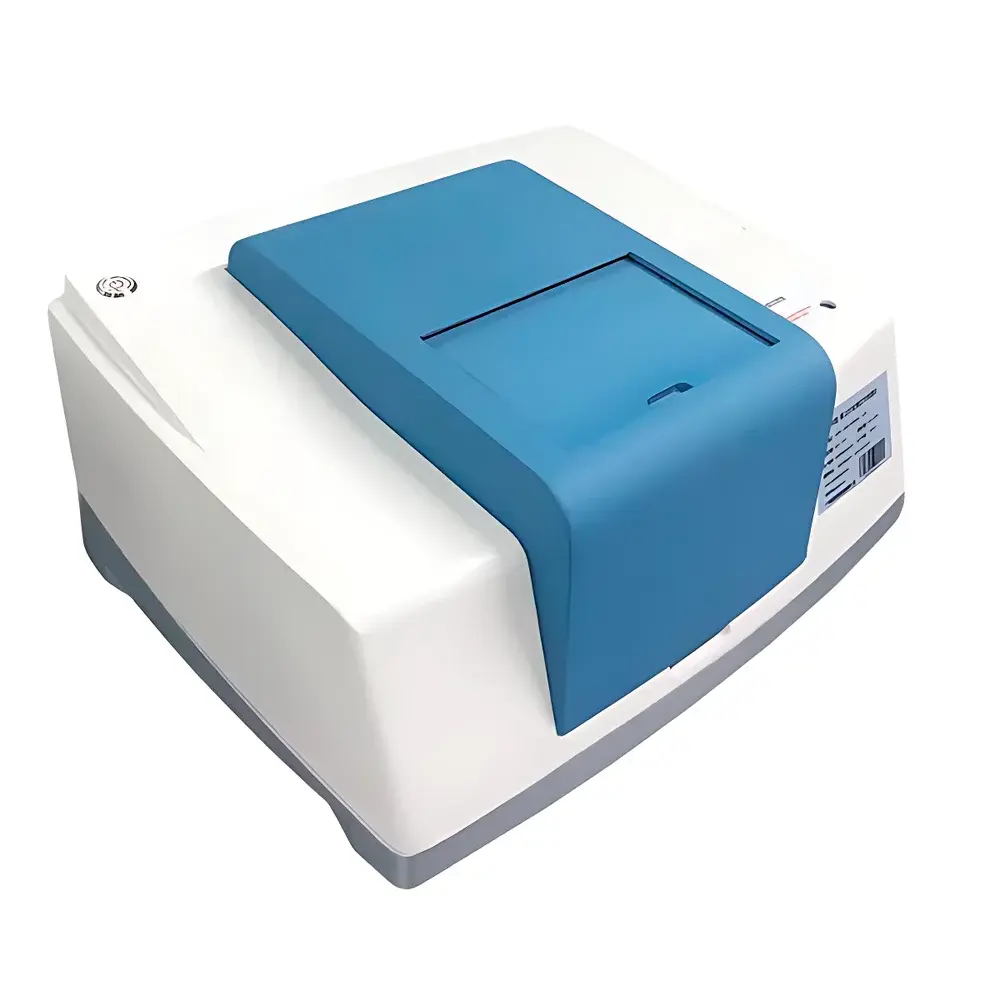
GBPI® BFH-960 Fourier Transform Infrared (FTIR) Spectrometer
| Brand | GBPI |
|---|---|
| Origin | Guangdong, China |
| Manufacturer Type | Direct Manufacturer |
| Instrument Type | Laboratory FTIR Spectrometer |
| Spectral Range | 7800–350 cm⁻¹ |
| Resolution | <1.0 cm⁻¹ |
| Scan Speed | 4 cm⁻¹ |
| Signal-to-Noise Ratio | 15,000:1 / 30,000:1 (at 4 cm⁻¹, 1 min scan) |
| Beamsplitter | KBr substrate with Ge coating |
| Detector | Imported high-sensitivity deuterated L-alanine triglycine sulfate (DLaTGS) |
| Source | Imported long-life, air-cooled high-intensity IR source |
| Interferometer | Sealed 30°-incidence Michelson interferometer with built-in auto-alignment optics |
| A/D Conversion | 24-bit, 500 kHz |
| Communication Interface | USB 2.0 (backward compatible with USB 3.0) |
| Dimensions | 450 × 350 × 235 mm (L×W×H) |
| Weight | 14 kg |
| Operating Temperature | 15–35 °C |
| Power Consumption | <30 W |
Overview
The GBPI® BFH-960 Fourier Transform Infrared (FTIR) Spectrometer is a laboratory-grade analytical instrument engineered for precision molecular identification and quantitative analysis across research, quality control, and regulatory environments. Based on the Michelson interferometer principle, it acquires interferograms via He–Ne laser-referenced optical path modulation, followed by real-time fast Fourier transformation to generate high-fidelity infrared absorption spectra. Its core architecture integrates a sealed, humidity-resistant interferometer, a high-stability ceramic IR source, and a thermoelectrically stabilized DLaTGS detector—ensuring reproducible spectral acquisition under routine lab conditions. Designed to meet the demands of pharmaceutical development, environmental monitoring, polymer characterization, forensic analysis, and food safety testing, the BFH-960 delivers research-level performance with compliance-ready operational integrity.
Key Features
- Hermetically sealed Michelson interferometer with 30° incident angle design and integrated automatic optical alignment—minimizing drift and eliminating manual recalibration.
- Germanium-coated potassium bromide (KBr) beamsplitter with anti-humidity membrane and oversized, reusable desiccant cartridge—providing >5× moisture resistance versus industry-standard FTIR systems.
- 7° forward-tilted humidity indicator window—enabling ergonomic visual inspection and timely molecular sieve replacement without tooling.
- Push-pull sample compartment door—reducing ambient CO₂ and H₂O vapor intrusion during measurement, critical for high-accuracy baseline stability in mid-IR region (4000–400 cm⁻¹).
- High-efficiency electrical architecture consuming <30 W at full operation—supporting continuous use in shared lab infrastructure without thermal load concerns.
- Gold-coated corner-cube retroreflectors with sub-arcsecond angular precision—ensuring long-term optical path consistency and wavelength fidelity.
- Voltage-controlled surface-emitting laser (VCSEL) reference source rated for >10 years of uninterrupted service—eliminating periodic He–Ne tube replacement and associated downtime.
- Diamond-turned optical components and modular mechanical layout—facilitating field-serviceable maintenance and component-level upgrades.
Sample Compatibility & Compliance
The BFH-960 supports universal sampling modalities including transmission (KBr pellet, solution cell), attenuated total reflectance (ATR), diffuse reflectance (DRIFTS), and specular reflection—compatible with solid, liquid, gel, and thin-film specimens. Its spectral range (7800–350 cm⁻¹) covers fundamental vibrational modes of organic functional groups (e.g., O–H, N–H, C=O, C–H), inorganic anions (e.g., NO₃⁻, SO₄²⁻, PO₄³⁻), and gaseous species (CO, CO₂, NH₃). The system meets essential metrological requirements outlined in ASTM E1421, ISO 18381, and USP , and supports audit-trail-enabled data acquisition compliant with FDA 21 CFR Part 11 when deployed with validated software configurations. Optional IQ/OQ documentation packages are available for GxP laboratories requiring GLP or GMP traceability.
Software & Data Management
The instrument is operated via GBPI’s proprietary FTIR Control Suite—a Windows-based application supporting intuitive workflow navigation, real-time interferogram preview, and multi-stage spectral processing. Key capabilities include automated baseline correction (Rubberband, Concave Rubberband), Savitzky–Golay smoothing, derivative spectroscopy (1st/2nd order), peak integration (area/height), functional group assignment using embedded logic engines, and advanced ATR correction algorithms accounting for refractive index and penetration depth. The software includes over 12 domain-specific spectral libraries (e.g., Chinese Pharmacopoeia, Veterinary Drug Compendium, Polymer Reference Library, Solvent IR Atlas, Food Additives Database), all searchable via similarity matching (hit quality index ≥95%). Users may create, annotate, and version-control custom libraries with password-protected access rights—fully aligned with data integrity principles per ALCOA+ guidelines.
Applications
- Pharmaceutical QC: Identification of active pharmaceutical ingredients (APIs), excipient compatibility screening, polymorph differentiation, and counterfeit drug detection per ICH Q5A/Q5C.
- Environmental Analysis: Quantification of microplastics in water matrices, identification of VOCs in air samples, and speciation of heavy metal complexes in soil extracts.
- Materials Science: Crosslink density assessment in elastomers, oxidation state analysis of transition metal oxides, and degradation profiling of biodegradable polymers.
- Forensic Chemistry: Discrimination of ink formulations, fiber type classification, and explosive residue fingerprinting using library-matched spectral overlays.
- Food & Beverage: Authentication of edible oils (e.g., olive vs. sunflower), detection of adulterants (e.g., melamine in milk powder), and monitoring Maillard reaction progression in thermal processing.
FAQ
What is the recommended calibration frequency for the BFH-960?
Annual verification using NIST-traceable polystyrene film standard (SRM 1921b) is advised; optional semi-annual checks are supported via built-in laser frequency validation mode.
Does the system support external accessories such as gas cells or cryostats?
Yes—the oversized sample compartment (≥100 mm vertical clearance) accommodates commercially available purged gas cells (25–100 mm pathlength), low-temperature ATR stages, and vacuum-compatible modules.
Is spectral data export compatible with third-party chemometric platforms?
Raw interferograms (.ifg) and processed spectra (.spa, .jdx, .csv) are natively exportable; ASCII formats enable direct ingestion into MATLAB, Python (SciPy), Unscrambler, and SIMCA.
How does the BFH-960 handle atmospheric compensation during ambient measurements?
Real-time background subtraction uses dual-beam referencing with dynamic water/CO₂ compensation algorithms—activated automatically upon background collection under identical environmental conditions.
Can the instrument be integrated into a LIMS environment?
Via OPC UA or TCP/IP API interface (available under enterprise license), enabling bidirectional data exchange with major LIMS vendors including LabWare, Thermo Fisher SampleManager, and STARLIMS.
Related Products



