
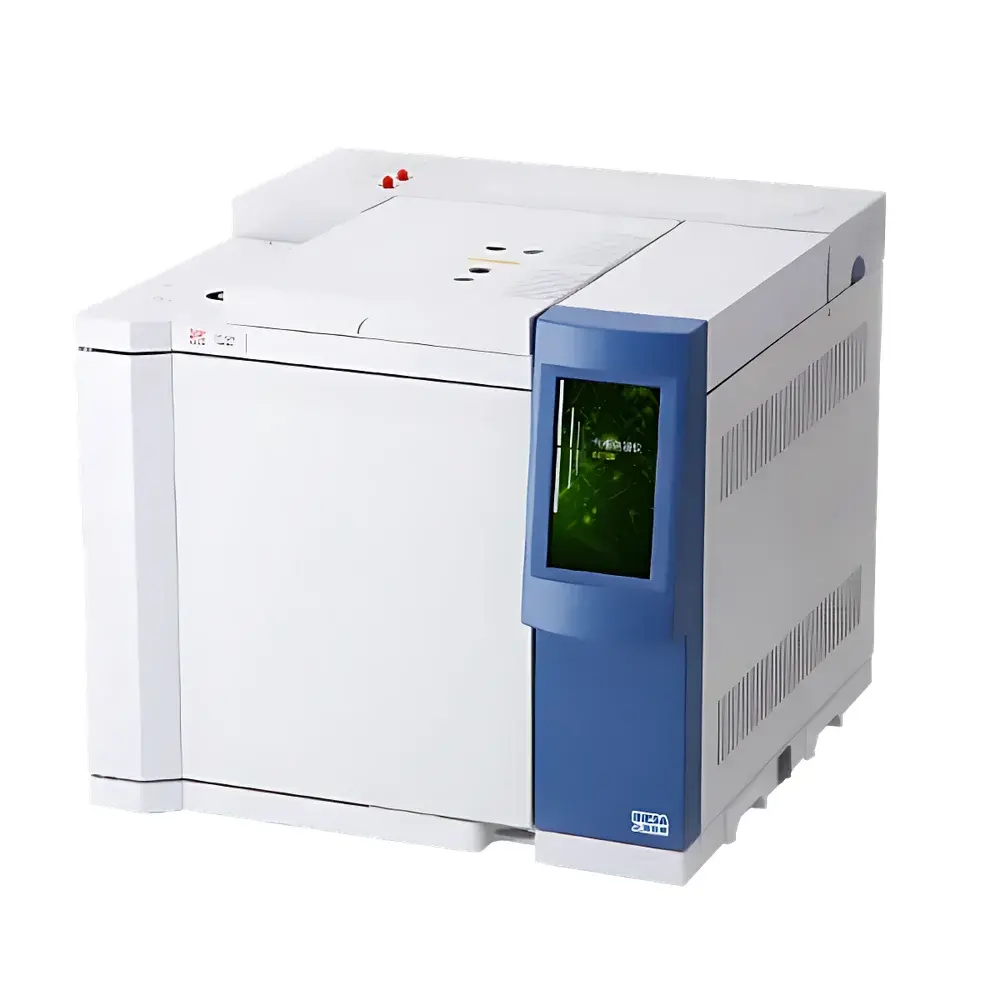
GBPI BJ-GC128 Gas Chromatograph
| Brand | GBPI |
|---|---|
| Origin | Guangdong, China |
| Manufacturer Type | Original Equipment Manufacturer (OEM) |
| Model | BJ-GC128 |
| Price | USD 22,000 (FOB Guangdong) |
| Touchscreen | 7-inch color capacitive display |
| Control Architecture | Dual-mode—embedded real-time OS + PC-based bidirectional software control |
| EFC/EPC | Electronic Flow Control / Electronic Pressure Control on all inlets and detectors |
| Inlet Zones | 2 independently heated (up to 400 °C), compatible with packed columns (φ3/φ4) and split/splitless capillary inlets |
| Detector Options | FID (MDL ≤ 2.5×10⁻¹² g/s n-hexadecane, dynamic range 10⁷), TCD (sensitivity ≥ 5000 mV·mL/mg n-hexadecane, baseline drift ≤ 0.15 mV/30 min), ECD (⁶³Ni source, MDL ≤ 80 fg/s, γ-HCH ≤ 8×10⁻¹⁴ g/mL, dynamic range 10³), FPD (P: MDL ≤ 2×10⁻¹² g/s, S: ≤ 4×10⁻¹¹ g/s, methyl parathion, P/S dynamic range 10³/10²) |
| Oven Specifications | Internal dimensions 280 × 310 × 160 mm |
| operating range | ambient +4 °C to 420 °C |
| Auxiliary Heaters | 2 additional zones (max 400 °C) |
| External Event Ports | 8 TTL-compatible digital I/O channels for valve sequencing, autosampler triggering, or thermal desorption synchronization |
| Connectivity | RS-232 serial port, LAN (LAM protocol), 20 method storage slots |
| Safety Features | Automatic oven fan & heater shutdown upon column chamber door opening |
| Power Requirements | 220 VAC ±10%, 50/60 Hz, 3000 W max |
Overview
The GBPI BJ-GC128 is a high-performance, modular gas chromatograph engineered for routine and research-grade volatile and semi-volatile organic compound analysis in environmental, pharmaceutical, petrochemical, and food safety laboratories. Built upon a dual-control architecture—integrating a real-time embedded system with PC-based bidirectional workstation software—the instrument delivers deterministic timing, traceable method execution, and robust reproducibility across extended unattended runs. Its core analytical principle relies on differential partitioning of analytes between a mobile gas phase (carrier gas: He, H₂, or N₂) and a stationary liquid or polymer phase coated inside fused-silica capillary columns. Separation occurs as compounds elute at characteristic retention times governed by polarity, volatility, and column interaction thermodynamics. The BJ-GC128 supports multi-detector configurations—including FID, TCD, ECD, and FPD—with independent, digitally regulated temperature zones and fully electronic pneumatic control (EPC/EFC), enabling precise method transfer and compliance-ready operation.
Key Features
- 7-inch high-resolution capacitive touchscreen interface with intuitive icon-driven navigation and real-time status visualization
- Dual-control capability: seamless synchronization between embedded firmware and Windows-based GC Workstation (bidirectional parameter update, real-time data streaming, and method upload/download)
- Electronic Pressure and Flow Control (EPC/EFC) on all inlets and detectors—eliminating mechanical flow controllers and enhancing retention time stability (< 0.02% RSD over 24 h)
- Eight configurable TTL-level external event ports for automated valve actuation, autosampler coordination, or integration with thermal desorbers and pyrolyzers
- Independent heating zones: two inlet ports (up to 400 °C), two detector modules (FID/TCD/ECD/FPD), and two auxiliary zones (up to 400 °C)—all with ±0.1 °C setpoint resolution and active thermal shielding
- Column oven with forced-air convection cooling (variable-frequency motor + rear-door mechanism), achieving 60 °C/min ramp rates and stable isothermal hold performance (drift < 0.01 °C per 1 °C ambient change)
- Comprehensive hardware diagnostics: self-test at power-on, continuous sensor monitoring, fault logging with timestamped error codes, and automatic recovery protocols
- Integrated safety interlocks: immediate oven fan deactivation and heater cutoff upon chamber door opening; low-carrier-gas pressure alarm with auto-shutdown
Sample Compatibility & Compliance
The BJ-GC128 accommodates a broad range of sample introduction formats—liquid injection (split/splitless), headspace analysis (via optional HS module), and solid-phase microextraction (SPME) through standardized inlet adapters. It supports both packed columns (φ3 mm and φ4 mm OD) and capillary columns (0.1–0.53 mm ID). Regulatory alignment is facilitated through design features essential for GLP/GMP environments: audit-trail-enabled method storage (20 user-defined methods), electronic signature support via workstation software, and full traceability of instrument parameters, sequence logs, and calibration events. While not pre-certified for FDA 21 CFR Part 11, the system architecture—including secure user access levels, immutable raw data files (.GCW binary + .CSV export), and time-stamped event logs—provides a validated foundation for laboratory-specific Part 11 implementation. Method development adheres to ASTM D3612 (petroleum hydrocarbons), ISO 11843-2 (detection limit validation), and USP (chromatographic system suitability).
Software & Data Management
The bundled GC Workstation software operates on Windows 10/11 (64-bit) and provides full instrument control, real-time chromatogram display, peak integration using iterative Gaussian deconvolution, and customizable reporting templates compliant with ISO/IEC 17025 documentation requirements. Raw data are stored in proprietary .GCW format with embedded metadata (instrument ID, operator, method name, acquisition time, detector settings, column history). Export options include ASCII (.CSV), AIA (.CDF), and PDF reports with embedded spectra and calibration curves. The software supports sequence batch processing, automatic baseline correction, retention time locking (RTL), and multi-point calibration curve generation with weighted linear regression (1/x, 1/x²). All method changes are logged with user ID and timestamp; raw data files are write-protected post-acquisition to prevent tampering.
Applications
- Environmental analysis: PAHs, PCBs, chlorinated pesticides (ECD), BTEX, and VOCs in soil/water/air matrices
- Pharmaceutical QC: residual solvents (ICH Q3C), assay purity, and extractables/leachables profiling
- Fuel and lubricant characterization: hydrocarbon type analysis (PIONA), oxygenate quantification (MTBE, ethanol), and sulfur speciation (FPD)
- Food and flavor chemistry: fatty acid methyl esters (FAME), terpenes, aldehydes, and off-flavor compounds
- Forensic toxicology: ethanol/blood alcohol confirmation, drug metabolite screening (FID/ECD), and accelerant residue identification
FAQ
Does the BJ-GC128 support remote monitoring and control over LAN?
Yes—via LAM (Local Area Method) protocol, enabling secure TCP/IP-based instrument status polling, method download, and start/stop commands from networked workstations within the same subnet.
Can the FID be operated simultaneously with the TCD or ECD?
Yes—dual-detector operation is supported with independent temperature and gas flow control; however, detector selection for data acquisition must be configured prior to run initiation in the workstation.
Is the column oven’s temperature uniformity validated per ASTM E1510?
The oven design meets the thermal mass and airflow criteria outlined in ASTM E1510; users may perform in-house uniformity mapping using calibrated micro-thermocouples at specified grid points per their internal SOP.
What is the maximum column length supported for capillary applications?
The standard oven accommodates up to 60 m capillary columns (0.53 mm ID); longer columns require custom mounting brackets and may impact resolution due to increased resistance and dwell volume.
Are firmware updates provided free of charge during the warranty period?
Yes—GBPI offers complimentary firmware upgrades for bug fixes and minor feature enhancements for 24 months post-purchase; major version releases may require validated requalification per laboratory policy.




