
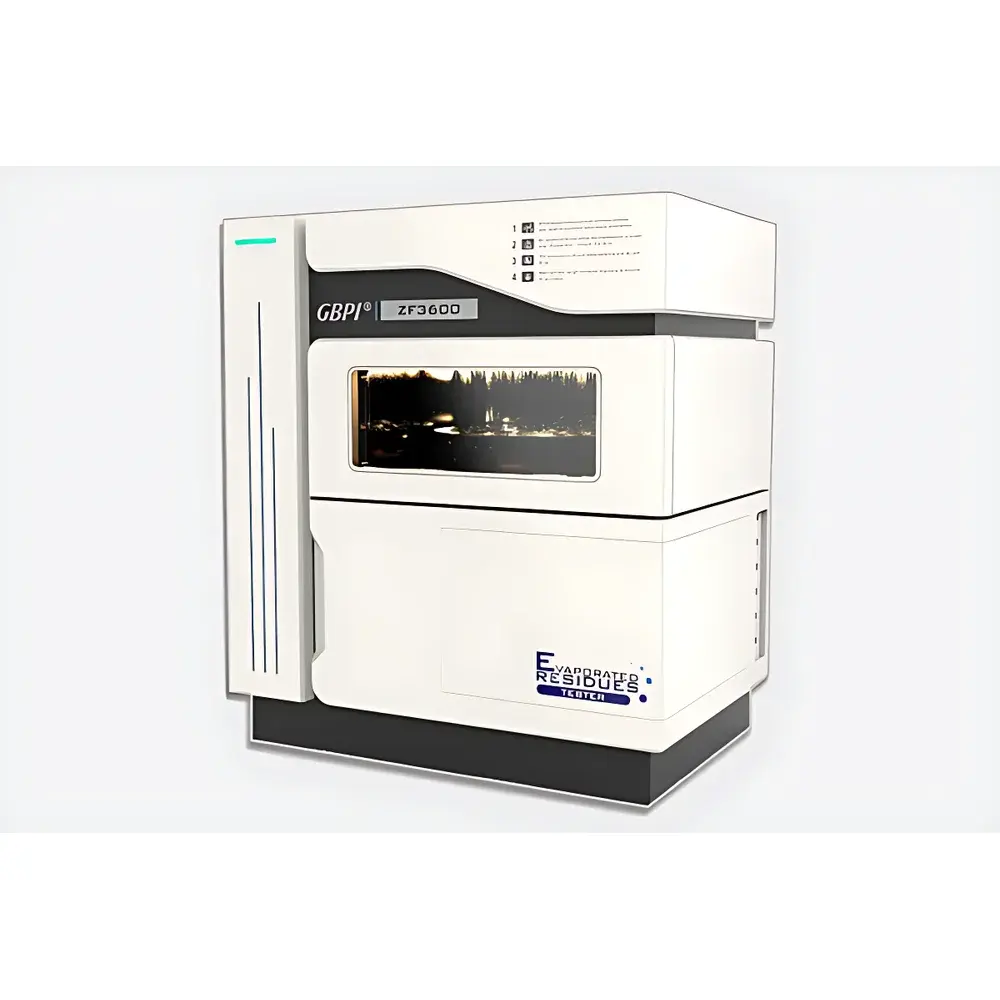
GBPI ZF3600K Automated Residue-on-Evaporation Gravimetric Analyzer
| Brand | GBPI |
|---|---|
| Origin | Guangdong, China |
| Manufacturer Type | Direct Manufacturer |
| Region Category | Domestic (China) |
| Model | ZF3600K |
| Pricing | Upon Request |
| Measurement Range | 0–80 g |
| Balance Resolution | 0.01 mg |
| Balance Capacity | 0–220 g |
| Constant-Weight Tolerance | ±0.3 mg (user-configurable) |
| Water Bath Temp Range | Ambient to 100 °C |
| Drying Chamber Temp Range | Ambient to 125 °C |
| Temperature Control Accuracy | ±0.5 °C |
| Sample Positions | 36 |
| Evaporating Dish Volume | 50 mL or 100 mL (selectable) |
| Pneumatic Interface | Φ8 mm |
| Dimensions (L×W×H) | 1200 × 850 × 1335 mm |
| Power Supply | 220 V, 50 Hz |
| Rated Power | 7000 W |
| OS | Windows 10 Pro 64-bit |
Overview
The GBPI ZF3600K Automated Residue-on-Evaporation Gravimetric Analyzer is a fully integrated, GMP-compliant laboratory instrument engineered for precise determination of non-volatile residue (NVR), total migration, and dissolved solids in aqueous and organic extracts—critical parameters in pharmaceutical, food contact material, packaging, and environmental testing. It operates on the gravimetric principle: sequential evaporation of solvent under controlled water bath conditions, followed by thermal drying, desiccation-cooling, and iterative high-precision weighing until constant mass is achieved. Unlike manual or semi-automated methods, the ZF3600K eliminates operator intervention through synchronized coordination of fluid handling, thermal management, environmental isolation, and microgram-level mass measurement. Its architecture conforms to the fundamental metrological requirements defined in pharmacopoeial monographs and regulatory test protocols—including ISO/IEC 17025 traceability frameworks—and supports full auditability for GLP and GMP environments.
Key Features
- Dual-Chamber Integrated Thermal Management: Independent water bath (ambient–100 °C) and drying chamber (ambient–125 °C) with electromagnetic temperature control (±0.5 °C accuracy), liquid-level sensing, auto-fill/drain, and fail-safe overheat protection.
- Automated Fluid Handling System: Pneumatically actuated dispensing with <0.1 mL residual volume per cycle; compatible with water, ethanol, hexane, acetic acid, chloroform, and other solvents specified in USP , EP 9.0, and GB standards.
- Triple High-Precision Balance Module: Three imported analytical balances (0.01 mg resolution, 220 g capacity), each housed within thermally stabilized, water-jacketed enclosures; mechanical isolation during heating/drying ensures weighing stability and repeatability.
- 36-Position High-Throughput Platform: Parallel processing of up to 36 samples with independent parameter sets per position; supports both liquid extracts and solid matrices (e.g., herbal powders, polymer films, filter papers).
- Solvent Recovery & Environmental Control: Integrated recirculating chiller (30-min cooldown to ambient), large-capacity coolant reservoir, and >90% solvent recovery efficiency via condensate collection bottles—reducing VOC emissions and disposal costs.
- Ergonomic & Visual Design: 1.2 m operational height, transparent observation window, real-time display of weight trends, temperature/humidity profiles, and process status—enabling immediate visual verification without opening the chamber.
Sample Compatibility & Compliance
The ZF3600K is validated for use across diverse sample matrices and regulatory domains. It meets the procedural and instrumentation requirements of multiple international standards, including: Ph. Eur. 9.0 WATER, PURIFIED; ChP 2020 Vol. II (Purified Water) and Vol. IV (Extractables & Loss on Drying); USP-NF 40–35 WATER DETERMINATION; GB 31604.8–2016 (Food Contact Materials); EN 1186–3:2002 Method A; Korea MOHW Chapter IV Section 2–8; GB/T 9740–2008 (Cigarette Tipping Paper); GB 8538–2016 and DZ/T 0064.9–2021 (Drinking Water & Groundwater Analysis); and GBT 14415–2007 / GBT 5750.4–2006 (Total Dissolved Solids). All hardware and software components are designed to support compliance with FDA 21 CFR Part 11 (electronic records/signatures), EU Annex 11 (computerized systems), and ISO/IEC 17025 calibration traceability.
Software & Data Management
The embedded Windows 10 Pro-based operating system features a modular, icon-driven interface compliant with ICH GCP and EU GMP Annex 11. Users define method templates—including evaporation time, drying cycles, cooling duration, and constant-weight criteria—for individual or batch execution. The system logs all critical events (e.g., balance readings, temperature setpoints, door openings, user logins) with immutable timestamps and operator ID. Audit trails are exportable in CSV or PDF, support electronic signatures, and retain metadata for full data lineage. Reports are customizable (PDF, Excel, XML), include raw weight sequences, statistical summaries (RSD, mean, min/max), and can be submitted directly to LIMS or QA review portals. Language localization supports English and Simplified Chinese without reinstallation.
Applications
- Quantification of non-volatile residue in purified water used for parenteral manufacturing (ChP/USP/EP)
- Total migration testing of food packaging materials (plastics, coatings, adhesives) per GB 31604.8 and EN 1186
- Residue analysis of cigarette tipping paper extractives (GB/T 9740)
- Determination of total dissolved solids (TDS) in drinking water, groundwater, and effluents (GB 8538, DZ/T 0064.9)
- Loss on drying (LOD) and extractable matter assessment for herbal medicines and APIs (ChP Vol. IV, USP )
- Quality control of chemical reagents and solvents where residual impurities affect downstream synthesis or analytical performance
FAQ
Does the ZF3600K comply with FDA 21 CFR Part 11 requirements?
Yes—the system implements role-based access control, electronic signature workflows, tamper-evident audit logs, and secure data storage aligned with Part 11 Subpart B.
Can the instrument handle halogenated solvents such as chloroform?
Yes—its sealed chamber design, corrosion-resistant internal surfaces, and dedicated solvent recovery path accommodate chlorinated and acidic solvents per GB/T 9740–2008 and EN 1186–3 protocols.
Is external balance calibration required between runs?
No—internal calibration routines are triggered automatically before each weighing sequence; optional external calibration using certified weights remains available via admin mode.
What is the minimum detectable mass change for constant-weight determination?
The system detects mass changes ≥0.01 mg and applies configurable convergence criteria (e.g., ≤0.3 mg difference over two consecutive weighings after drying/cooling cycles).
Can test data be exported to a central LIMS without manual intervention?
Yes—via configurable ODBC drivers or RESTful API endpoints, enabling scheduled automated data push to enterprise laboratory informatics platforms.



