
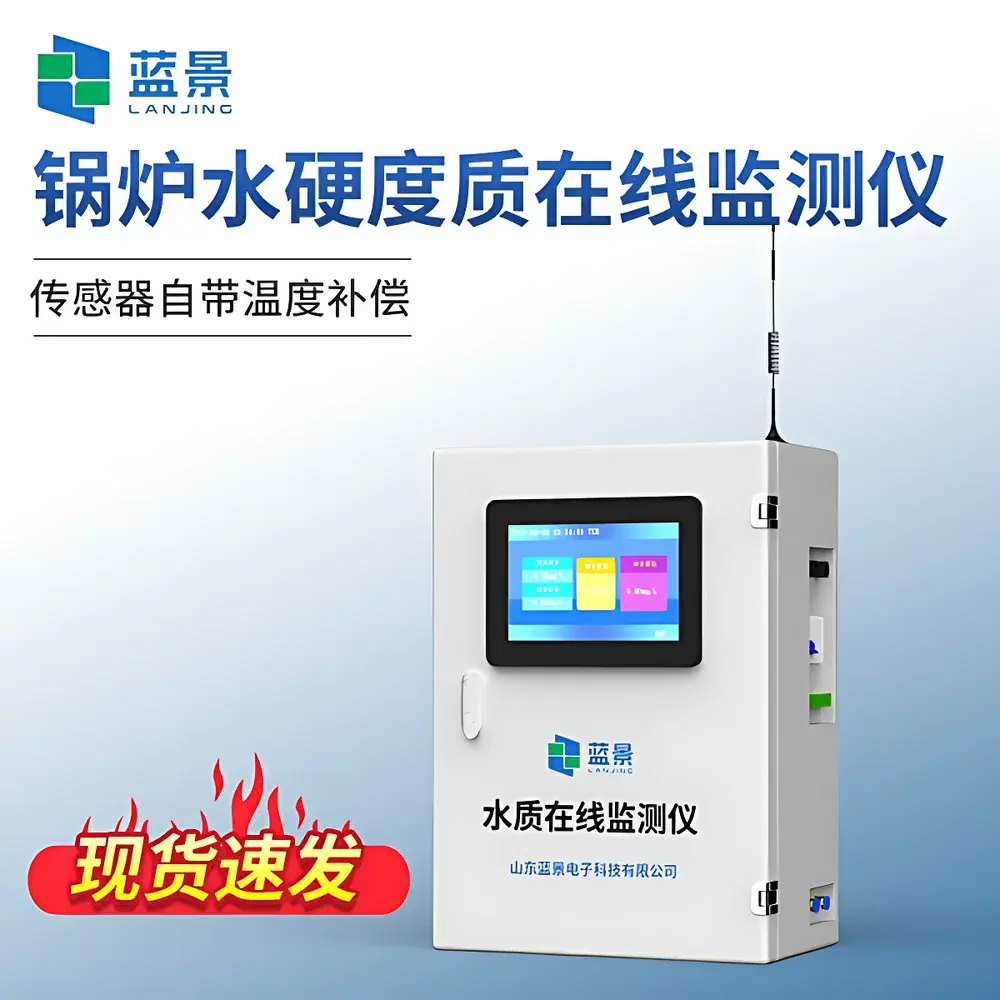
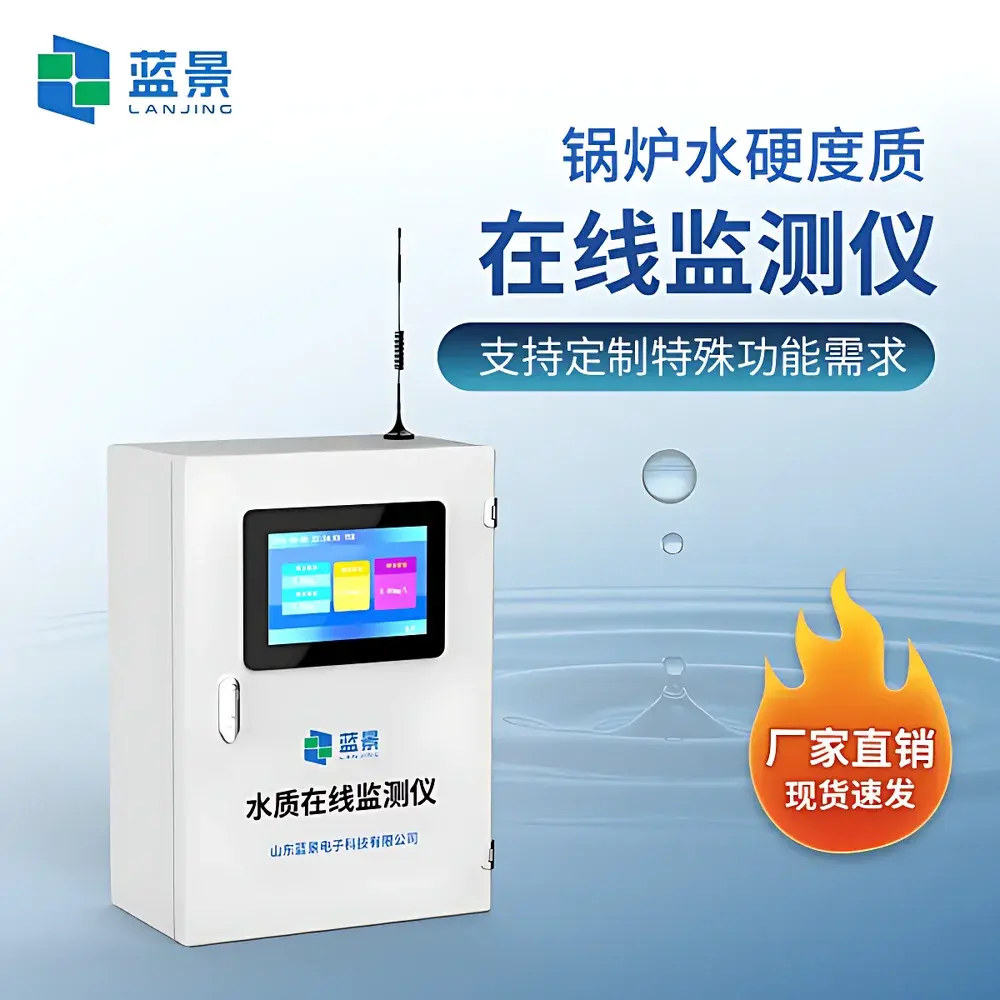
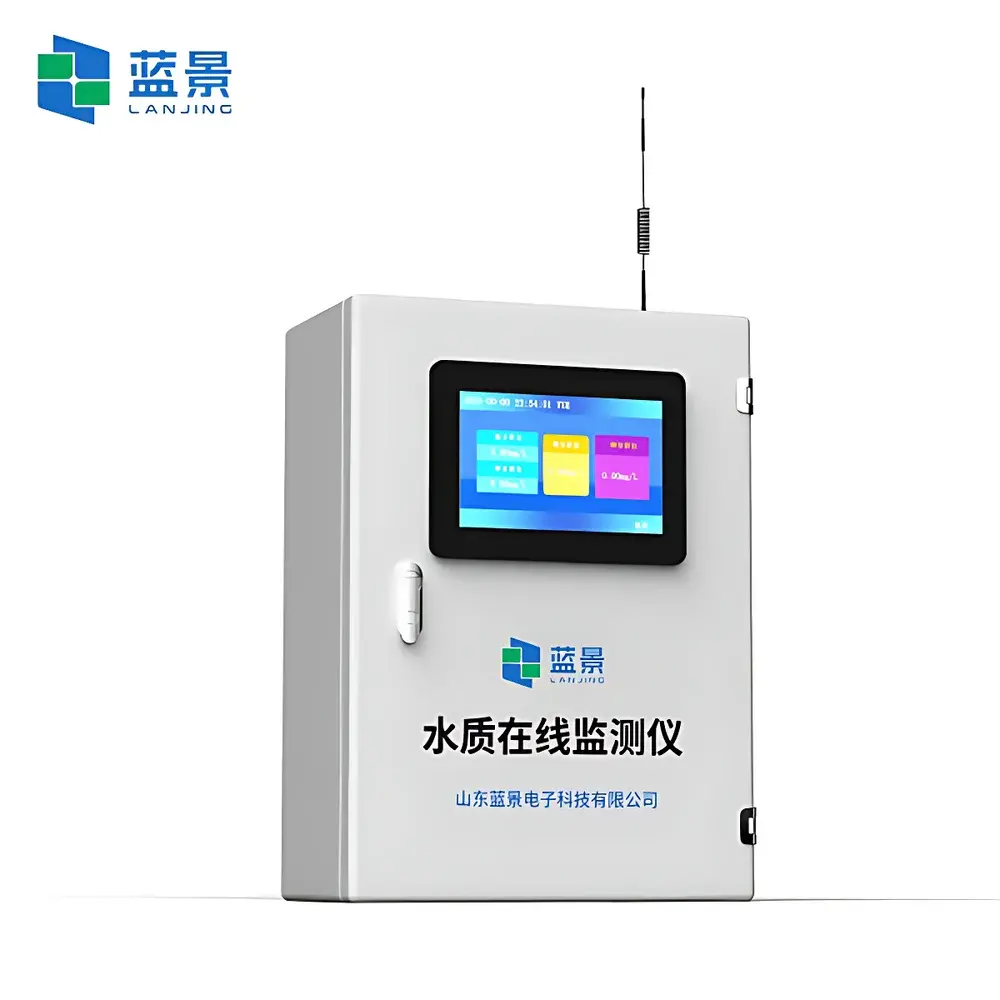
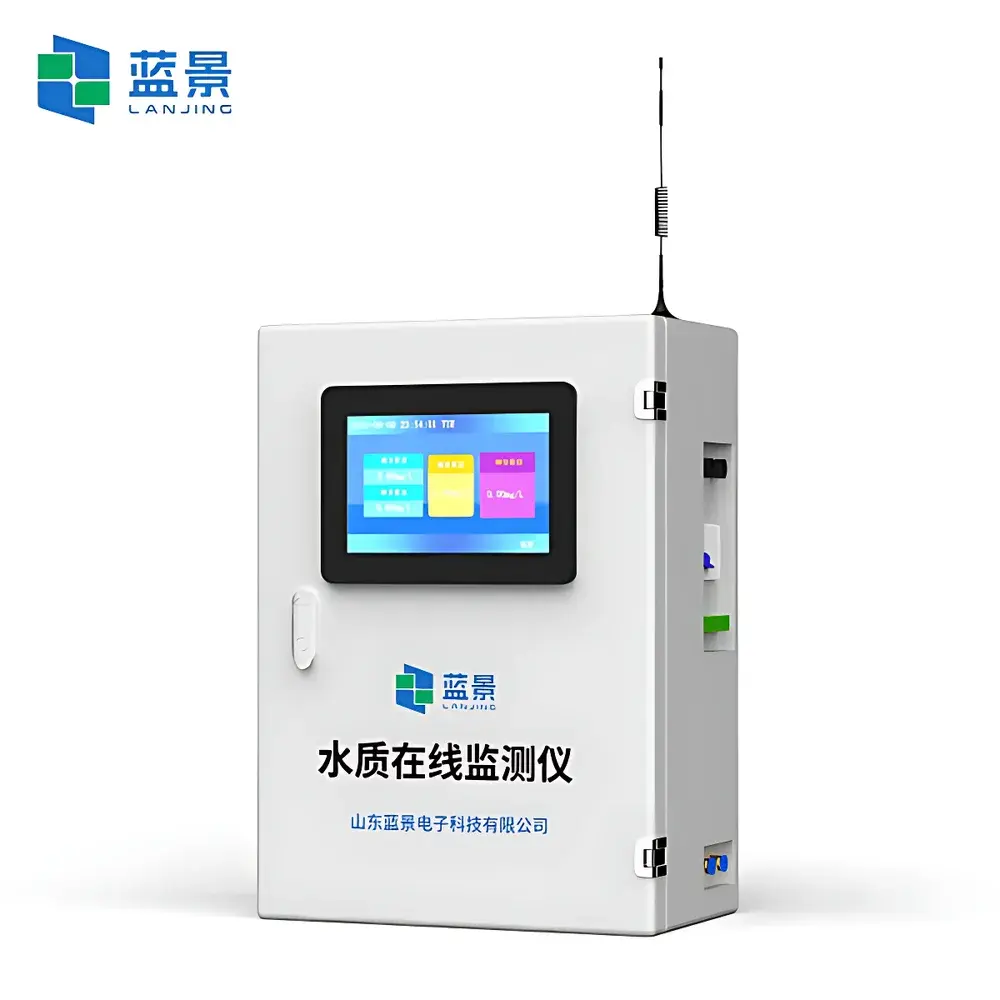
Bluejing LJ-YDZ Online Boiler Water Hardness & Multi-Parameter Water Quality Monitoring System
| Brand | Bluejing |
|---|---|
| Origin | Shandong, China |
| Manufacturer Type | Direct Manufacturer |
| Model | LJ-YDZ |
| Measurement Parameters | Hardness (0.2–40,000 mg/L as CaCO₃), Chloride Ion, pH/Temp, Dissolved Oxygen (DO), Oxidation-Reduction Potential (ORP) |
| Display | 10-inch Color TFT Touchscreen (Bilingual Chinese/English UI) |
| Output Options | 4–20 mA (opto-isolated), RS-485 / RS-232 (Modbus RTU), Relay Alarms (dual SPDT), Optional HART, NB-IoT/GPRS/LoRa |
| Power Supply | AC 220 V ±10% or DC 24 V |
| Power Consumption | ≥5 W |
| Enclosure Rating | IP65 (main cabinet), IP68 (submersible sensors) |
| Operating Temperature | 0–60 °C (non-freezing) |
| Storage Temperature | −10–60 °C |
| Installation Modes | Top-mount, Top-flange, Side-wall, In-line, Immersion, Flow-through |
| Sensor Protection | Integrated optical-electronic filtration, self-cleaning brush, ruggedized protective cap |
| DO Measurement Principle | Fluorescence-based (membrane-covered, electrolyte-free) |
| Temperature Compensation | Built-in NTC sensor per probe |
| Data Refresh Interval | Adjustable down to 1 s |
| Repeatability | ≤1% FS |
| Hardness Accuracy | ±1–2% of calibrated range |
| Dimensions (Cabinet) | 156 × 150 × 85 mm (W×H×D) |
| Panel Cutout | 156 × 94 mm |
| Standard Cable Length | 10 m (customizable) |
Overview
The Bluejing LJ-YDZ Online Boiler Water Hardness & Multi-Parameter Water Quality Monitoring System is an integrated, cabinet-mounted analytical platform engineered for continuous, real-time surveillance of critical water quality parameters in industrial boiler feedwater and closed-loop cooling systems. Unlike conventional single-parameter analyzers, the LJ-YDZ employs a modular architecture that consolidates hardness (as CaCO₃), chloride ion concentration, pH, temperature, dissolved oxygen (DO), and oxidation-reduction potential (ORP) sensing within a single robust enclosure. Its core measurement methodology for DO relies on fluorescence quenching—eliminating the need for consumable electrolytes or membrane replacement—and hardness is determined via selective ion-sensitive electrode technology coupled with digital signal conditioning. All sensors incorporate built-in NTC thermistors for automatic temperature compensation, ensuring stable calibration across dynamic thermal conditions typical of steam generation environments. Designed for deployment in utility rooms, mechanical spaces, or outdoor-rated enclosures, the system meets functional safety requirements for uninterrupted operation under variable pressure and flow regimes—without dependence on sample conditioning or external peristaltic pumping.
Key Features
- 10-inch high-resolution color touchscreen interface with bilingual (English/Chinese) navigation and intuitive configuration menus
- Multi-sensor fusion architecture supporting simultaneous acquisition and display of up to six independent parameters
- Optically filtered fluorescence-based DO sensor—zero electrolyte consumption, no polarization time, minimal drift
- Self-cleaning mechanical brush mechanism integrated into sensor housings to mitigate fouling from suspended solids or scaling deposits
- Dual SPDT relay outputs with user-definable hysteresis (adjustable deadband) to prevent chattering during threshold transitions
- Industrial-grade TI microcontroller unit with EMI-hardened circuitry and watchdog timer ensuring >10-year data retention during power loss
- Galvanically isolated 4–20 mA analog outputs compliant with IEC 61000-4 immunity standards
- RS-485/RS-232 serial interfaces implementing Modbus RTU protocol for seamless integration into SCADA, DCS, or PLC networks
- IP65-rated wall-mount cabinet constructed from corrosion-resistant coated steel; IP68-rated submersible probes suitable for direct pipe insertion or immersion
- Flexible mounting options including top-flange, side-wall, in-line flow cell, and free-hanging immersion configurations
Sample Compatibility & Compliance
The LJ-YDZ is validated for use in low-conductivity, high-purity boiler feedwater (typically 0.1–10 µS/cm), as well as medium-hardness condensate return streams. It complies with fundamental performance expectations outlined in ASTM D1066 (Standard Practice for Sampling Steam), ISO 8502-9 (Corrosion testing — Evaluation of surface cleanliness), and EN 14899:2006 (Water analysis — Guidance on validation of on-line analyzers). While not certified to full IEC 62443 or SIL-2, its hardware design adheres to electromagnetic compatibility (EMC) Class A limits per CISPR 11 and operates reliably in environments governed by ASME B31.1 Power Piping Code requirements. The system supports audit-ready data logging when configured with optional secure storage modules, aligning with GLP-aligned operational practices for traceability and review.
Software & Data Management
Data handling is managed through embedded firmware supporting timestamped internal storage (≥30 days at 1-min intervals) and configurable external export via Modbus registers. No proprietary software is required for basic commissioning—configuration occurs entirely via touchscreen GUI. For enterprise integration, the device exposes standard Modbus function codes (03h, 06h, 10h) enabling read/write access to all measured values, alarm states, calibration logs, and diagnostic flags. Optional cloud connectivity kits support MQTT over NB-IoT/GPRS/LoRa, transmitting encrypted JSON payloads to third-party platforms such as Siemens MindSphere, Azure IoT Hub, or custom LIMS instances. All communication channels are configurable for TLS 1.2 encryption where supported by gateway infrastructure. Audit trails—including parameter changes, calibration events, and relay activations—are retained locally and exportable via USB or serial dump.
Applications
- Real-time monitoring of feedwater hardness to prevent scale formation in drum-type and once-through boilers
- Chloride ion tracking in condensate systems to mitigate stress corrosion cracking (SCC) of austenitic stainless steel components
- DO profiling in deaerator outlet lines to verify oxygen scavenger dosing efficacy and minimize pitting corrosion
- pH and ORP trending for amine treatment control and hydrazine residual verification
- Preventive maintenance triggering based on rate-of-change analysis of hardness drift or DO saturation anomalies
- Regulatory reporting support for EPA Clean Water Act Section 304(h) or local discharge permit compliance dashboards
FAQ
What calibration protocols does the LJ-YDZ support?
The system accepts manual two-point calibration for pH and hardness sensors using NIST-traceable standard solutions. DO calibration is performed via air-saturation or zero-oxygen (sodium sulfite) methods. Calibration history—including date, operator ID, and deviation metrics—is stored internally.
Can the LJ-YDZ operate in high-pressure boiler feed lines?
Yes—the IP68-rated sensors are rated for continuous immersion at pressures up to 10 bar (145 psi). For inline installation, optional high-pressure flow cells with ANSI 150 flanges are available.
Is FDA 21 CFR Part 11 compliance supported?
Out-of-the-box, the LJ-YDZ does not include electronic signature or role-based access control required for Part 11. However, when deployed behind validated middleware (e.g., Emerson DeltaV or Honeywell Experion), it functions as a compliant field device within broader GxP workflows.
How often does the self-cleaning brush activate?
Brush cycle frequency is programmable from 1 minute to 24 hours. Default setting is every 30 minutes during active measurement mode.
Does the system support predictive maintenance diagnostics?
It provides raw sensor diagnostics (impedance, response time, signal noise floor) accessible via Modbus register map. Advanced fault prediction requires integration with external analytics engines using exported time-series data.
Related Products







