
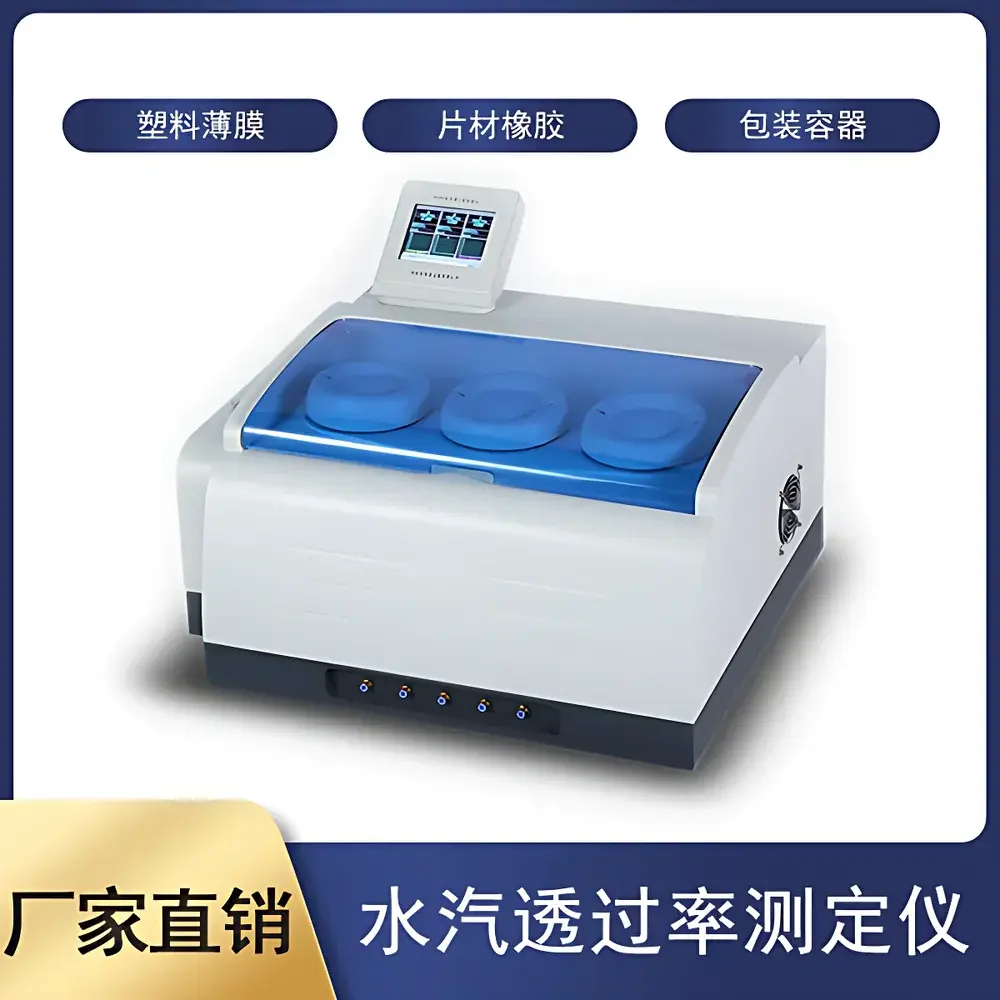
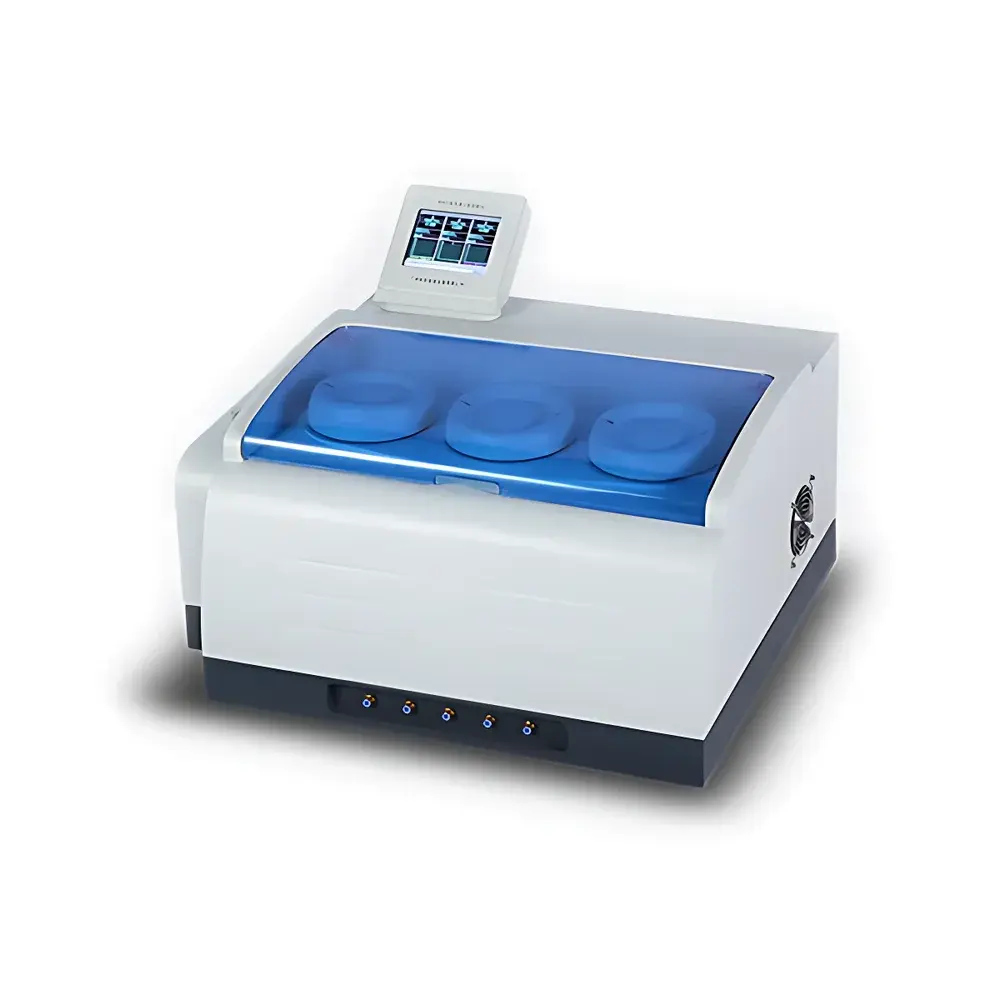
GBPI W405I Water Vapor Transmission Rate (WVTR) Tester
| Brand | GBPI |
|---|---|
| Origin | Guangdong, China |
| Manufacturer Type | Manufacturer |
| Country of Origin | Domestic (China) |
| Model | W405I |
| Pricing | Upon Request |
| Test Range | 0.005–500 g/(m²·24h) |
| Accuracy | 0.001 g/(m²·24h) |
| Temperature Control | 15–45 °C (optional up to 60 °C), ±0.1 °C |
| Humidity Control | 0% RH (dry), 30–90% RH, 100% RH, ±1% RH |
| Permeation Area | 50.24 cm² (down to 0.785 cm² with optional fixtures) |
| Specimen Size | Φ100 mm |
| Max Thickness | ≤3 mm |
| Sample Capacity | 1–3 specimens per test cycle |
| Carrier Gas | ≥99.999% N₂, pressure ≥0.1 MPa, flow rate 5–120 mL/min |
| Dimensions | 610 × 550 × 400 mm |
| Weight | 57.1 kg |
| Power | 1000 W, AC 220 V / 50 Hz (110 V available on request) |
Overview
The GBPI W405I Water Vapor Transmission Rate (WVTR) Tester is a gravimetric–sensor hybrid instrument engineered for precise, traceable, and compliant measurement of water vapor permeation through packaging and functional barrier materials. It operates on the principle of dynamic relative humidity gradient methodology: a conditioned humid gas stream flows over the specimen’s upstream side while dry carrier gas sweeps the downstream side; water molecules permeating across the sample are transported to a high-stability electrolytic moisture sensor, where real-time concentration detection enables calculation of WVTR in g/(m²·24h). This method conforms to core international standards including ASTM F1249–2013 (for modulated IR detection), ISO 15106-2:2005 (infrared detection), JIS K7129:2008, and Chinese pharmacopoeial and national standards GB/T 26253–2010 and YBB 00092003–2015. Designed for R&D laboratories, QC departments, and regulatory-compliant manufacturing sites, the W405I delivers metrologically traceable results suitable for stability studies, shelf-life modeling, and barrier specification validation.
Key Features
- Triple-test-chamber architecture with independent temperature/humidity control and sensor arrays—enables concurrent testing of up to three dissimilar specimens (e.g., film, coated paperboard, and thermoformed cup) with fully autonomous start/stop cycles and individual report generation.
- High-resolution electrolytic moisture sensor with automatic over-range protection and drift compensation algorithms, calibrated using GBW(E)130543/4 certified reference materials issued by China’s National Institute of Metrology—ensuring data traceability to SI units under ISO/IEC 17025 framework.
- ARM-based embedded control system with 7-inch color touchscreen interface—supports standalone operation without external PC; real-time visualization of temperature, RH, sensor signal, and calculated WVTR curves with toggleable overlays and zoom functionality.
- Dual-stream humidity generation system (dry + saturated gas blending) achieves ±1% RH stability across 0–100% RH range; programmable thermal control (±0.1 °C) via electromagnetic stepwise regulation supports accelerated aging protocols and low-humidity barrier evaluation (e.g., aluminum foil laminates).
- Modular fixture system accommodates flat films (Φ100 mm), rigid sheets (≤3 mm), and 3D containers—including PET bottles, aluminum cans, pouches, blister packs, and fiber-based food service ware—using standardized cup-and-cap or vacuum-seal configurations per ASTM F1249 Annex A3.
Sample Compatibility & Compliance
The W405I accepts a broad spectrum of industrial materials: polymer films (BOPP, PET, PE, PVDC, EVOH), metallized substrates (AlOx, SiOx, vacuum-deposited Al), paperboard composites (liquid cartons, pharmaceutical blister lidding), elastomeric tubing (PPR, TPE), battery enclosures, solar backsheet laminates, and medical device packaging (sterile barrier systems, transdermal patches). All testing adheres to Good Manufacturing Practice (GMP) Annex 11 and FDA 21 CFR Part 11 requirements via role-based user authentication, electronic signature enforcement, and full-system audit trails covering method changes, calibration events, raw sensor outputs, and final report exports. Instrument qualification documentation—including IQ/OQ/PQ templates—is provided to support GLP and ISO 13485 environments.
Software & Data Management
The integrated GBPI LabSuite™ software implements ALCOA+ principles (Attributable, Legible, Contemporaneous, Original, Accurate, Complete, Consistent, Enduring, Available). Users log in with tiered credentials (Administrator, Operator, Reviewer, Auditor); each action—parameter modification, baseline execution, or report export—is timestamped and linked to user ID. All raw sensor voltage traces, environmental logs, and intermediate calculations are stored in encrypted SQLite databases with configurable retention policies. Reports comply with ICH M4 Q5 and USP formatting guidelines and export natively to PDF/A-2, Excel (.xlsx), and CSV formats—retaining metadata such as operator name, instrument serial number, standard material lot, and uncertainty budget per GUM (JCGM 100:2008).
Applications
- Pharmaceutical packaging: Quantifying WVTR of HDPE bottles, PVC/PVDC blisters, and cold-form foil for moisture-sensitive APIs (e.g., lyophilized biologics, hygroscopic small molecules).
- Food & beverage: Validating barrier integrity of retort pouches, microwave trays, and single-serve coffee capsules against ISO 15106-2-defined failure thresholds.
- Electronics encapsulation: Measuring moisture ingress through conformal coatings and battery housing polymers to predict corrosion onset per IPC-CC-830B.
- Medical devices: Assessing water vapor transmission through wound dressings, IV bag films, and surgical drape laminates per ISO 11607-1:2019 Annex D.
- Renewable energy: Characterizing edge-seal durability and backsheet delamination risk in photovoltaic modules under damp heat (IEC 61215-2 MQT 10.1).
FAQ
What calibration standards are supported?
The W405I is validated using GBW(E)130543/4 certified water vapor permeation reference films—traceable to China’s National Primary Standard for Moisture Permeation—and supports user-performed daily verification per ASTM F1249 Section 9.2.
Can the instrument test non-planar samples without custom fixtures?
Standard configuration includes flat-film holders only; container testing (bottles, cups, pouches) requires optional accessories (GBPI-CF series) sold separately—each validated per ASTM F1249 Annex A3 geometry tolerances.
Is nitrogen supply mandatory?
Yes—high-purity (≥99.999%) nitrogen is required as carrier gas to ensure sensor linearity and eliminate interference from ambient oxygen or hydrocarbons; compressed air or synthetic air is not acceptable.
How is data integrity maintained during power interruption?
Embedded non-volatile memory retains all active test parameters, sensor history, and environmental logs; upon restart, the system resumes acquisition from last valid timestamp without data loss.
Does the software support LIMS integration?
Yes—via configurable ODBC drivers and HL7-compliant API endpoints; full schema documentation and TLS 1.2–secured RESTful interfaces are included in the Enterprise License package.
Related Products







