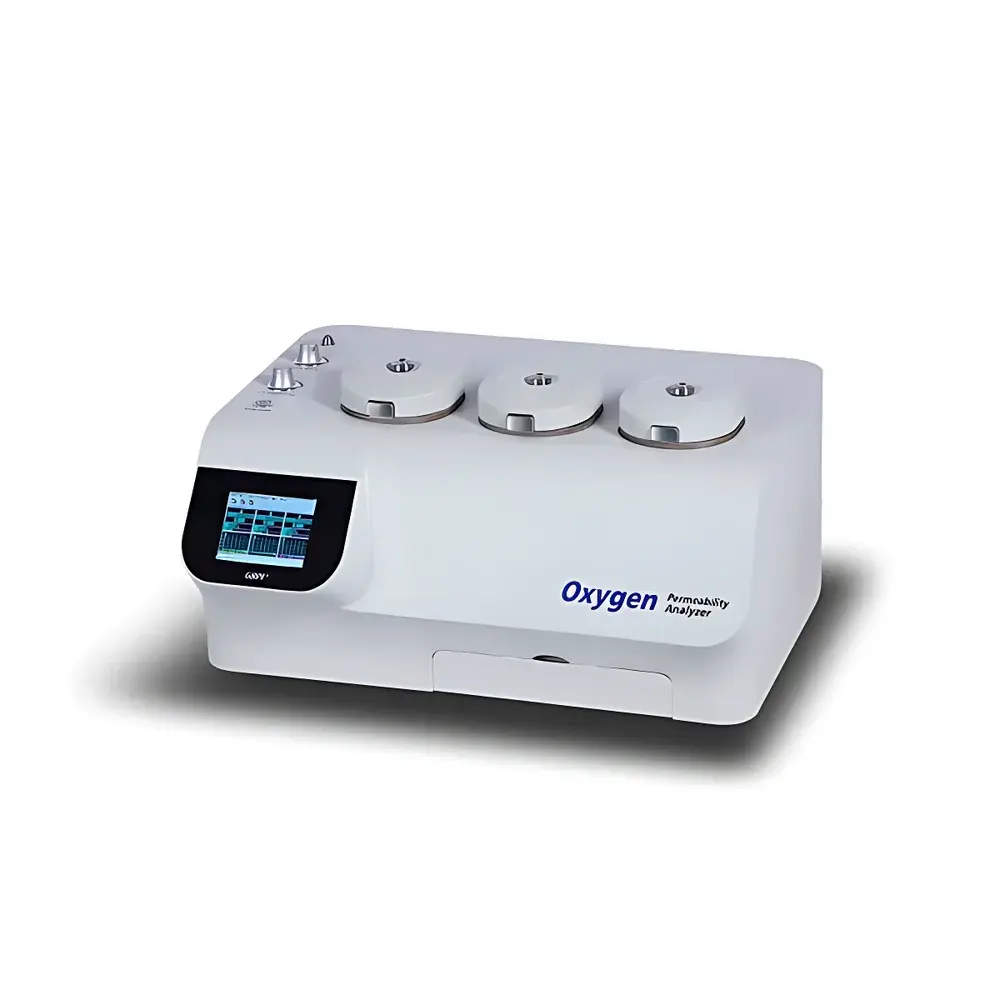
GBPI Y310-B2 Coulometric Oxygen Transmission Rate Analyzer
| Brand | GBPI |
|---|---|
| Origin | Guangdong, China |
| Manufacturer Type | Original Equipment Manufacturer (OEM) |
| Region of Manufacture | Domestic (China) |
| Model | Y310-B2 |
| Price Range | USD 14,000 – 70,000 |
Overview
The GBPI Y310-B2 Coulometric Oxygen Transmission Rate (OTR) Analyzer is a precision laboratory instrument engineered for the quantitative determination of oxygen permeation through polymeric films, laminates, rigid sheets, and packaging containers. It operates on the principle of coulometric detection—where oxygen molecules diffusing across a test specimen are quantitatively reduced at a cathode in an electrochemical cell, generating a current directly proportional to the molar flux of O₂. This method delivers high sensitivity, long-term stability, and trace-level resolution without reliance on optical or paramagnetic sensing. Designed for compliance with global regulatory and quality assurance frameworks, the Y310-B2 supports routine QC testing in pharmaceutical packaging development, food shelf-life prediction, medical device barrier validation, and advanced material R&D—particularly where ultra-low OTR values (e.g., aluminum foil, SiOₓ-coated PET, or multilayer barrier films) demand sub-0.01 cm³/(m²·24h) measurement fidelity.
Key Features
- Coulometric sensor architecture with imported high-stability electrochemical O₂ detector; auto-range protection prevents sensor saturation during high-flux testing.
- Triple-test chamber configuration: three independent, thermally isolated cells enable concurrent evaluation of heterogeneous samples—each with autonomous start/stop, data logging, and report generation.
- Advanced environmental control: programmable temperature regulation (15–45 °C standard; 5–50 °C optional) with ±0.1 °C stability; dual-stream humidity control (0% RH dry gas + saturated wet gas) delivering ±1% RH accuracy across 30–90% RH range.
- ARM-based embedded controller enables stand-alone operation—no PC required for basic test execution, calibration, or real-time curve monitoring.
- Full GMP-compliant software architecture aligned with FDA 21 CFR Part 11 and EU Annex 11 requirements: role-based user access (Administrator, Operator, Reviewer), full audit trail (system, method, and run-level), electronic signatures, and immutable data archiving.
- Automated calibration workflow supporting both certified reference films (e.g., 125 μm standard membrane) and NIST-traceable O₂/N₂ gas mixtures—calibration data entered via GUI triggers automatic slope/intercept recalculation.
Sample Compatibility & Compliance
The Y310-B2 accommodates flat specimens up to Φ100 mm and ≤3 mm thickness—including monolayer plastics (LDPE, PP), metallized films (AlOx, SiOx), paperboard laminates, rubber elastomers, ceramic substrates, and rigid packaging forms (bottles, trays, pouches) when used with optional permeation fixtures. Its extended-range mask accessory extends measurable OTR from 0.02–16,500 cm³/(m²·24h) to 260,000 cm³/(m²·24h), enabling characterization of highly permeable materials such as non-woven fabrics or hydrogel membranes. The system conforms to 12 international standards including ASTM D3985 (coulometric), ASTM F1927 (container), ISO 15105-2, GB/T 19789-2005, YBB00082003-2015 (Chinese pharmaceutical packaging), and DIN 53380-3—ensuring data portability across multinational supply chains and regulatory submissions.
Software & Data Management
The Windows-based GBPI OTR Studio v4.x provides intuitive workflow configuration, real-time visualization of OTR, O₂ concentration, temperature, and RH trends—with zoom, pan, overlay, and curve-hiding functions. All raw and processed data reside in an encrypted local SQL database with timestamped versioning. Reports comply with GLP/GMP documentation requirements: auto-generated PDF/Office exports include instrument ID, operator ID, calibration history, environmental logs, statistical summaries (mean, SD, CV%), and digital signature fields. Audit trails record every action—including parameter edits, result overrides, and user logins—with hash-verified integrity and exportable CSV metadata for third-party review.
Applications
- Pharmaceutical packaging validation per USP , EP 3.2.1, and ICH Q5C—assessing blister foil integrity and sachet laminate performance under accelerated aging conditions.
- Food packaging shelf-life modeling: correlating OTR with lipid oxidation kinetics in snack bags, coffee pouches, and dairy trays.
- Medical device packaging qualification (ISO 11607-1): evaluating Tyvek®/PET/Al barrier systems for sterile barrier integrity.
- R&D of next-generation barrier coatings: quantifying OTR reduction after ALD, plasma polymerization, or nanocellulose lamination.
- Electronics encapsulation: measuring moisture/O₂ ingress into OLED display backplanes and flexible battery laminates.
FAQ
What gas supply requirements does the Y310-B2 have?
High-purity carrier gases are mandatory: ≥99.999% O₂ (for calibration) and ≥99.999% N₂ (for purge and zero baseline). Both require stainless-steel regulators with 0–0.4 MPa output and 1/8″ NPT inlet fittings.
Is the instrument compliant with FDA 21 CFR Part 11?
Yes—the software implements full electronic signature enforcement, audit trail retention (≥10 years), role-based permissions, and data immutability per Part 11 Subpart B specifications.
Can it test rigid containers like bottles or cups?
Yes, using optional container fixtures (sold separately) that seal against the specimen’s opening while maintaining controlled T/RH inside the headspace.
How often must the coulometric sensor be calibrated?
Initial calibration is performed at installation using certified reference films or gases; subsequent recalibration is recommended before each critical test series or after sensor exposure to >100,000 cm³/(m²·24h) OTR environments.
Does the system support IQ/OQ/PQ documentation?
Comprehensive qualification protocols—including Installation Qualification (IQ), Operational Qualification (OQ), and Performance Qualification (PQ) templates—are provided with the instrument and align with ISO/IEC 17025 and ASTM E2500 guidance.