
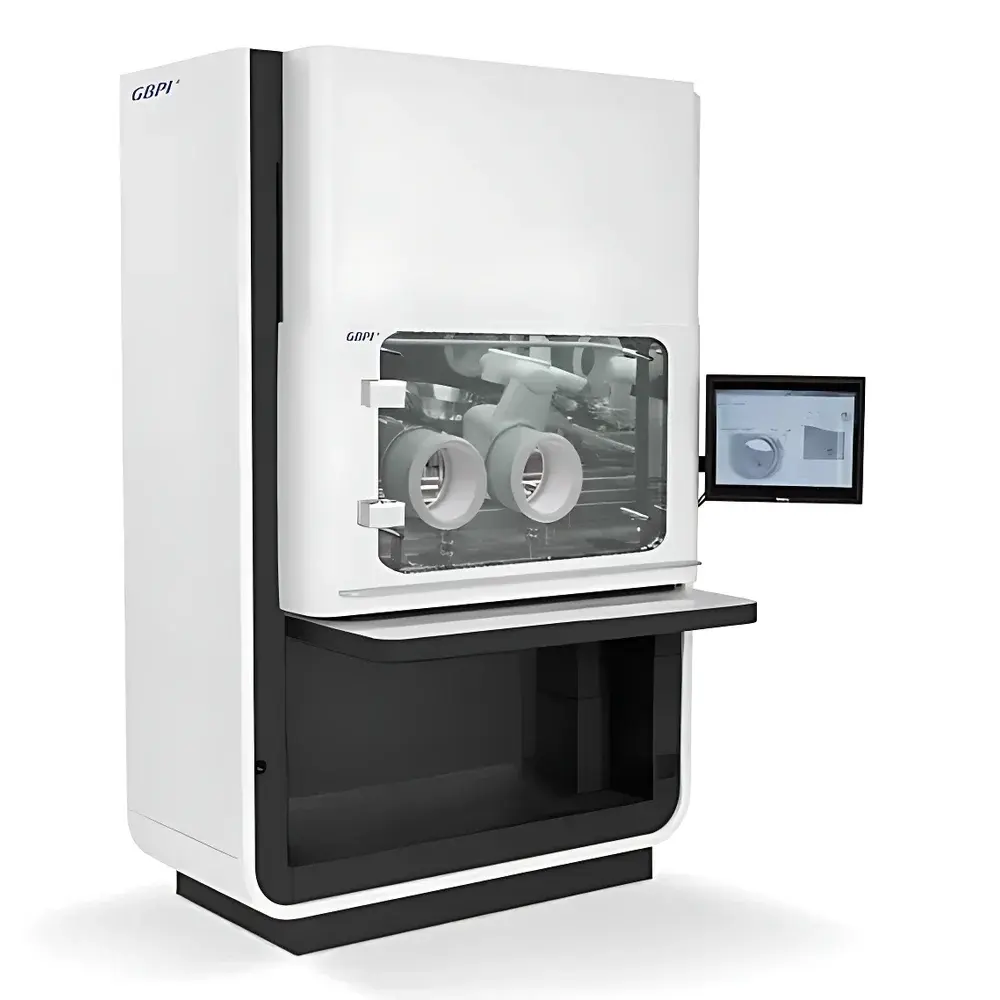
GBPI GB-XF1000AG Bacterial Filtration Efficiency (BFE) Tester for Meltblown Nonwovens
| Brand | GBPI |
|---|---|
| Origin | Guangdong, China |
| Manufacturer Type | Direct Manufacturer |
| Country of Origin | China |
| Model | GB-XF1000AG |
| Price Range | USD 42,000 – 70,000 |
| Sampling Flow Rate | 28.3 L/min ±2.5% |
| Aerosol Generation Flow Rate | 8–10 L/min ±2.5% |
| Peristaltic Pump Flow Range | 0.006–3.0 mL/min ±2.5% |
| Pre-Flowmeter Pressure (Sampling) | −20 to 0 kPa ±2.5% |
| Pre-Flowmeter Pressure (Aerosol) | 0–300 kPa ±2.5% |
| Ambient Temperature Range | −40 to 99 °C ±2.5% |
| Aerosol Chamber Negative Pressure | −90 to −120 Pa ±2.0% |
| Cabinet Negative Pressure | −50 to −200 Pa |
| Data Storage Capacity | >100,000 test records |
| Vortex Mixer | 8 × Φ16×150 mm tubes |
| HEPA Filter Efficiency | ≥99.99% for particles ≥0.3 µm |
| Aerosol Mass Median Diameter (MMD) | 3.0 ± 0.3 µm, GSD ≤1.5 |
| Andersen Cascade Impactor Stages | Stage I >7 µm, II: 4.7–7 µm, III: 3.3–4.7 µm, IV: 2.1–3.3 µm, V: 1.1–2.1 µm, VI: 0.6–1.1 µm |
| Aerosol Chamber Dimensions | 600 × 85 × 30 mm (L×Ø×T) |
| Positive Control Target | 2200 ± 500 CFU |
| Negative Pressure Cabinet Airflow | ≥5 m³/min |
| Cabinet Dimensions (W×D×H) | 755 × 400 × 990 mm |
| Main Unit Dimensions (W×D×H) | 1200 × 630 × 2100 mm |
| Noise Level | <65 dB(A) |
| Net Weight | ~150 kg |
| Power Supply | AC 220 V ±10%, 50 Hz |
| Power Consumption | <1500 W |
Overview
The GBPI GB-XF1000AG Bacterial Filtration Efficiency (BFE) Tester is a purpose-built, ISO/IEC 17025-aligned instrument engineered for quantitative assessment of microbial aerosol retention performance in meltblown nonwoven fabrics—particularly those used in surgical masks, N95 respirators, and other medical face coverings. It operates on the principle of controlled bioaerosol challenge and dual-path parallel sampling, where standardized Staphylococcus aureus (ATCC 6538) aerosols are generated at a defined mass median aerodynamic diameter (MMAD) of 3.0 ± 0.3 µm and geometric standard deviation (GSD) ≤1.5. The test sample is mounted between two identical, calibrated impaction pathways: one upstream (challenge side) and one downstream (filtrate side), each feeding into an integrated six-stage Andersen cascade impactor. Colony-forming units (CFUs) recovered from agar plates across all stages are enumerated after incubation, enabling precise calculation of BFE (%) as: [(CFUupstream − CFUdownstream) / CFUupstream] × 100. This methodology ensures traceable, reproducible results compliant with YY 0469–2004, YY/T 0969–2013, ASTM F2101–19, ASTM F2100–22, and EN 14683:2019.
Key Features
- Class II biosafety-compliant negative-pressure cabinet with continuous airflow ≥5 m³/min and real-time pressure monitoring (−50 to −200 Pa), minimizing operator exposure during aerosol handling.
- Dual independent flow control systems: precision peristaltic pump (0.006–3.0 mL/min, resolution 0.001 mL/min) for liquid suspension delivery and high-stability aerosol generator (8–10 L/min) with adjustable nozzle pressure (0–300 kPa).
- Integrated six-stage Andersen impactor with validated cut-point fidelity—Stage I (>7 µm) through Stage VI (0.6–1.1 µm)—enabling granular particle-size-resolved collection and filtration efficiency profiling.
- Embedded industrial-grade microcomputer with 10.4-inch high-brightness capacitive touchscreen interface, supporting real-time parameter logging, alarm thresholds, and audit-ready event timestamps.
- Onboard vortex mixer (8-position, Φ16×150 mm tube capacity) and HEPA-filtered internal lighting for consistent sample preparation and visual inspection under controlled conditions.
- Comprehensive safety architecture: front-mounted switchable tempered glass access door, built-in RCD (residual-current device), fire-retardant insulation between cabinet layers, and acoustic noise suppression (<65 dB(A)).
Sample Compatibility & Compliance
The GB-XF1000AG accommodates flat-sheet specimens up to 100 mm × 100 mm (standard test area per YY 0469), including polypropylene meltblown media, electrospun nanofibers, and laminated composites. All fluidic and aerosol pathways are constructed from corrosion-resistant stainless steel and borosilicate glass to prevent biofilm formation or chemical interference. Instrument calibration is traceable to NIST-certified flow meters and pressure transducers; routine verification includes positive control challenge (2200 ± 500 CFU) and system blank checks. The platform supports full compliance documentation packages required for GLP-regulated laboratories and FDA 21 CFR Part 11–enabled environments when paired with optional secure user authentication and electronic signature modules.
Software & Data Management
Firmware v3.2+ delivers native CSV export via USB 2.0 port, supporting direct transfer to LIMS or statistical analysis platforms (e.g., JMP, Minitab). Each test record stores full metadata—including ambient temperature/humidity, pre- and post-flow pressures, aerosol generation parameters, impactor stage CFU counts, calculated BFE, and operator ID—encrypted and time-stamped with UTC synchronization. Audit trails capture all parameter modifications, user logins, and report generations. Data retention exceeds 100,000 complete test cycles without degradation; automatic backup to external storage is configurable at user-defined intervals. Optional software add-ons provide automated pass/fail decision logic per EN 14683 Type I/II/IIIR thresholds and multi-lot comparative trending reports.
Applications
- Quality control of meltblown web production lines—monitoring fiber fineness, charge stability, and basis weight effects on BFE.
- Regulatory submission testing for CE marking (EN 14683), FDA 510(k), and NMPA registration dossiers.
- R&D evaluation of novel antimicrobial coatings, plasma-treated surfaces, or hybrid filtration architectures.
- Method validation and inter-laboratory comparison studies under ISO/IEC 17043 proficiency testing schemes.
- Training and certification of personnel in ISO 18184 and ASTM E2149 antimicrobial efficacy protocols (when adapted with viral surrogates).
FAQ
What biological agent is used for BFE testing, and is substitution permitted?
Staphylococcus aureus ATCC 6538 is the reference organism specified in YY 0469, ASTM F2101, and EN 14683. Substitution requires full re-validation per ISO 17025 Clause 7.2.2 and documented equivalence demonstration.
Can the instrument perform viral filtration efficiency (VFE) testing?
Not natively. VFE requires MS2 bacteriophage or Phi6 aerosolization under BSL-2 containment and separate biosafety certification. The GB-XF1000AG’s fluidic design and cabinet integrity support such adaptation only after third-party risk assessment and engineering modification.
Is the Andersen impactor calibrated per ISO 14644-3?
Yes—each impactor undergoes annual calibration using polystyrene latex (PSL) spheres and aerodynamic diameter verification via cascade impactor intercomparison per ISO 21501-4 Annex D.
How is data integrity ensured for regulatory audits?
All raw sensor outputs, manual entries, and calculation logs are immutably stored with SHA-256 hashing. User roles (Admin/Operator/Reviewer) enforce separation of duties; electronic signatures comply with FDA 21 CFR Part 11 Subpart B requirements when enabled.
What maintenance intervals are recommended for HEPA filters and aerosol nozzles?
HEPA filters require replacement every 12 months or after 2000 operational hours; aerosol nozzles must be ultrasonically cleaned and flow-verified quarterly using certified reference standards.





