
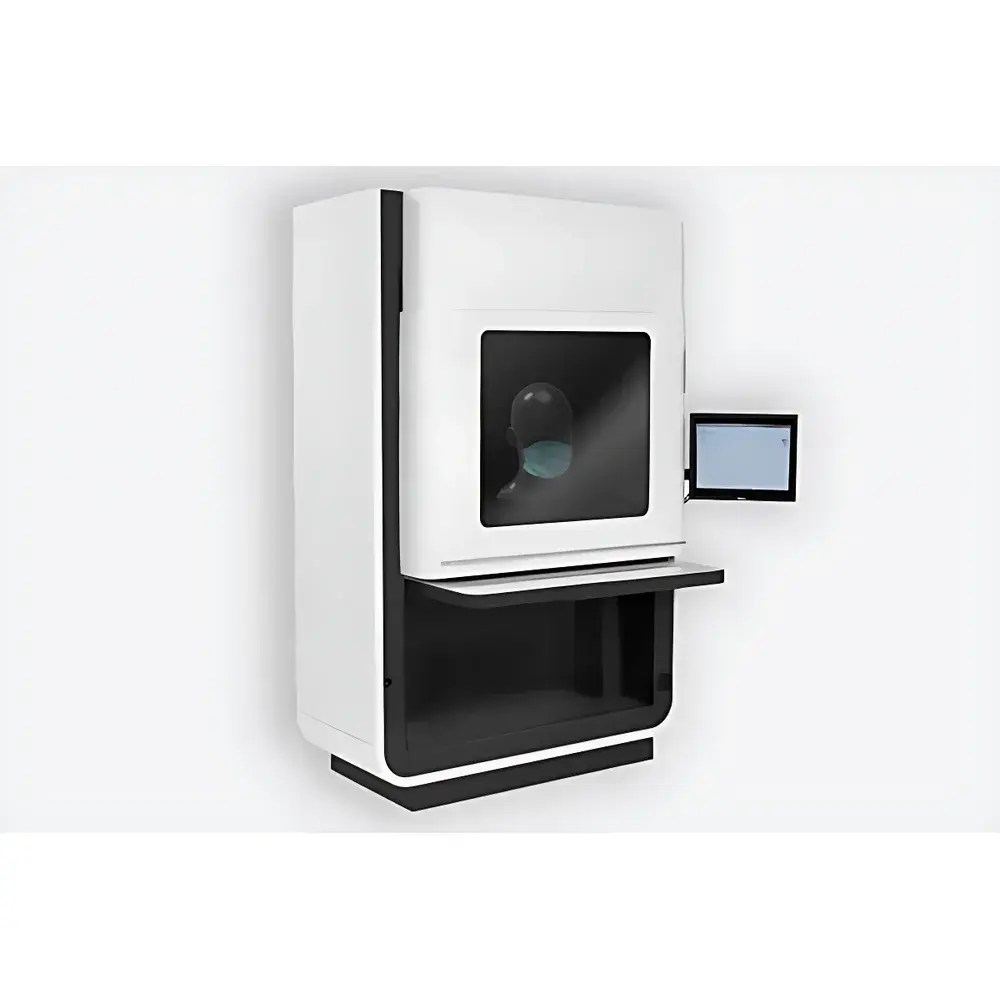
GBPI GB-KF1000A Medical Face Mask Particle Filtration Efficiency Tester
| Brand | GBPI |
|---|---|
| Origin | Guangdong, China |
| Manufacturer Type | OEM/ODM Manufacturer |
| Country of Origin | China |
| Model | GB-KF1000A |
| Instrument Type | Optical Aerosol Photometer-Based Filtration Efficiency Tester |
| Detection Principle | Real-Time Dual-Aerosol (NaCl & Paraffin Oil) Photometric Measurement |
| Compliance Standards | GB/T 6165–2008, GB 2626–2006, GB/T 32610–2016 |
| Sample Volume | 500 L Self-Cleaning Test Chamber |
| Aerosol Generation | Controlled NaCl (MMAD 0.6 µm, 25 mg/m³) and Paraffin Oil (MMAD 0.3 µm, 25 mg/m³) |
| Flow Control | 0.5–1.5 L/min (±2.5% accuracy) |
| Pressure Drop Range | 0–1500 Pa (±1% full scale) |
| Respiratory Simulation | Sinusoidal waveform, 20 breaths/min, 1.5 L tidal volume |
| Data Output | USB export & embedded thermal printer |
| Laser Source Lifetime | >10,000 h |
| PMT Detector | High-sensitivity photomultiplier tube |
| Filter Monitoring | Automatic HEPA usage tracking & cleaning alerts for optical path |
Overview
The GBPI GB-KF1000A Medical Face Mask Particle Filtration Efficiency Tester is an integrated, standards-compliant instrumentation platform engineered for precise quantification of filtration performance and breathing resistance of medical and industrial respiratory protective devices. It operates on the principle of real-time photometric aerosol concentration comparison—measuring upstream (challenge) and downstream (penetrated) particle mass concentrations using calibrated optical photometers equipped with long-life laser diodes and high-gain photomultiplier tubes (PMTs). The system introduces two standardized test aerosols—sodium chloride (NaCl) with a mass median aerodynamic diameter (MMAD) of 0.6 µm and paraffin oil with MMAD 0.3 µm—at a controlled concentration of 25 mg/m³ ±10% into a 500 L self-cleaning test chamber housing a certified anthropomorphic headform. Simulated respiration follows a sinusoidal waveform (20 cycles/min, 1.5 L tidal volume), enabling dynamic assessment of both mechanical filtration efficiency and airflow resistance under physiologically relevant conditions. Designed in strict alignment with Chinese national standards GB/T 6165–2008 (efficiency and resistance testing of high-efficiency air filters), GB 2626–2006 (self-contained filtering respirators), and GB/T 32610–2016 (daily-use protective masks), the GB-KF1000A supports regulatory verification, R&D validation, and quality control workflows in mask manufacturing, certification laboratories, and public health institutions.
Key Features
- Integrated dual-function architecture: simultaneous particle filtration efficiency and inhalation/exhalation resistance measurement per GB 2626–2006 Annex B and GB/T 32610–2016 Clause 6.3.
- 500 L stainless-steel self-cleaning test chamber with automated purge cycle (1–2 min), glove ports for operator-safe mask mounting, and leak-tight sealing verified to <0.5% volumetric loss per ISO 14644-3 protocols.
- Modular headform interface supporting three standardized head sizes (small, medium, large) per GB/T 2626–2006 Annex A; quick-connect design enables tool-free replacement and alignment verification.
- Programmable aerosol generation control: independent regulation of NaCl and paraffin oil aerosol output via external generators, with real-time feedback loop maintaining target concentration stability within ±10%.
- High-fidelity respiratory simulation: digitally synthesized sinusoidal airflow profile synchronized with photometric sampling at 10 Hz resolution, ensuring temporal correlation between flow dynamics and particle penetration events.
- Optical subsystem diagnostics: automatic laser source runtime logging, PMT gain calibration history, and scheduled maintenance prompts for optical window cleaning and HEPA filter replacement based on cumulative operating hours and pressure differential trends.
- Human-centric HMI: 10.1-inch capacitive touchscreen with graphical real-time display of flow curve, upstream/downstream concentration traces, calculated filtration efficiency (%), and pressure drop (Pa) — all compliant with IEC 61000-4-3 EMC requirements.
Sample Compatibility & Compliance
The GB-KF1000A accommodates flat-fold, cup-shaped, and valved medical/surgical masks, KN95/N95-equivalent respirators, and reusable cloth-based barriers conforming to dimensional constraints defined in GB/T 32610–2016 Figure 1 and GB 2626–2006 Section 5.2. All test configurations maintain facial seal integrity through adjustable headform mounting fixtures and standardized strap tensioning procedures. The instrument satisfies metrological traceability requirements outlined in JJF 1001–2011 (General Terminology and Definitions for Metrology) and supports audit-ready documentation for GLP-compliant laboratories. While not FDA 510(k)-cleared as a medical device itself, its test methodology aligns with ISO 16900-1:2015 (Respiratory protective devices — Methods of test — Part 1: Determination of filtration efficiency) and serves as a primary reference method for domestic type-testing under CNAS accreditation scopes (e.g., CNAS-CL01:2018).
Software & Data Management
Embedded firmware (v3.2+) provides full test sequence automation—including chamber preconditioning, aerosol stabilization, respiratory cycle initiation, and post-test purge—without external PC dependency. All raw photometric signals, flow sensor outputs, and time-stamped metadata are stored internally with microsecond-level timestamp resolution. Data export is supported via USB 2.0 mass storage mode (CSV/Excel-compatible format), including calculated metrics: total filtration efficiency (salt/oil), arithmetic mean efficiency across 10 respiratory cycles, peak inspiratory/exhalatory resistance, and coefficient of variation (CV%) for repeatability assessment. The system maintains a tamper-evident audit trail log recording operator ID (via optional RFID badge integration), test start/end timestamps, calibration status flags, and environmental parameters (chamber temperature/humidity if externally interfaced). Optional software module GBPI-QMS Link enables secure network upload to LIMS environments and supports 21 CFR Part 11-compliant electronic signatures when deployed with validated Windows-based client applications.
Applications
- Regulatory compliance testing for Class II medical masks under China NMPA requirements (YY 0469–2011, YY/T 0969–2013).
- Pre-market validation of novel filter media (electret meltblown, nanofiber composites, graphene-enhanced layers) against standardized challenge aerosols.
- Batch release testing in GMP-certified production facilities, with pass/fail criteria configurable per internal SOPs or customer specifications.
- Comparative analysis of aging effects (thermal, humidity, UV exposure) on filtration performance decay kinetics.
- Training and proficiency testing for national PPE inspection agencies and third-party certification bodies (e.g., CMA-accredited labs).
- Research into face seal leakage contributions via controlled gap introduction experiments using calibrated orifice inserts.
FAQ
Does the GB-KF1000A comply with international standards such as ISO 16900 or EN 149?
It implements core photometric measurement principles aligned with ISO 16900-1:2015 and EN 149:2001+A1:2009 Annex B, though formal conformity assessment requires lab-specific validation per ISO/IEC 17025:2017.
Can the instrument be used for testing respirators with exhalation valves?
Yes—valve functionality is preserved during testing; downstream sampling occurs distal to the valve outlet to assess total inward leakage (TIL) per GB 2626–2006 Clause 6.4.
Is external aerosol generation mandatory?
Yes—the GB-KF1000A controls but does not generate aerosols internally; it interfaces with standard TSI 3475/3485 or Palas MFP-3000 series generators via analog/digital I/O.
What maintenance intervals are recommended for optical components?
Laser source and PMT require no routine recalibration; optical windows should be cleaned every 50 operational hours or after 100 test cycles, as prompted by the built-in maintenance scheduler.
How is data integrity ensured during power interruption?
All active measurements are buffered in non-volatile RAM; upon recovery, the system resumes logging from last valid timestamp without data loss.



