
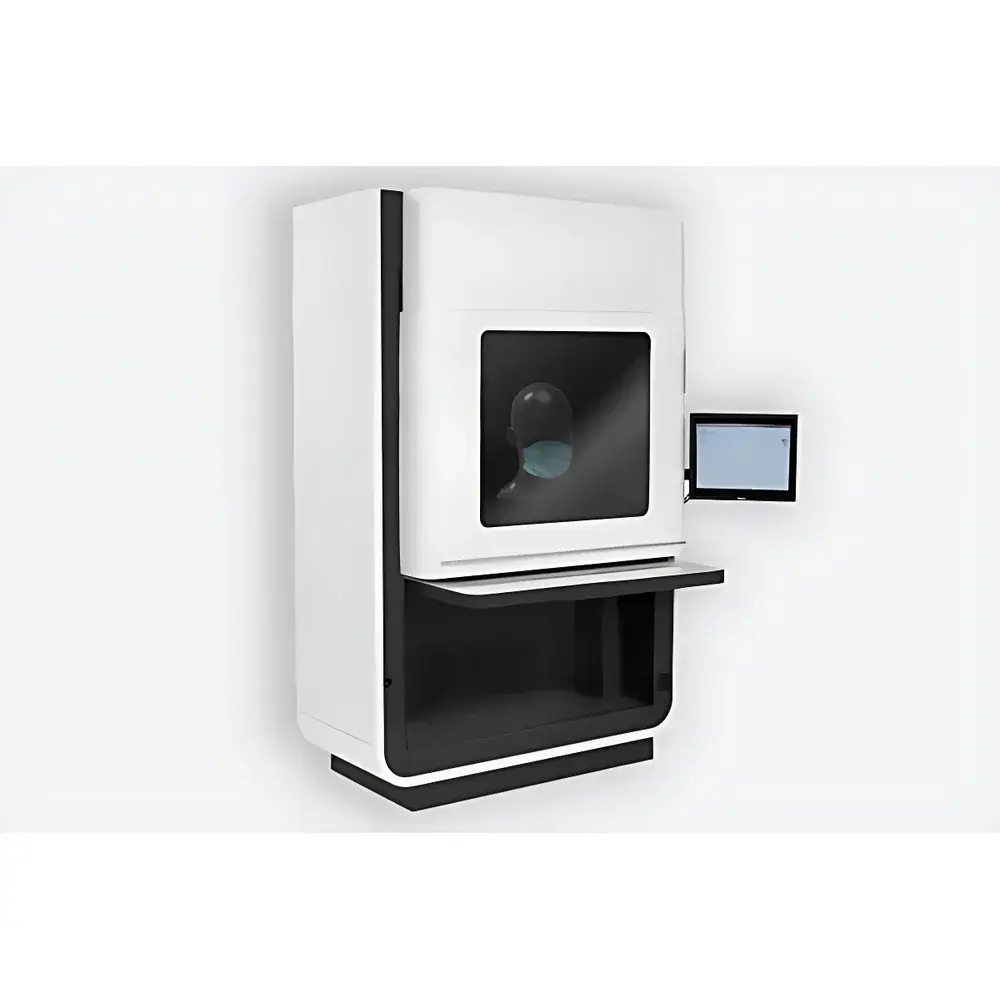
GBPI GB-KF1000 Optical Particle Counter for Respirator Filtration Efficiency Testing
| Brand | GBPI |
|---|---|
| Origin | Guangdong, China |
| Manufacturer Type | Direct Manufacturer |
| Regional Classification | Domestic (China) |
| Model | GB-KF1000 |
| Instrument Category | Optical Particle Counter |
| Price Range | USD 14,000 – 42,000 (FOB Guangdong) |
| Compliance Standards | GB/T 6165–2008, GB 2626–2006, GB/T 32610–2016 |
Overview
The GBPI GB-KF1000 Optical Particle Counter for Respirator Filtration Efficiency Testing is a fully integrated, regulatory-compliant instrumentation platform engineered for quantitative assessment of particulate filtration performance in respiratory protective devices—including medical masks, surgical masks, N95/N99 respirators, and daily-use protective face coverings. It operates on the principle of real-time optical light-scattering photometry to measure upstream and downstream aerosol concentrations across a defined test chamber, enabling calculation of particle filtration efficiency (PFE) under standardized breathing simulation conditions. The system conforms to core Chinese national standards governing respirator evaluation: GB/T 6165–2008 (test methods for high-efficiency air filters), GB 2626–2006 (self-contained, filter-type particle respirators), and GB/T 32610–2016 (technical specifications for everyday protective masks). Its 500 L self-cleaning test chamber houses a standardized headform that replicates human anthropometry and respiratory dynamics via programmable sinusoidal breathing—ensuring physiologically relevant exposure profiles during challenge testing.
Key Features
- Integrated dual-function architecture: simultaneous measurement of filtration efficiency and inhalation/exhalation resistance in a single instrument cycle.
- Self-contained 500 L stainless-steel test chamber with automated decontamination cycle (1–2 min), equipped with glove ports for operator-safe mask installation and removal.
- Modular headform interface supporting three standardized headform types (adult male/female, adolescent) — hot-swappable without recalibration.
- Independent control of external sodium chloride (NaCl) and paraffin oil aerosol generators; precise regulation of challenge aerosol concentration (25 mg/m³ ±10%) and particle size distribution (mass median aerodynamic diameter: 0.6 μm for NaCl, 0.3 μm for oil).
- High-stability laser photometer system featuring long-life diode laser source and calibrated photomultiplier tube detector; optimized for linear response across 0.001–100 μg/L concentration range.
- Real-time graphical display of respiratory flow waveform (20 breaths/min, 1.5 L tidal volume) and automatic PFE computation per ISO/GB-defined algorithms.
- Comprehensive maintenance tracking: photometer cleaning interval logging, HEPA filter service life monitoring, and scheduled replacement alerts.
- Data export via USB flash drive or direct thermal printing; no cloud dependency or proprietary software lock-in.
Sample Compatibility & Compliance
The GB-KF1000 accommodates flat-fold, cup-shaped, and molded respirators up to standard adult facial dimensions. All testing protocols strictly follow the airflow, aerosol generation, sampling, and data reporting requirements outlined in GB 2626–2006 and GB/T 32610–2016. While primarily aligned with Chinese national standards, its operational parameters—including aerosol size distribution, flow rate (85 L/min for resistance, 0.5–1.5 L/min for photometric sampling), and pressure differential measurement (0–1500 Pa)—are compatible with comparative assessments against ASTM F2299 (for PFE using latex spheres) and EN 149:2001+A1:2009 (for filtering facepieces). The system’s sealed optical path and negative-pressure chamber design ensure zero aerosol leakage during operation, meeting occupational safety requirements for laboratory personnel handling hazardous particulates.
Software & Data Management
The embedded control firmware provides deterministic, audit-ready operation without third-party OS dependencies. All test sequences are timestamped and logged with full parameter traceability: aerosol type, concentration setpoint, breathing frequency, tidal volume, sampling flow, upstream/downstream photometer readings, and calculated PFE (%) and pressure drop (Pa). Data files conform to CSV format for seamless import into LIMS or statistical analysis tools (e.g., JMP, Minitab). The system supports 21 CFR Part 11–compliant data integrity practices when paired with external electronic signature workflows—though native digital signature functionality is not embedded. No remote connectivity or internet access is enabled by default, minimizing cybersecurity exposure in regulated QC environments.
Applications
- Quality control release testing of surgical and medical masks in manufacturing facilities.
- Regulatory pre-submission validation for NMPA Class II/III medical device registration.
- R&D screening of novel filter media (e.g., electret nonwovens, nanofiber composites) under standardized breathing profiles.
- Comparative benchmarking of filtration efficiency vs. breathability trade-offs across product variants.
- Internal GLP-compliant method verification and equipment qualification (IQ/OQ/PQ).
- Educational use in university-level biomedical engineering and industrial hygiene laboratories.
FAQ
What aerosol types and sizes does the GB-KF1000 support for filtration testing?
It supports sodium chloride (NaCl) aerosol with mass median aerodynamic diameter (MMAD) of 0.6 μm and paraffin oil aerosol with MMAD of 0.3 μm, both at nominal concentration of 25 mg/m³ ±10%, per GB 2626–2006 and GB/T 32610–2016.
Does the system comply with international standards such as ASTM or EN?
While designed to meet Chinese national standards, its physical test parameters align closely with ASTM F2299 (PFE using latex spheres) and EN 149:2001+A1:2009 (flow rate, pressure drop, and challenge aerosol criteria), enabling cross-standard correlation studies.
Is the photometer calibrated traceable to NIST or equivalent national metrology institutes?
Calibration is performed using GBPI-certified reference aerosols and verified against internal photometric standards; end users may perform field verification with ISO 21501-4–compliant polystyrene latex (PSL) standards.
Can the system be used for testing reusable respirators after multiple decontamination cycles?
Yes—the repeatable breathing simulation and aerosol challenge protocol enables longitudinal performance assessment of reprocessed respirators, provided mask integrity and fit are independently verified prior to each test cycle.
What maintenance intervals are recommended for critical components?
Photometer optics cleaning is prompted every 200 hours of cumulative operation; HEPA exhaust filter replacement is advised every 1,000 hours or upon >150 Pa pressure rise across the filter, whichever occurs first.



