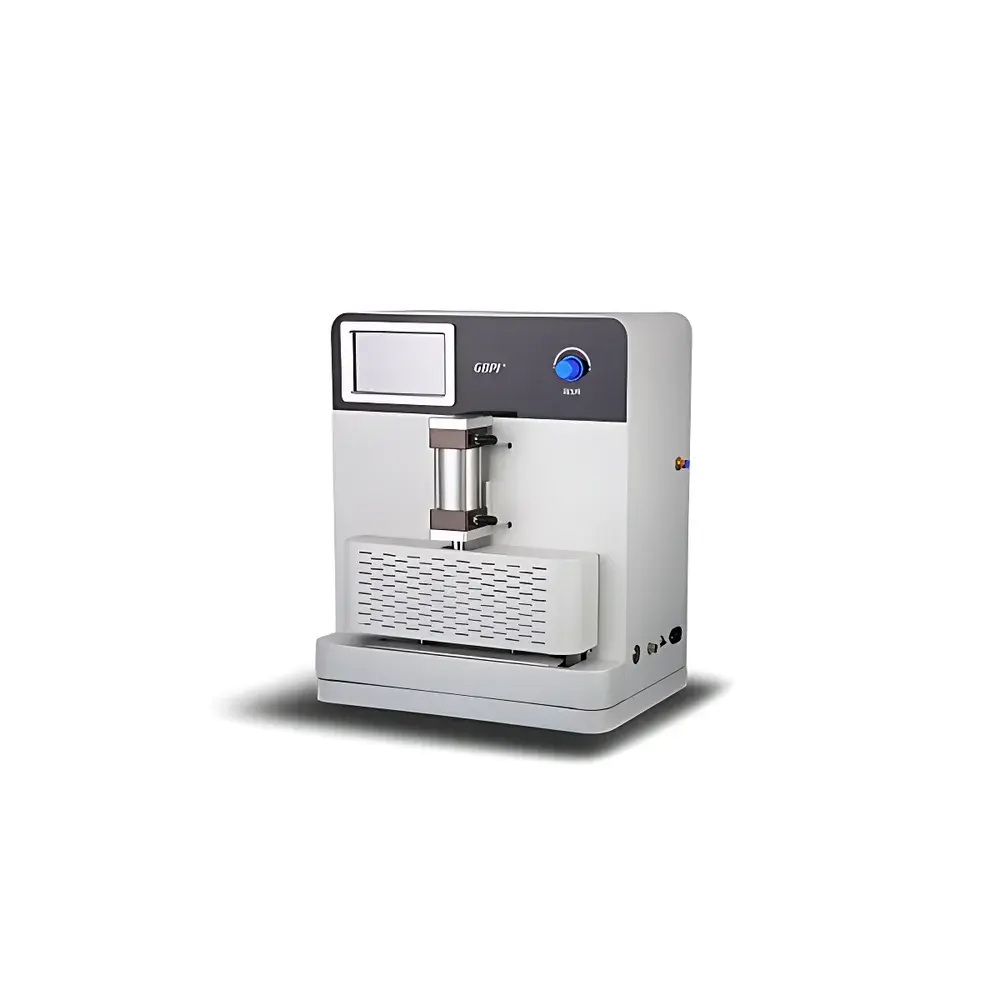
GBPI GBB-F2C Heat Sealing Tester
| Brand | GBPI |
|---|---|
| Origin | Guangdong, China |
| Manufacturer | GBPI Packaging Instruments Co., Ltd. |
| Model | GBB-F2C |
| Temperature Range | Ambient to 300 °C |
| Temperature Control Accuracy | ±0.2 °C |
| Sealing Time Range | 0.01 s – 99.99 h |
| Sealing Pressure Range | 0.05 – 0.8 MPa |
| Sealing Area | 35 mm × 10 mm (smooth surface |
| Dimensions | 700 × 400 × 540 mm (L×W×H) |
| Power Supply | AC 220 V, 50 Hz |
Overview
The GBPI GBB-F2C Heat Sealing Tester is a precision-engineered instrument designed for quantitative evaluation of heat seal integrity in flexible packaging materials. It operates on the principle of controlled thermal compression—applying defined temperature, pressure, and dwell time to induce molecular interdiffusion at polymer interfaces—thereby enabling reproducible assessment of seal initiation temperature (SIT), hot tack strength, and ultimate seal strength. This device is essential for R&D laboratories, quality control departments, and regulatory testing units across pharmaceutical packaging, food packaging, medical device sterilization pouches, and consumer goods industries where seal reliability directly impacts product shelf life, sterility assurance, and compliance with barrier performance requirements.
Key Features
- Five independently controllable upper sealing zones plus one lower sealing bar—enabling simultaneous multi-point thermal profiling or gradient-based seal optimization studies.
- Digital PID temperature control architecture with ±0.2 °C stability across the full 0–300 °C operating range; integrated temperature sensor calibration port simplifies traceable verification per ISO/IEC 17025 procedures.
- Pneumatic actuation system with external cylinder and real-time pressure monitoring (0.05–0.8 MPa), ensuring consistent force application independent of ambient humidity or mechanical wear.
- Dual operational modes: fully automated sequence execution (programmable via touchscreen) and manual foot-switch activation—supporting both routine QC checks and exploratory method development.
- Modular sealing face design: standard 35 mm × 10 mm smooth surface (lower bar fitted with food-grade silicone pad); optional anti-adhesion coatings (e.g., ceramic-reinforced PTFE), custom geometries (rounded, stepped, or micro-textured), and material-specific anodized aluminum or stainless-steel configurations available upon request.
- 7-inch capacitive touchscreen interface displaying real-time parameters—including individual zone temperatures, applied pressure, elapsed sealing time, and system status—with intuitive icon-driven navigation and multilingual UI support (English, Spanish, French, Chinese).
Sample Compatibility & Compliance
The GBB-F2C accommodates a broad spectrum of thermoplastic films and laminates, including but not limited to LDPE, HDPE, PP, PET, PA, EVOH, metallized polyester, and coextruded structures used in blister packaging, sachets, pouches, and sterile barrier systems. Its configuration adheres to critical international test standards: QB/T 2358–1998 (Chinese national standard for plastic film heat seal strength), ASTM F2029–22 (Standard Test Method for Making Heat-Sealed Packages for Test Specimens), and YBB00122003–2015 (Chinese Pharmacopoeia packaging material specification). When operated under documented SOPs, it supports GLP-compliant data generation and is compatible with FDA 21 CFR Part 11–ready software add-ons for audit trail, electronic signature, and user access control.
Software & Data Management
While the base unit features embedded firmware with local parameter storage (up to 100 test protocols), optional PC-based software enables advanced data handling: automated export of CSV/Excel files, statistical process control (SPC) charting (X̄-R, Cp/Cpk), comparative analysis across material lots or seal parameter sets, and integration with LIMS via TCP/IP or USB mass storage. All timestamped test records include operator ID, environmental conditions (if connected to optional external hygrometer/thermometer), and full parameter traceability—meeting requirements for ISO 9001:2015 clause 8.5.2 and ICH Q5C stability protocol documentation.
Applications
- Determination of optimal sealing parameters during packaging line qualification and validation (IQ/OQ/PQ).
- Hot tack curve generation for high-speed vertical form-fill-seal (VFFS) and horizontal form-fill-seal (HFFS) processes.
- Comparative evaluation of seal performance under accelerated aging (e.g., post-sterilization or post-retort conditions).
- Root cause analysis of seal failures (leakage, delamination, channeling) in complaint investigations.
- Development and verification of new laminate structures intended for barrier-sensitive applications (e.g., oxygen-sensitive pharmaceuticals or moisture-sensitive nutraceuticals).
- Supporting regulatory submissions requiring evidence of package integrity per USP , ISO 11607–1, and EU Annex 1 requirements.
FAQ
What standards does the GBB-F2C comply with?
It is configured to meet QB/T 2358–1998, ASTM F2029–22, and YBB00122003–2015. Optional calibration certificates are available per ISO/IEC 17025 accredited laboratories.
Can the sealing area be customized beyond 35 × 10 mm?
Yes—custom sealing bar widths (5–100 mm), lengths (up to 300 mm), and surface finishes (mirror-polished, matte, grooved, or coated) are offered as factory-installed options.
Is compressed air supply included?
No—the unit requires an externally supplied clean, dry, oil-free compressed air source (4–6 bar typical; ISO 8573–1 Class 2:2:2 recommended). A compatible air regulator/filter/lubricator kit can be ordered separately.
Does the system support GLP/GMP audit trails?
The standalone unit logs timestamps and parameters locally; full 21 CFR Part 11 compliance requires the optional PC software module with role-based user authentication and immutable electronic records.
How often does temperature calibration require verification?
Per ISO/IEC 17025 guidance, verification should occur before each shift when used in regulated environments—or at minimum, daily—and after any maintenance affecting thermal sensors or heating elements.