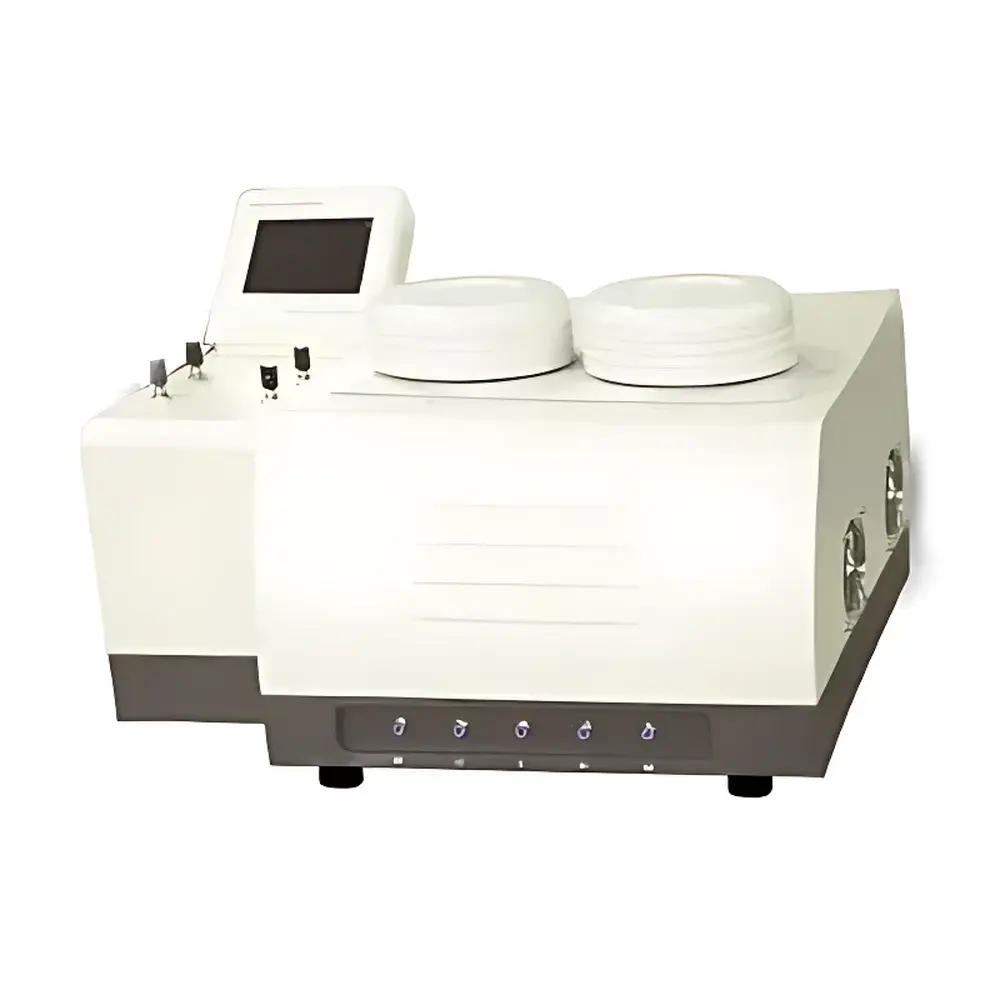
GBPI W202T Electrolytic Water Vapor Transmission Rate (WVTR) Tester for Solar Backsheet
| Brand | GBPI |
|---|---|
| Model | W202T |
| Measurement Principle | Electrolytic Sensor Method |
| Test Range (Film/Sheet) | 0.001–100 g/m²·24h (extendable to 0.1–1000 g/m²·24h with mask) |
| Test Range (Packaged Goods) | 0.001–5 g/pkg·d |
| Resolution (Film) | 0.001 g/m²·24h |
| Resolution (Package) | 0.00001 g/pkg·d |
| Temperature Control Range | 15–45 °C (optional 5–50 °C) |
| Temperature Accuracy | ±0.1 °C |
| Humidity Control Range | 0–90 % RH (dry air to 90 % RH) |
| Humidity Accuracy | ±1 % RH |
| Sample Size | Ø80 mm (test area: 50.24 cm²) |
| Max Sample Thickness | ≤2 mm |
| Carrier Gas | High-Purity N₂ (≥99.999%, user-supplied) |
| Operating Pressure | ≥0.1 MPa |
Overview
The GBPI W202T Electrolytic Water Vapor Transmission Rate (WVTR) Tester is a precision-engineered instrument designed specifically for the quantitative evaluation of water vapor permeation through solar photovoltaic backsheet materials and high-barrier packaging substrates. It operates on the internationally standardized electrolytic sensor principle—defined in ISO 15106-3 and ASTM F1249—where water vapor diffusing across a conditioned test specimen is carried by a dry carrier gas stream to a proprietary dual-electrode amperometric sensor. The sensor quantifies moisture concentration via Faraday’s law of electrolysis, enabling trace-level detection with high linearity and long-term stability. Unlike gravimetric or infrared-based methods, the electrolytic approach delivers superior sensitivity below 0.01 g/m²·24h and eliminates baseline drift caused by ambient humidity fluctuations. The W202T is engineered for reproducible, GLP-compliant barrier performance validation in R&D laboratories, quality control environments, and certification testing facilities serving the solar energy, pharmaceutical packaging, and flexible electronics industries.
Key Features
- Dual independent test chambers with automatic chamber switching and real-time pressure equalization—ensuring consistent boundary conditions across sequential or parallel measurements.
- Integrated electromagnetic temperature control system with programmable ramp profiles; achieves ±0.1 °C accuracy over 15–45 °C (5–50 °C optional), eliminating external chillers or heaters.
- Double-stream humidity control architecture: saturated humid gas flows upstream while ultra-dry N₂ sweeps downstream, enabling precise RH gradients from 0 to 90 % RH at ±1 % RH stability.
- Embedded Linux platform with 240×320 true-color resistive touchscreen—supports full instrument operation without PC dependency, including method setup, real-time curve visualization, and report generation.
- Automated end-point detection with adaptive algorithm: terminates tests upon signal convergence, preventing over-testing and preserving sensor lifetime.
- Comprehensive sensor protection protocol—including zero-gas purging cycles, auto-calibration prompts, and thermal derating during idle periods—to maintain electrochemical cell integrity over >5,000 test cycles.
- Modular firmware architecture: calibration, test execution, and data export functions operate as isolated software modules, minimizing cross-contamination risks during regulatory audits.
- Expandable configuration: optional accessories enable testing of high-permeability films (via diffusion-limiting masks) and rigid or semi-rigid packages (e.g., PET bottles, aluminum pouches) using validated fixture kits.
Sample Compatibility & Compliance
The W202T accommodates flat specimens up to 2 mm thick and Ø80 mm in diameter (effective test area: 50.24 cm²), supporting polymeric backsheets (e.g., PET/PA/EVOH laminates), fluoropolymer-coated TPT, and multilayer barrier films used in bifacial and PERC solar modules. Its design conforms to critical international standards governing WVTR measurement validity: ISO 15106-3 (electrolytic method), ASTM F1249 (for high-barrier films), GB/T 21529 (Chinese national standard), DIN 53122-1 (German industrial specification), and YBB 00092003 (Chinese pharmaceutical packaging regulation). All firmware and data handling routines support ALCOA+ principles—ensuring attributable, legible, contemporaneous, original, accurate, complete, consistent, enduring, and available records. Audit trails comply with FDA 21 CFR Part 11 requirements when paired with validated software deployment protocols.
Software & Data Management
The included GBPI WVTR Analysis Suite runs on Windows 10/11 and communicates via USB 2.0 with deterministic latency. It provides synchronized acquisition of WVTR, temperature, RH, and sensor current waveforms at 10 Hz sampling rate. Raw data are stored in encrypted .wvtr binary format with embedded metadata (operator ID, calibration timestamp, environmental logs). Reporting modules generate PDF/CSV outputs featuring time-segmented statistical summaries (mean, SD, CV%), overlayable permeation curves, and annotated failure flags (e.g., seal leakage, sensor saturation). All reports include digital signatures, revision history, and electronic audit trails compliant with ISO/IEC 17025 clause 7.8. Data export supports LIMS integration via HL7 or ASTM E1384-compliant XML schemas.
Applications
- Accelerated aging studies of PV backsheets under IEC 61215-defined damp heat (85 °C/85 % RH) preconditioning followed by WVTR tracking.
- Comparative barrier assessment of fluorinated ethylene propylene (FEP), polyvinylidene fluoride (PVDF), and ethylene tetrafluoroethylene (ETFE) coatings on polyester substrates.
- Batch-release testing of roll-to-roll coated barrier films per UL 1703 and IEC 62788-5-2 specifications.
- Root-cause analysis of delamination events in multilayer encapsulants via correlation of WVTR spikes with FTIR-ATR spectral shifts.
- Regulatory submission dossiers requiring ISO 17025-accredited WVTR data for medical device sterile barrier systems.
FAQ
What carrier gas is required for operation?
High-purity nitrogen (≥99.999 %) is mandatory; oxygen is not used in the electrolytic sensor circuit. A regulated supply at ≥0.1 MPa is required.
Can the instrument measure WVTR of blister packs or HDPE bottles?
Yes—when equipped with the optional package testing fixture kit (sold separately), the W202T validates permeation through 3D containers per ASTM F1140/F1141 burst-test aligned protocols.
Is sensor recalibration required between tests?
No—zero-point verification occurs automatically before each test sequence. Full 2-point calibration (dry air + certified humidity standard) is recommended every 30 days or after 100 test cycles.
Does the software support multi-user role-based access control?
Yes—administrator, analyst, and reviewer roles enforce segregation of duties; password policies align with NIST SP 800-63B.
How is temperature uniformity verified across the test cavity?
GBPI supplies a NIST-traceable PT100 probe kit; users perform cavity mapping per ISO/IEC 17025 clause 6.4.1 prior to accreditation audits.