
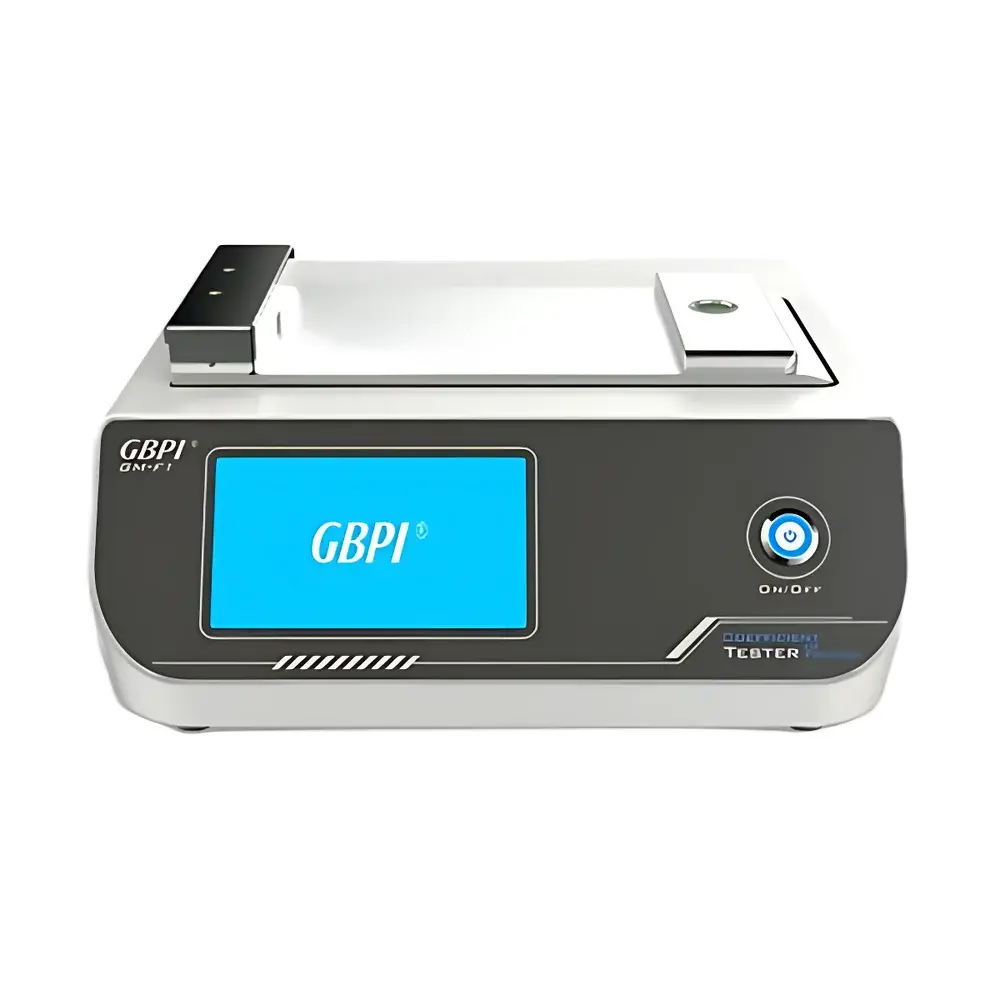
GBPI GM-F1A Inclined-Plane Coefficient of Friction Tester
| Brand | GBPI |
|---|---|
| Origin | Guangdong, China |
| Manufacturer Type | Manufacturer |
| Product Category | Domestic |
| Model | GM-F1A |
| Pricing | Upon Request |
| Angle Range | 0°–85° |
| Angular Resolution | 0.01° |
| Sensor Accuracy | ±0.1 %FS |
| Angular Velocity Range | 0.1–10 °/s |
| Standard Slider | 63.5 mm × 63.5 mm (200 g) |
| Optional Sliders | 90 mm × 100 mm (1300 g) |
| Dimensions (L×W×H) | 400 mm × 366 mm × 173 mm |
| Display | Touchscreen LCD |
| Rated Power | 250 W |
| Power Supply | AC 220 V, 50 Hz |
| Net Weight | 15 kg |
Overview
The GBPI GM-F1A Inclined-Plane Coefficient of Friction Tester is an engineered precision instrument designed for the quantitative determination of static and kinetic coefficients of friction (COF) under controlled angular inclination. It operates on the fundamental principle of gravitational force resolution: a test specimen—rigidly mounted on a calibrated slider—is placed on an adjustable inclined plane; as the angle increases incrementally, the point at which relative motion initiates defines the static COF (μs = tan θs), while continued motion under constant or ramped angular velocity yields the kinetic COF (μk = tan θk). This method complies with classical tribological conventions and provides direct, traceable physical measurement without reliance on motorized horizontal sled translation—offering enhanced mechanical stability and reduced parasitic inertia effects. The GM-F1A is purpose-built for packaging R&D, quality control laboratories, and materials characterization facilities requiring repeatable, standards-aligned surface interaction data across polymeric, metallic, and fibrous substrates.
Key Features
- High-fidelity angular positioning system with 0.01° resolution and programmable angular velocity (0.1–10 °/s), enabling precise replication of standardized ramp profiles per ASTM D1894, ASTM D202, and ISO 8295.
- Dual-mode operation: standalone touchscreen interface for rapid on-site testing and full PC-integrated mode with real-time force-angle curve visualization and automated μs/μk extraction.
- Modular slider configuration supporting three standard masses (200 g, 235 g ±10 g, 1300 g) with custom mass options available to meet application-specific normal force requirements (e.g., high-load film-on-film or foil-on-foil interfaces).
- Integrated load cell with ±0.1 % full-scale accuracy, temperature-compensated signal conditioning, and low-drift analog-to-digital conversion ensuring metrological integrity across extended test sequences.
- GMP-compliant software architecture compliant with FDA 21 CFR Part 11 requirements, featuring role-based user access control, electronic signatures, immutable audit trails for all parameter changes and test executions, and timestamped event logging.
- Open API and HL7/LIMS-ready communication protocols support seamless integration into centralized laboratory informatics systems, including enterprise-grade LIMS and digital twin infrastructure.
Sample Compatibility & Compliance
The GM-F1A accommodates flat, flexible, and semi-rigid sheet materials up to 3 mm thickness and 150 mm width, including but not limited to biaxially oriented polypropylene (BOPP), polyethylene terephthalate (PET), aluminum foil, metallized polyester, corrugated board, coated paperboard, nonwovens, and elastomeric films. Its mechanical design conforms to the dimensional and loading constraints specified in ASTM D4918 (for plastic films), TAPPI T815 (for packaging papers), and ISO 8295 (plastics—determination of coefficient of friction). All firmware and software modules undergo annual verification against NIST-traceable angular calibration artifacts and certified reference sliders. Instrument validation documentation—including IQ/OQ protocols, uncertainty budgets per GUM (JCGM 100:2008), and compliance matrices for ISO/IEC 17025:2017—can be supplied upon request.
Software & Data Management
The proprietary GBPI CoF Studio v3.2 software delivers deterministic test sequencing, real-time plotting of normal force vs. tangential resistance, and automatic threshold detection for both breakaway (static) and sliding (kinetic) events. Each test session generates a structured XML dataset containing raw sensor outputs, metadata (operator ID, environmental conditions, calibration status), and derived metrics (μs, μk, standard deviation across n ≥ 5 replicates). Reports export to PDF, CSV, and Excel formats with configurable templates aligned to internal SOPs or regulatory submission requirements. Audit trail records preserve every action—including parameter edits, result overrides, and report generation—with cryptographic hashing to prevent tampering. Remote access via secure TLS 1.3 tunnel enables off-site instrument monitoring, historical data retrieval, and collaborative troubleshooting without local network exposure.
Applications
- Packaging film development: quantifying slip additive efficacy, evaluating batch-to-batch consistency in爽滑性 (slip performance), and optimizing anti-blocking formulations.
- Pharmaceutical blister packaging: verifying COF values for PVC/PVDC lidding compatibility to ensure reliable feed-through in high-speed cartoning lines.
- Flexible electronics substrate qualification: characterizing interfacial friction between copper-clad polyimide and handling rollers during roll-to-roll processing.
- Automotive interior trim validation: assessing frictional behavior of thermoplastic olefin (TPO) laminates against synthetic leather under varying humidity conditions.
- Regulatory submissions: generating GLP-compliant datasets for USP , ISO 15378, and MDR Annex I Chapter III technical documentation packages.
FAQ
Does the GM-F1A comply with FDA 21 CFR Part 11 for electronic records and signatures?
Yes. The embedded operating system enforces user authentication, audit trail generation, and electronic signature capture in accordance with Part 11 Subpart B requirements.
Can the instrument be calibrated using third-party accredited laboratories?
Absolutely. GBPI provides dimensional and angular calibration certificates traceable to CNAS-accredited providers; customers may also engage ISO/IEC 17025-certified labs using our published calibration procedure (GBPI-CAL-GM-F1A-Rev.4).
Is it possible to modify the slider geometry for non-standard samples?
Yes. Custom slider footprints, contact surface finishes (e.g., sandblasted, polished, PTFE-coated), and mass configurations are available under engineering consultation and formal change control documentation.
What environmental conditions are recommended for optimal COF measurement accuracy?
Testing should be conducted in a conditioned environment per ASTM D618: 23 °C ±2 °C and 50 %RH ±5 %RH, with sample equilibration time ≥40 hours prior to measurement.
How frequently must the angular encoder be verified?
We recommend quarterly verification using GBPI-supplied optical angle gauge (certified ±0.005°) and annual full recalibration by authorized service centers.






