
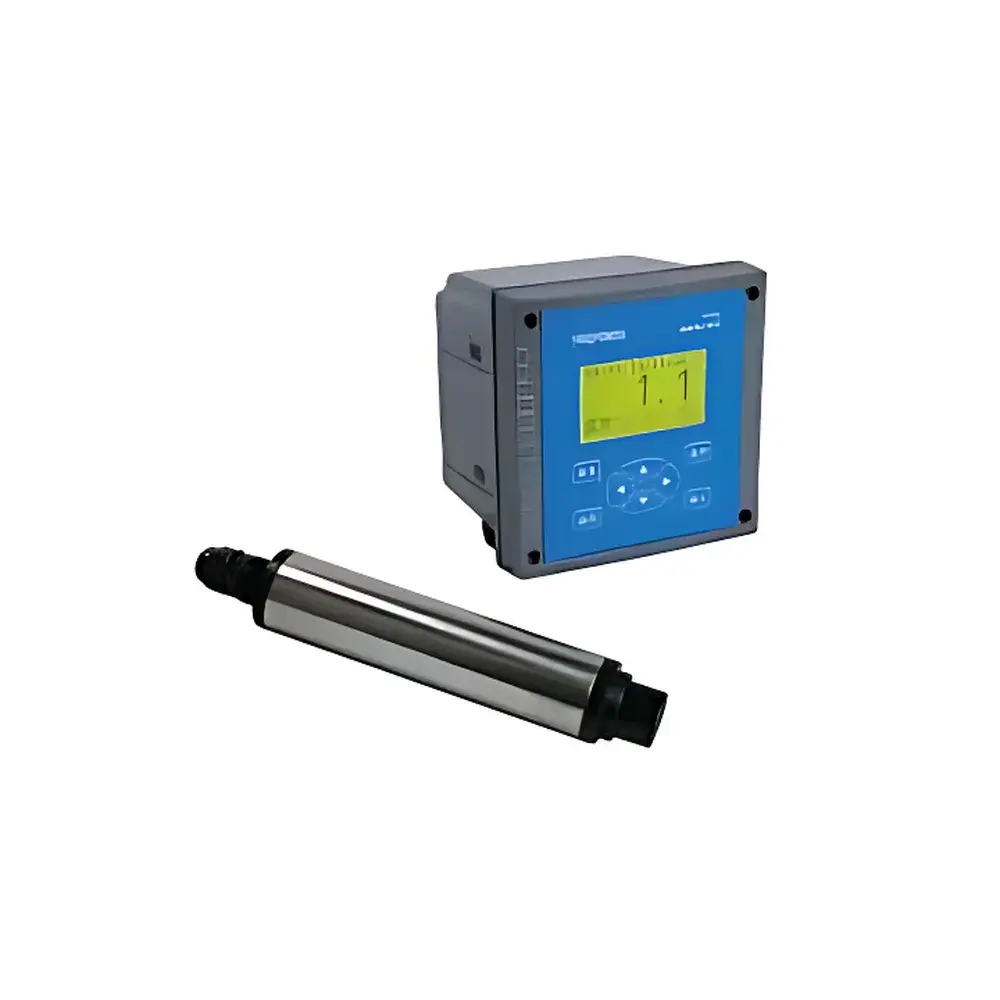
Timepower TP152 Optical Dissolved Oxygen Monitor
| Brand | Timepower |
|---|---|
| Origin | Beijing, China |
| Manufacturer Type | Manufacturer |
| Origin Category | Domestic |
| Model | TP152 |
| Instrument Type | Portable |
| Measurement Principle | Fluorescence Quenching (Optical) |
| Measurement Range | 0.00–20.00 mg/L |
| Accuracy | ±1.5% F.S. |
| Repeatability | ≤1% |
| Detection Limit | ±2 ppb |
| Response Time (T90) | <5 min at 25 °C |
| Resolution | 0.01 mg/L |
| Temperature Compensation Range | 0–60.0 °C |
| Sample Temperature Range | 5–60 °C |
| Ambient Temperature Range | 5–45 °C |
| Humidity | ≤90% RH (non-condensing) |
| Storage/Transport Temp | −25–55 °C (electrode >0 °C) |
| Enclosure Rating | IP65 |
| Display | 128×64 LCD, Chinese interface |
| Power Supply | AC 85–265 V, 45–65 Hz |
| Power Consumption | ≤15 W |
| Dimensions (H×W×D) | 145×120×150 mm |
| Panel Cutout | 138×138 mm |
| Weight | 0.64 kg |
| Output Signals | 0–10 mA / 0–20 mA / 4–20 mA (selectable, load <300 Ω) |
| Relay Output | AC 220 V / 3 A or DC 30 V / 3 A |
| Data Storage | Cyclic memory with >10-year data retention after power loss |
Overview
The Timepower TP152 Optical Dissolved Oxygen Monitor is a robust, maintenance-optimized online analyzer engineered for continuous, high-reliability dissolved oxygen (DO) measurement in natural water bodies, wastewater treatment systems, aquaculture facilities, and industrial process streams. Unlike electrochemical Clark-type sensors, the TP152 employs fluorescence quenching technology—based on the photophysical interaction between molecular oxygen and a proprietary oxygen-sensitive fluorophore immobilized on the sensor cap. When excited by blue light (typically ~470 nm), the fluorophore emits red luminescence (~600 nm); the presence of dissolved O₂ molecules non-radiatively deactivates this excited state, shortening both the lifetime and intensity of the emitted signal. The instrument precisely measures the phase shift (or lifetime decay) between excitation and emission signals, comparing it against factory-calibrated reference curves to compute DO concentration in mg/L. This optical method eliminates oxygen consumption during measurement, imposes no flow velocity requirements, supports static-water deployment, and delivers stable performance without membrane replacement, electrolyte refills, or electrode polarization.
Key Features
- Fluorescence-based sensing ensures zero oxygen consumption, enabling accurate DO quantification in low-flow or stagnant environments—including sediment interfaces, reservoirs, and batch reactors.
- Integrated stainless-steel housing with IP65-rated enclosure provides electromagnetic shielding and corrosion resistance for long-term field deployment in harsh outdoor or industrial settings.
- No consumables required: eliminates routine membrane replacement, electrolyte replenishment, cathode polishing, or anode cleaning—reducing total cost of ownership and operational downtime.
- High chemical interference immunity: unaffected by common aqueous contaminants such as H₂S, CO₂, Cl⁻, NH₃, and heavy metal ions that degrade electrochemical sensor stability and accuracy.
- Robust optical sensor design: the fluorophore-coated cap maintains calibration integrity even after minor surface abrasion or partial biofouling; simple mechanical wiping restores full functionality.
- Intuitive Chinese-language menu system with 128×64 monochrome LCD display enables rapid configuration and real-time monitoring without external software or training.
- Dual-mode analog output (0–10 mA, 0–20 mA, or 4–20 mA selectable) and programmable relay alarms support seamless integration into SCADA, DCS, and PLC-based control architectures.
Sample Compatibility & Compliance
The TP152 is validated for use across diverse aqueous matrices including freshwater, seawater (with salinity compensation applied), municipal and industrial wastewater, activated sludge, and recirculating aquaculture systems. Its optical principle inherently avoids chloride poisoning, hydrogen sulfide passivation, and oxygen depletion artifacts associated with amperometric sensors. While not certified to ISO 5814 or ASTM D888 under third-party audit, the instrument’s measurement methodology aligns with the physical principles referenced in these standards for optical DO determination. Its data storage architecture retains timestamped readings for >10 years following power interruption—supporting GLP-compliant recordkeeping. The device meets CE electromagnetic compatibility (EMC) requirements (EN 61326-1) and low-voltage directive (LVD) safety standards (EN 61010-1). For regulated environments, optional firmware upgrades may enable audit-trail logging compatible with FDA 21 CFR Part 11 supplementary documentation practices.
Software & Data Management
The TP152 operates autonomously without host PC dependency. All configuration, calibration, and alarm thresholds are managed via front-panel navigation. Internal cyclic memory stores up to 10,000 timestamped DO values (including temperature-compensated readings), automatically overwriting oldest entries upon buffer saturation. Stored data remains intact through power cycles due to non-volatile flash memory. No proprietary software is required for data retrieval; however, optional RS485 Modbus RTU interface (available upon request) permits integration with centralized data acquisition platforms for trend analysis, remote diagnostics, and regulatory reporting. Calibration logs—including date, operator ID (manual entry), and span/reference values—are retained alongside measurement history to satisfy internal QA/QC traceability requirements.
Applications
- Wastewater treatment plants: real-time monitoring of DO in aeration basins, oxidation ditches, and SBR reactors to optimize blower energy use and biological nitrification/denitrification efficiency.
- Drinking water distribution: verification of residual DO in clearwells and storage tanks to prevent anaerobic conditions and associated taste/odor compound formation.
- Aquaculture and hatchery operations: precise DO control in raceways, ponds, and RAS systems to maintain species-specific physiological thresholds and reduce mortality risk.
- Environmental monitoring networks: unattended deployment in rivers, lakes, and estuaries for seasonal hypoxia assessment and eutrophication studies.
- Industrial cooling water systems: early detection of microbial activity and biofilm development through anomalous DO depletion patterns.
- Research laboratories: reference-grade DO profiling in controlled mesocosm experiments where sensor drift and maintenance frequency must be minimized.
FAQ
Does the TP152 require daily calibration or frequent zero/span adjustments?
No. Due to the inherent stability of the fluorescence quenching mechanism and factory calibration traceability, the TP152 typically requires only annual verification using air-saturated water or certified standard solutions—unless exposed to extreme mechanical shock or chemical exposure.
Can the sensor operate submerged continuously without flow?
Yes. The optical design eliminates diffusion-limited response, allowing reliable operation in still water, sediment pore water, or low-velocity channels without stirring or pumping.
Is temperature compensation automatic and adjustable?
Yes. The integrated Pt1000 RTD provides continuous in-situ temperature measurement from 0–60.0 °C, and the instrument applies NIST-traceable polynomial compensation per ISO 5814 Annex B.
What mounting options are available for the sensor probe?
Standard configurations include submersible (cable-mounted), flanged, and flow-cell installations. Custom mechanical adapters (e.g., for pipe clamps or buoy-mounted arrays) can be engineered upon technical specification submission.
How is data retrieved from the instrument’s internal memory?
Data export is performed via front-panel menu navigation—readings can be scrolled, filtered by time range, and confirmed visually. For automated extraction, the optional RS485 Modbus interface enables polling by supervisory systems.







