
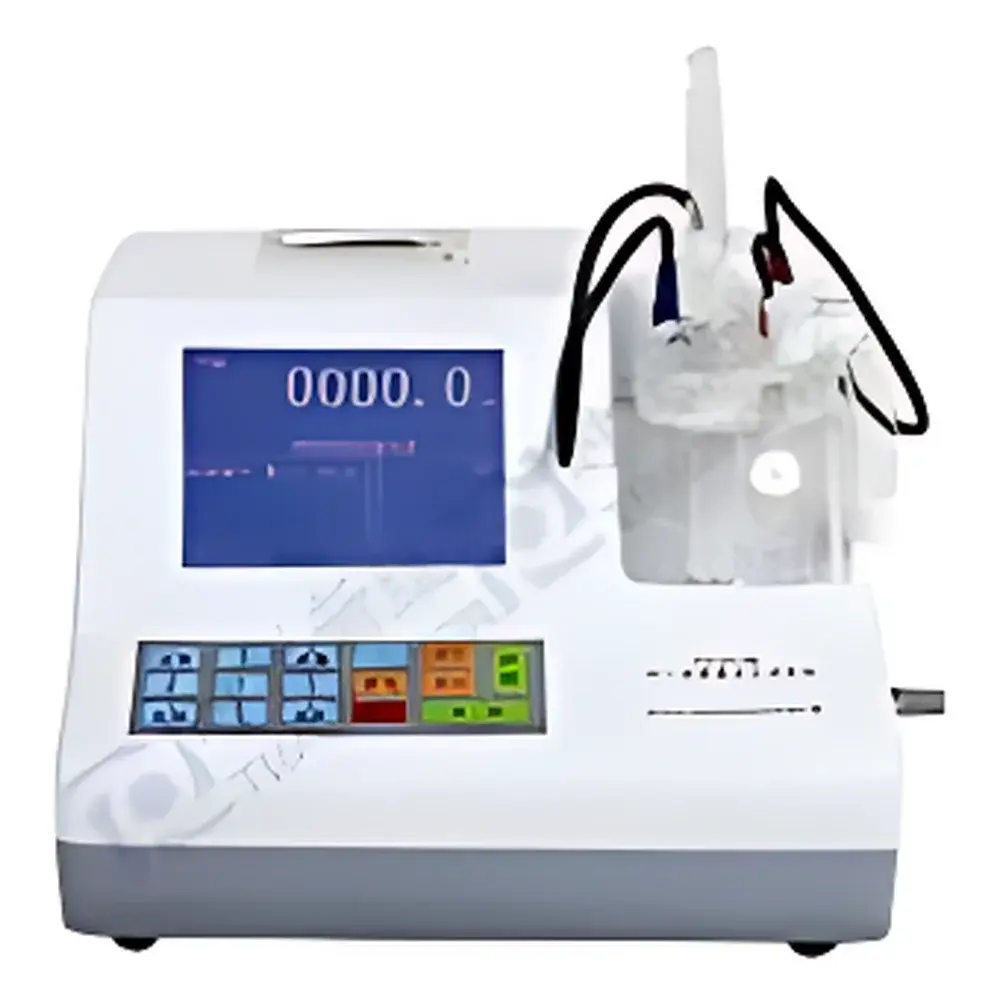
TimePower TP653 Coulometric Karl Fischer Moisture Titrator
| Brand | TimePower |
|---|---|
| Origin | Beijing, China |
| Manufacturer | TimePower Measurement & Control Co., Ltd. |
| Type | Coulometric Titrator |
| Model | TP653 |
| Measurement Principle | Coulometric Karl Fischer Titration |
| Water Range | 3 µg – 100 mg H₂O |
| Resolution | 0.1 µg |
| Accuracy | ±20% at 3 µg, ±10% at 10 µg, ±1% at 100 µg, ±0.5% above 100 µg (excluding sample handling error) |
| Electrolysis Current | 0–400 mA |
| Display | Backlit Chinese LCD |
| Data Storage | Internal non-volatile memory |
| Printer | Thermal, 36-character Chinese/ASCII output |
| Operating Temperature | 10–40 °C |
| Power Supply | AC 220 V ±10%, 50 Hz ±10% |
| Power Consumption | <200 W |
| Dimensions (W×D×H) | 310 × 315 × 215 mm |
| Weight | 3.5 kg |
Overview
The TimePower TP653 is a precision coulometric Karl Fischer moisture titrator engineered for trace water quantification in diverse matrices—including volatile liquids, viscous oils, solid pharmaceuticals, gaseous samples, and hygroscopic powders. It operates on the fundamental electrochemical principle of coulometric Karl Fischer titration, where iodine is generated *in situ* via controlled electrolysis of iodide ions in the anolyte solution. The stoichiometric reaction between iodine, sulfur dioxide, water, and base (typically imidazole in methanol-based reagents) enables absolute quantification of water without reliance on volumetric reagent standardization. This method delivers superior accuracy and repeatability for samples containing ≤100 mg of water per analysis—making the TP653 particularly suited for quality control in high-value, low-moisture applications such as active pharmaceutical ingredients (APIs), lithium battery electrolytes, silicone polymers, and specialty solvents.
Key Features
- 32-bit embedded microprocessor with real-time operating system for deterministic control and minimal latency in titration endpoint detection
- Coulometric generation of iodine with dual-circuit balanced titration architecture—reducing drift, improving signal-to-noise ratio, and minimizing systematic bias across dynamic range
- Integrated baseline compensation algorithm that automatically corrects for background current drift during prolonged operation or ambient humidity fluctuations
- Waterproof-sealed dual-compartment electrolytic cell with optimized electrode geometry—reducing equilibration time to <90 seconds and extending reagent lifetime by up to 40% compared to conventional designs
- Motor-driven automatic reagent dispensing and waste evacuation system—eliminating manual pipetting, reducing operator exposure to toxic solvents (e.g., pyridine-free reagents), and ensuring consistent cell conditioning
- Real-time electrochemical curve visualization on high-contrast monochrome LCD—enabling immediate assessment of reagent activity, electrode passivation, and titration kinetics
- Full numeric keypad with six user-definable calculation formulas (e.g., % w/w, ppm, mg/g, relative humidity correction) supporting rapid unit conversion and batch normalization
- Rugged engineering-grade ABS housing with chemical-resistant surface finish—designed for long-term stability in laboratory environments with solvent vapors and temperature gradients
Sample Compatibility & Compliance
The TP653 supports direct injection, oven coupling (via optional adapter), and gas sampling modes—enabling compliant analysis of samples specified in ASTM D6304, ISO 760, USP <921>, EP 2.5.12, and JP 2.53. It meets method validation requirements for GMP-regulated environments when operated under documented SOPs, including audit trail capability (via printed records), calibration verification logs, and raw data retention. Its performance aligns with critical industry standards: GB/T 1600 (pesticides), GB 7600 (transformer oil), GB/T 683 (petrochemical solvents), GB/T 11133 (liquid hydrocarbons), SH/T 0246 (light distillates), and SH/T 0255 (additive packages). All hardware and firmware comply with IEC 61010-1 safety requirements for electrical equipment used in measurement, control, and laboratory use.
Software & Data Management
While the TP653 operates as a standalone instrument with no external PC dependency, its thermal printer provides GLP-compliant hardcopy output—including date/time stamp, sample ID, measured water mass (µg), calculated concentration (% or ppm), operator ID field, and reagent lot number. Internal memory retains ≥1,000 test records with timestamp, result, and method identifier. Data export is supported via RS-232 interface (optional USB-to-serial adapter) for integration into LIMS or ELN systems. All printed reports satisfy FDA 21 CFR Part 11 requirements when paired with procedural controls governing access, review, and archival—no electronic signature module is embedded, preserving regulatory flexibility.
Applications
- Pharmaceutical QC: Residual moisture in lyophilized proteins, excipients, and tablet coatings per USP <921>
- Petrochemical testing: Water in jet fuel (ASTM D6304), transformer oil (IEC 60814), and biodiesel (EN 14971)
- Electronics materials: Trace H₂O in Li-ion battery electrolytes and photoresist solvents (≤10 ppm detection limit achievable)
- Agrochemicals: Moisture content in technical-grade pesticides and wettable powders (GB/T 1600)
- Food & flavor chemistry: Water activity proxies in essential oils, glycerides, and emulsifiers
- Polymers & adhesives: Reaction moisture monitoring in silicone curing, polyurethane prepolymers, and epoxy resins
FAQ
What sample types require oven attachment for reliable analysis?
Volatile, thermally labile, or heterogeneous solids (e.g., tablets, granules, polymer pellets) benefit from headspace oven vaporization to ensure complete water release without decomposition.
Is the TP653 compatible with pyridine-free Karl Fischer reagents?
Yes—the sealed electrolytic cell and optimized anolyte/catholyte separation are fully compatible with modern imidazole- or diethanolamine-based reagents.
How often must the electrolytic cell be cleaned or regenerated?
Under routine use with clean solvents, cell maintenance is required every 2–3 months; frequency increases with high-salt or particulate-laden samples.
Can the instrument be calibrated using certified water standards?
Yes—traceable 1.00 mg/g and 10.00 mg/g water-in-methanol standards (e.g., Merck Certipur®) are recommended for daily system suitability verification.
Does the TP653 support multi-point linearity verification?
Linearity assessment is performed manually using serial dilutions of certified standards; the instrument records each result independently for post-hoc regression analysis.





