
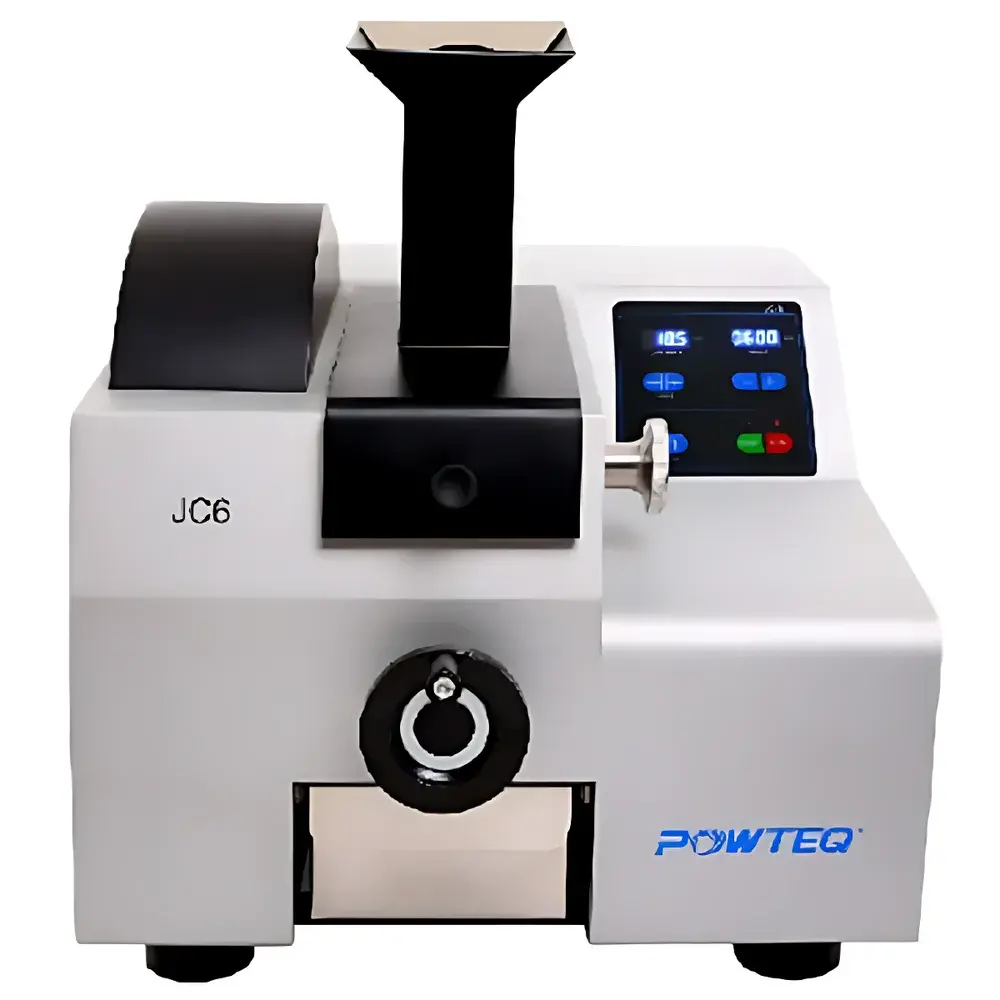
Grindemann JC6 Jaw Crusher
| Brand | Grindemann |
|---|---|
| Origin | Beijing, China |
| Manufacturer Type | Authorized Distributor |
| Country of Origin | China |
| Model | JC6 |
| Pricing | Available Upon Request |
| Feed Size | ≤ 60 mm |
| Maximum Output Capacity | 200–300 g/min |
| Final Particle Size (d90) | < 0.5 mm |
| Adjustable Jaw Gap | 1–15 mm |
| Drive | Eccentric Shaft with Manual Gap Adjustment |
| Construction | Cast Iron Frame with Interchangeable Jaw Plates |
| Safety | Splash-Proof Hopper, Emergency Stop, CE-Compliant Enclosure |
Overview
The Grindemann JC6 Jaw Crusher is a precision-engineered laboratory-scale primary crushing instrument designed for reproducible, controlled size reduction of heterogeneous solid samples. Operating on the principle of compressive crushing—where material is subjected to mechanical stress between two opposing jaw surfaces—one stationary and one reciprocating via an eccentric shaft—the JC6 delivers consistent pre-grinding performance across a broad spectrum of sample types. Its wedge-shaped crushing chamber geometry ensures progressive particle reduction through elliptical jaw motion, enabling efficient fragmentation without excessive heat generation or contamination. The device is intended for use in analytical sample preparation workflows where representative sub-sampling, homogenization, and downstream compatibility with mills, sieves, or elemental analyzers (e.g., XRF, ICP-OES) are critical. Designed for benchtop deployment, it complies with general electrical safety standards (IEC 61000-6-2/6-4) and incorporates physical safeguards including a splash-resistant feed hopper and emergency stop circuitry.
Key Features
- Manually adjustable jaw gap (1–15 mm), calibrated via precision-machined handwheel with zero-point compensation to maintain dimensional accuracy despite plate wear
- Six interchangeable jaw plate materials—manganese steel, stainless steel (304/316), tungsten carbide, zirconia ceramic, heavy-metal-free alloy steel, and food-grade polymer—enabling application-specific contamination control and wear resistance
- Compact, space-efficient desktop footprint (W × D × H: 320 × 410 × 380 mm) with front-accessible collection drawer and tool-free hopper removal
- Dust-minimized operation supported by fully enclosed crushing chamber and integrated static-dissipative housing
- Robust cast iron frame with vibration-dampening base mount, ensuring stable operation at variable throughput rates (200–300 g/min typical)
- Final output characterized by narrow particle size distribution: d90 ≤ 0.5 mm under standard operating conditions (feed size ≤ 60 mm, medium-hardness quartzite)
Sample Compatibility & Compliance
The JC6 accommodates feed materials ranging from medium-hard (Mohs 4–5) to hard (Mohs 6–7) and brittle or moderately tough substances—including metallic alloys (e.g., Nb-Ti, Fe-V), geological matrices (granite, basalt, barite), industrial ceramics (sintered alumina, electroceramics), construction aggregates (bauxite, quartz sand, cement clinker), and carbonaceous solids (coke, anthracite). It is not recommended for fibrous, highly elastic, or moisture-sensitive samples exceeding 10% water content. While the JC6 itself carries no ISO/IEC 17025 certification, its design supports GLP-compliant sample preparation protocols when operated within documented SOPs. Jaw plate material selection aligns with ASTM D3403 (standard practice for sample preparation of coal and coke) and ISO 1833-1 (textile fiber analysis prerequisites), and zirconia/tungsten carbide options meet USP <701> requirements for low-metal leaching in pharmaceutical excipient grinding validation.
Software & Data Management
The JC6 is a manually operated mechanical instrument with no embedded firmware, touchscreen interface, or digital connectivity. All operational parameters—including jaw gap setting, feed rate estimation, and maintenance logs—are recorded externally using laboratory notebook systems or LIMS-integrated templates. For audit readiness, users are advised to document jaw plate lot numbers, cumulative operating hours, and calibration verification dates (per zero-point adjustment procedure) in accordance with 21 CFR Part 11 Annex 11 principles for non-automated equipment. Optional accessories include a digital caliper kit (for gap verification) and certified reference material (CRM) test batches for periodic performance verification.
Applications
- Geochemical laboratories: Preparation of rock and ore samples prior to fusion bead synthesis or acid digestion for multi-element ICP-MS analysis
- Metallurgical R&D: Pre-crushing of ferroalloys and refractory metal powders to achieve uniform feedstock for planetary ball milling
- Cement and building materials testing: Reduction of clinker nodules and brick waste to enable Blaine fineness measurement and strength modeling
- Environmental labs: Size reduction of contaminated soil cores and slag fractions for TCLP extraction and heavy metal speciation
- Ceramic and glass R&D: Controlled comminution of raw batch materials (e.g., feldspar, kaolin, cullet) to ensure homogeneity in sintering trials
FAQ
What is the maximum feed size the JC6 can accept?
The JC6 accepts feed particles up to 60 mm in largest dimension; oversized material must be pre-screened or manually broken prior to loading.
Can the JC6 be used for cryogenic or wet grinding?
No—this unit is strictly for dry, ambient-temperature crushing. Moisture accumulation may cause jamming or accelerated wear; cryogenic operation is mechanically unsupported.
How often should jaw plates be replaced?
Replacement frequency depends on sample abrasiveness and daily throughput; typical service life ranges from 200–800 operating hours for manganese steel plates when processing medium-hard silicates.
Is third-party calibration available for the JC6?
Grindemann provides traceable gap verification documentation upon request; external metrology labs may perform dimensional inspection of jaw geometry but cannot calibrate mechanical motion due to lack of transducers or feedback loops.
Does the JC6 comply with ATEX or explosion-proof standards?
It does not carry ATEX certification; however, its spark-resistant construction (non-ferrous options available) and absence of electrical components in the crushing zone permit safe use in non-hazardous classified areas per NEC Class I, Division 2 guidelines.



