
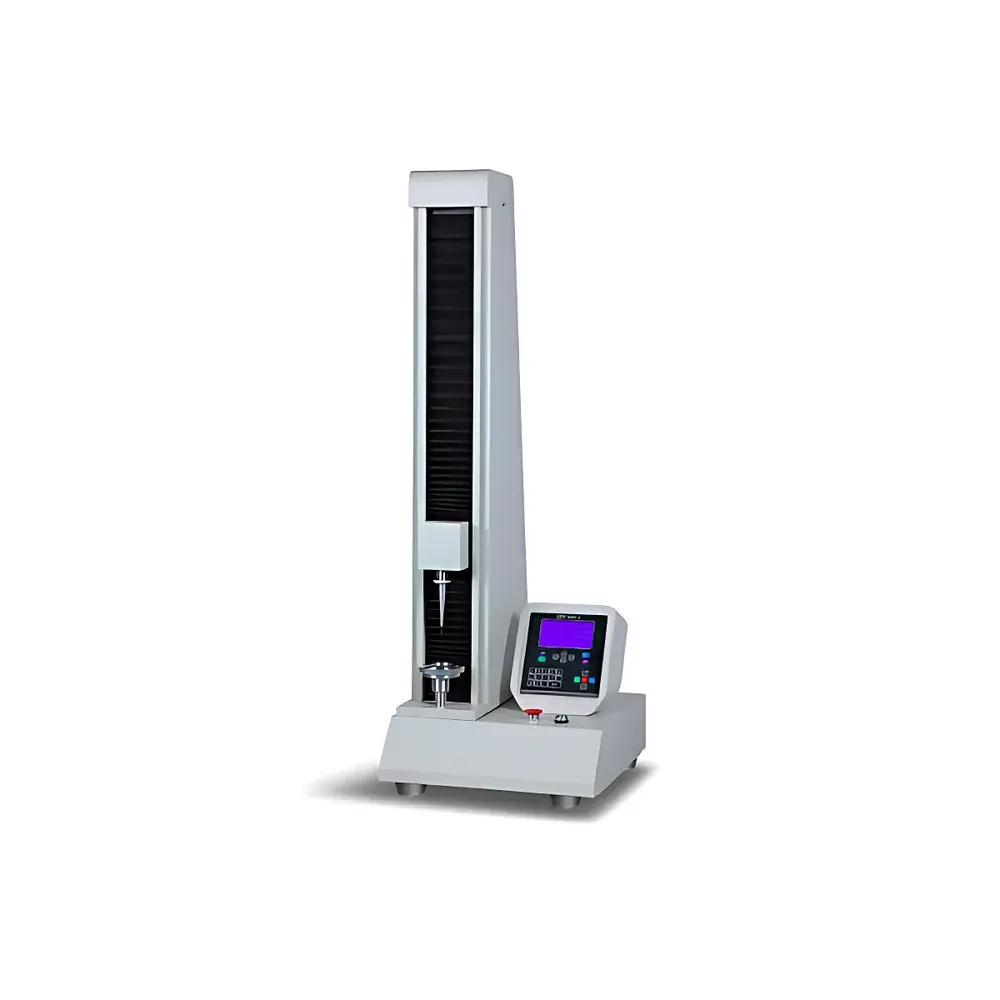
GBPI GBH-1L1 Single-Column Electronic Tensile Testing Machine for Film Stretch, Puncture & Tear Analysis
| Brand | GBPI |
|---|---|
| Origin | Guangdong, China |
| Manufacturer Type | Direct Manufacturer |
| Country of Origin | China |
| Model | GBH-1L1 |
| Instrument Type | Electronic Tensile Tester |
| Max Test Load | 1.5 kN |
| Force Range | 0–500 N (optional 0–1500 N) |
| Elongation Capacity | up to 1400% |
| Force Accuracy | ±0.5% of reading (Class 0.5) |
| Crosshead Travel | 750 mm |
| Displacement Resolution | ±0.5% of reading |
| Effective Specimen Width | 30 mm (customizable to 50 mm) |
| Test Speed | 0–500 mm/min, continuously variable |
| Power Supply | AC 220 V, 50 Hz |
| Rated Power | 1000 W |
| Dimensions (W×D×H) | 600 × 600 × 1300 mm |
| Weight | 70 kg |
Overview
The GBPI GBH-1L1 is a precision-engineered single-column electronic tensile testing machine designed specifically for mechanical property characterization of thin, flexible packaging materials. It operates on the fundamental principle of uniaxial force application under controlled displacement and velocity conditions, enabling quantitative measurement of tensile strength, elongation at break, puncture resistance, tear propagation (including straight, trouser, and Elmendorf-style), peel adhesion, heat seal strength, compression, bending, and shear behavior. Its modular load frame architecture—featuring high-rigidity dual upright columns, precision-ground ball screws, and a digitally regulated AC servo drive system—ensures minimal thermal drift, zero positional offset during low-speed loading, and long-term mechanical stability across repeated test cycles. The instrument meets the structural and metrological requirements of ISO 7500-1 (Class 0.5 verification), ASTM E4 (load cell calibration), and JJG 139 (Chinese national verification regulation for universal testing machines), establishing it as a compliant platform for quality control laboratories operating under GLP, GMP, or ISO/IEC 17025 frameworks.
Key Features
- Multi-functional test capability: pre-configured protocols for ASTM D882 (tensile properties of plastic film), ASTM D1938 (trouser tear), ASTM F88 (heat seal strength), ASTM D3330 (peel adhesion), ISO 37 (vulcanized rubber), and GB/T 1040 series (plastics tensile testing).
- Dual-mode control architecture: supports both embedded touchscreen operation (compact interface) and external PC-based control via RS232 serial communication—enabling standalone use or full integration into lab networks.
- High-fidelity data acquisition: 100 Hz sampling rate ensures accurate capture of transient force peaks, yield points, and post-yield deformation characteristics in viscoelastic films.
- Modular sensor support: multi-channel analog input accommodates simultaneous installation of load cells (up to ±1500 N range) and extensometers or digital encoders for independent strain measurement.
- Mechanical robustness: hardened steel crosshead, preloaded ball screw transmission, and anti-backlash guide rails guarantee repeatability better than ±0.5% across 10,000+ test cycles without recalibration.
- Comprehensive safety system: hardware-based overload cutoff, mechanical upper/lower limit switches, emergency stop circuitry, and software-enforced travel boundaries prevent specimen overextension or actuator damage.
- Flexible fixture ecosystem: standard 30 mm manual tensile grips; optional pneumatic clamps (with adjustable pressure control) for consistent gripping of low-modulus or highly extensible films (e.g., LDPE, TPU, metallized PET).
Sample Compatibility & Compliance
The GBH-1L1 is validated for use with polymeric films (BOPP, PET, PE, CPP), laminated structures (paper-aluminum-plastic composites), nonwovens, rubber sheets, foils, adhesive tapes, and pharmaceutical blister lidding materials. Its 750 mm effective stroke and 1400% elongation capacity accommodate high-ductility specimens such as elastic thermoplastic elastomers (TPEs) and hydrogel films. All test methods implemented comply with mandatory regulatory standards including GB/T 8808 (peel strength of composite films), GB/T 13022 (tensile properties of plastic films), YBB00112003 (pharmaceutical packaging standards), and ASTM D828 (tensile properties of paper). Data integrity meets FDA 21 CFR Part 11 requirements when used with audit-trail-enabled software configurations, supporting traceability in regulated QC environments.
Software & Data Management
The included Windows-based control software provides real-time force-displacement curve visualization, automatic calculation of key parameters (tensile modulus, yield stress, breaking strength, puncture energy, tear resistance), and statistical reporting per ISO 5725. Raw data export is supported in CSV and Excel-compatible formats; custom report templates allow user-defined field mapping for LIMS integration. Curve overlay functionality enables comparative analysis across batches or material grades. The software architecture supports multi-user permission levels, electronic signatures, and time-stamped audit logs—fulfilling documentation requirements for ISO 9001, ICH Q5, and USP compliance. Firmware updates are delivered via encrypted USB drive (4 GB included), ensuring secure version control.
Applications
This instrument serves as a primary mechanical testing platform in packaging R&D labs evaluating seal integrity of pouches and sachets; in food and pharma manufacturing QA departments verifying incoming film specifications against purchase agreements; and in third-party testing institutes conducting accredited conformity assessments per CNAS-CL01. Typical use cases include: quantifying delamination resistance in retortable pouch laminates; assessing puncture resistance of medical device barrier films; validating tear initiation energy in child-resistant packaging; measuring hot-tack strength during form-fill-seal process development; and characterizing creep behavior of biodegradable mulch films under sustained load.
FAQ
What standards does the GBH-1L1 support out-of-the-box?
It includes built-in test methods aligned with 28 national and international standards, including GB/T 1040, ASTM D882, ISO 37, and YBB pharmaceutical packaging specifications.
Can the system be integrated into an existing laboratory network?
Yes—via RS232 serial interface or optional Ethernet module, supporting SCADA-level data streaming and remote diagnostics.
Is calibration certification provided with shipment?
A factory calibration certificate traceable to NIM (National Institute of Metrology, China) is included; optional third-party ISO/IEC 17025-accredited calibration is available upon request.
What maintenance is required for long-term accuracy?
Annual verification of load cell linearity and crosshead displacement accuracy is recommended; no routine lubrication or mechanical adjustment is needed due to sealed ball screw and brushless servo design.
Does the software support multi-language interfaces?
English and Simplified Chinese UIs are pre-installed; additional language packs (German, Spanish, Japanese) can be deployed via firmware update.



