
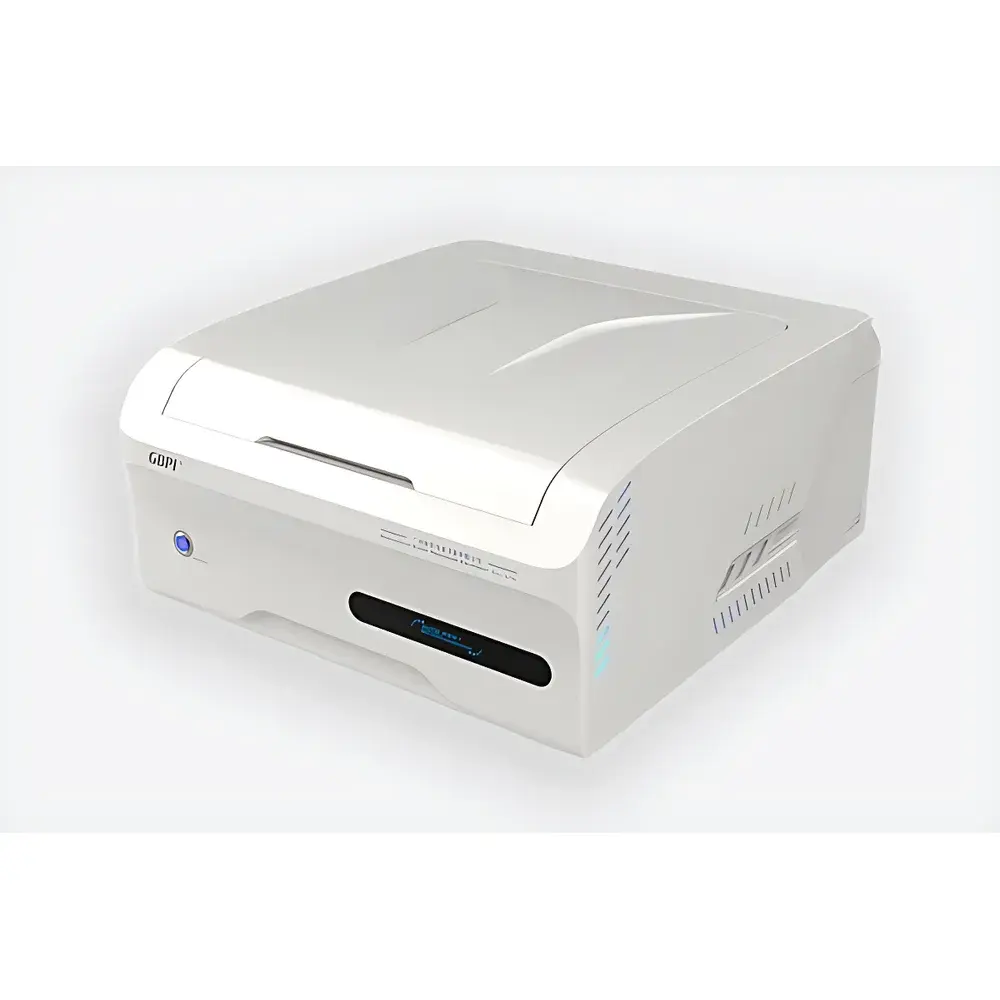
GBPI W900 Gravimetric Water Vapor Transmission Rate (WVTR) Tester
| Brand | GBPI |
|---|---|
| Origin | Guangdong, China |
| Manufacturer Type | Direct Manufacturer |
| Region Classification | Domestic (China) |
| Model | W900 |
| Price Range | USD 70,000 – 140,000 |
| Measurement Principle | Gravimetric Cup Method (ASTM E96 / GB/T 1037) |
| Test Modes | Gain-Weight & Loss-Weight |
| Test Stations | 9 |
| WVTR Range (Film) | 0.05–10,000 g/m²·24h |
| WVTR Range (Container) | 0.0002–30 g/pkg·24h |
| Mass Resolution | 0.1 mg |
| Temperature Control | 10–50 ±0.1 °C |
| Humidity Control | 5–95% RH, up to 100% RH |
| Airflow Velocity | 0.5–2.5 m/s (optional low-flow: 0.03–0.5 m/s) |
| Sample Diameter | Φ74 mm |
| Max Sample Thickness | ≤3 mm |
| Standard Test Area | 33 cm² |
| Carrier Gas | Compressed air (≥0.6 MPa), Φ6 mm polyurethane tubing |
Overview
The GBPI W900 Gravimetric Water Vapor Transmission Rate (WVTR) Tester is an ISO/ASTM-compliant benchtop instrument engineered for precise, reproducible quantification of water vapor permeation through packaging and barrier materials. It operates on the gravimetric cup method—internally referenced as ASTM E96 (Standard Test Methods for Water Vapor Transmission of Materials) and GB/T 1037 (Chinese national standard for plastic film and sheeting)—where mass change of a sealed test cup over time serves as the primary metric for calculating WVTR. The system integrates dual-mode operation: gain-weight (desiccant-filled cup, inverted orientation) and loss-weight (water-filled cup, upright orientation), enabling accurate characterization across low-, medium-, and high-permeability substrates—from ultra-barrier metallized films to highly hygroscopic nonwovens. Its thermally and hygrothermally stabilized test chamber ensures spatial uniformity in temperature (±0.1 °C) and relative humidity (5–100% RH), critical for minimizing edge effects and drift during extended-duration tests (up to 168 hours). Designed for regulatory-grade testing environments, the W900 meets foundational requirements for GLP-compliant data generation and supports audit-ready workflows when paired with optional GMP-compliant software modules.
Key Features
- Nine independent test stations with synchronized environmental control, enabling parallel evaluation of heterogeneous samples under identical conditions.
- Patented chamber architecture featuring 3D volumetric thermal homogenization and real-time airflow velocity monitoring (0.5–2.5 m/s, with low-flow option down to 0.03 m/s), eliminating localized condensation and boundary-layer artifacts.
- Integrated high-stability analytical balance (210 g capacity, 0.1 mg resolution) with active thermal isolation and anti-humidity shielding to preserve long-term calibration integrity.
- Self-regulating humidity generation and drying system—no consumable desiccant cartridges or manual refills required—ensuring uninterrupted multi-day operation.
- Automated diagnostic startup sequence verifying sensor calibration, airflow integrity, temperature/humidity setpoint convergence, and balance zero stability prior to test initiation.
- Dual-path gas handling: compressed air supply (≥0.6 MPa) routed via Φ6 mm polyurethane tubing to both humidification and desiccation subsystems, supporting traceable carrier gas delivery per ISO 2528 and ASTM D1653 protocols.
Sample Compatibility & Compliance
The W900 accommodates flat specimens up to Φ74 mm diameter and 3 mm thickness—including monolayer and multilayer polymer films (e.g., PET, OPP, PE, PVDC), metallized laminates, aluminum foil composites, paperboard, coated papers (e.g., cigarette packaging), nonwovens, medical-grade breathable membranes, and rigid containers (bottles, pouches, trays, blister packs). For container testing, custom fixtures enable seal-integrity validation and headspace-corrected WVTR calculation per ASTM F1249 (for thin-walled packages) and ISO 15106-3. All test methodologies align with internationally recognized standards: ASTM E96 (desiccant and water methods), GB/T 1037, GB/T 16928, ISO 2528, TAPPI T464, DIN 53122-1, and YBB00092003-2015 (Chinese pharmaceutical packaging standard). The instrument’s mechanical design and control firmware are structured to support 21 CFR Part 11 readiness when deployed with validated computerized system modules.
Software & Data Management
The embedded control interface provides real-time visualization of mass drift, environmental setpoints, and calculated WVTR values per station. Raw mass vs. time datasets are timestamped at user-defined intervals (1–240 min) and stored in CSV-compatible format. Optional GMP Computerized System software extends functionality with role-based user authentication (admin/operator/auditor), electronic signatures, immutable audit trails (including parameter changes, calibration events, and test aborts), and automated report generation compliant with Annex 11 and ALCOA+ principles. All data files include embedded metadata: operator ID, sample ID, test method (gain/loss), environmental log, and uncertainty estimates derived from balance repeatability and environmental stability metrics.
Applications
The W900 serves as a core metrology platform across regulated and industrial sectors. In pharmaceutical packaging, it validates moisture barrier performance of PTP blisters, HDPE bottles, and sterile barrier systems per USP and EP 3.2.11. In food packaging R&D, it quantifies shelf-life limiting factors for snack bags, coffee pouches, and retortable trays. Medical device manufacturers use it to assess vapor transmission through wound dressings, IV bag films, and sterilization wraps. Emerging applications include WVTR certification of solar backsheet polymers (IEC 61215-2 MQT10), lithium-ion battery enclosure plastics (UN 38.3 moisture ingress modeling), automotive fuel tank liners (SAE J1737), and single-use bioprocessing films (ISO 11607-1). It also supports comparative lifecycle analysis of compostable films (ASTM D6400) and barrier-coated paper cups (TIP 0304-01).
FAQ
What standards does the W900 comply with for pharmaceutical packaging testing?
It fully supports ASTM E96, GB/T 1037, YBB00092003-2015, and ISO 2528—enabling compliance with Chinese NMPA, US FDA, and EU EMA packaging guidance for moisture-sensitive dosage forms.
Can the W900 test rigid containers such as bottles or cans?
Yes—using optional container fixtures and headspace correction algorithms aligned with ASTM F1249 and ISO 15106-3 for quantitative WVTR determination of 3D geometries.
Is the balance protected against environmental drift during long-term tests?
Yes—the balance is housed in a thermally isolated compartment with active humidity suppression; its zero stability is verified automatically before each test cycle.
Does the system support 21 CFR Part 11 compliance?
When configured with the optional GMP Computerized System module, it delivers full electronic record/electronic signature (ER/ES) capability, including audit trail, user access controls, and change management.
What maintenance is required for the humidity control system?
The integrated water vapor generator and desiccant-free drying module require no consumables; routine verification includes quarterly balance calibration and annual sensor traceable recalibration per ISO/IEC 17025 guidelines.
Related Products





