
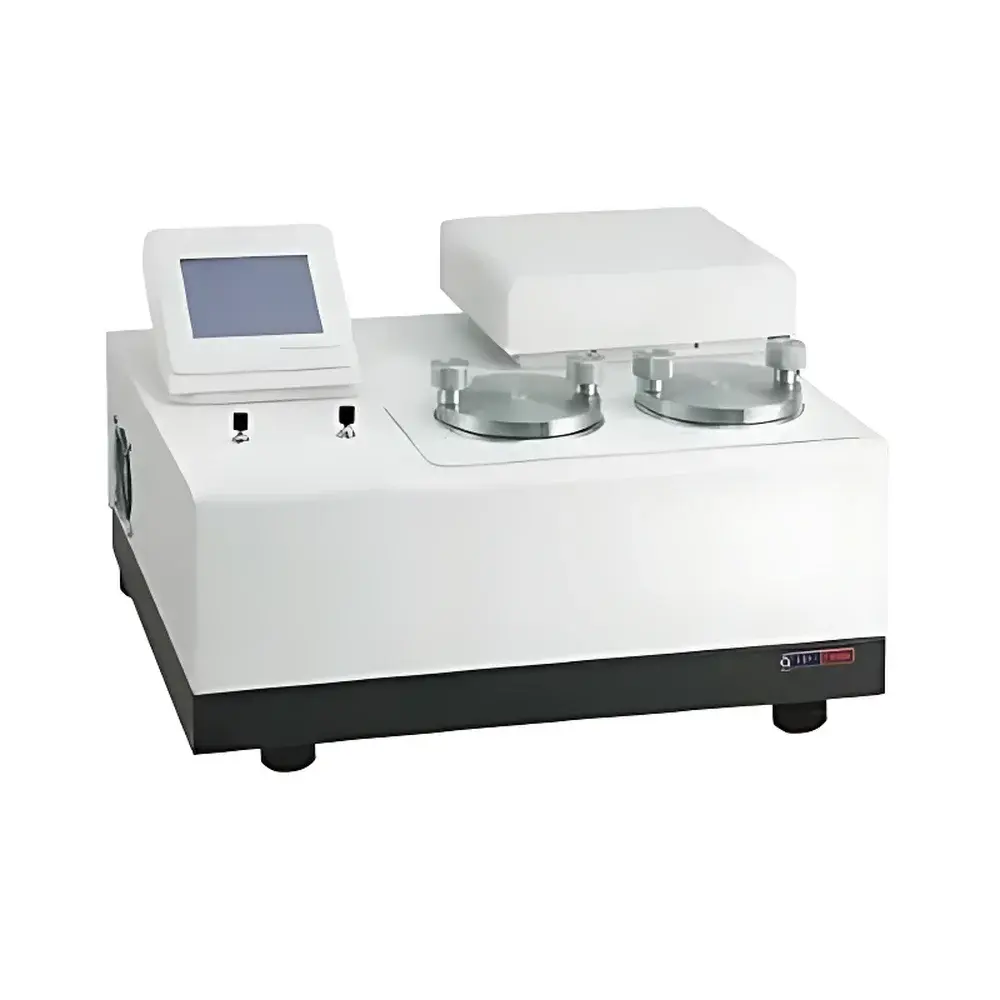
Guangzhou Biaoji W402 Infrared Sensor-Based Water Vapor Transmission Rate (WVTR) Tester for Solar Backsheet
| Key | Origin: Guangdong, China |
|---|---|
| Manufacturer Type | Authorized Distributor |
| Product Origin | Domestic (China) |
| Model | W402 |
| Pricing | Upon Request |
| Test Principle | Infrared Sensor Method (ISO 15106-2, ASTM F1249 compliant) |
| Measurement Range | 0.001–100 g/m²·24h (film) |
| Temperature Control | 15–45 °C ±0.1 °C |
| Humidity Control | 0%RH, 30–90%RH ±1%RH |
| Test Area | 50 cm² |
| Sample Size | 108 mm × 108 mm |
| Max Thickness | ≤3 mm |
| Carrier Gas | High-Purity N₂ (≥99.999%), 0.28 MPa, 0–200 mL/min |
| Touchscreen Interface | 240,000-color 7″ TFT LCD |
| Data Output | Real-time curves (WVTR, T, RH, H₂O concentration), CSV/PDF export via USB or PC software |
Overview
The Guangzhou Biaoji W402 Infrared Sensor-Based Water Vapor Transmission Rate (WVTR) Tester is an engineered solution for precise, traceable, and standards-compliant moisture barrier characterization—specifically optimized for photovoltaic solar backsheet materials, high-barrier packaging films, and rigid containers. It operates on the infrared sensor principle defined in ISO 15106-2 and ASTM F1249: a conditioned nitrogen stream (high humidity) flows over the test specimen’s upstream side, while dry nitrogen sweeps the downstream side. Water vapor permeating through the sample is carried by the dry carrier gas to a highly stable, temperature-compensated infrared detector. The detector quantifies H₂O concentration via absorption at 2.6 µm, enabling direct calculation of WVTR (g/m²·24h or g/pkg·d) without gravimetric weighing or desiccant interference. This method eliminates drift associated with humidity sensors and offers superior repeatability (<1.5% RSD) across low-to-high permeability ranges—critical for validating the long-term encapsulation integrity of solar modules exposed to humid tropical or coastal environments.
Key Features
- Dual independent test chambers with automatic pressure balancing—enabling concurrent or sequential testing of two specimens under identical environmental conditions.
- Embedded 7-inch true-color touchscreen interface with real-time graphical display of WVTR, temperature, relative humidity, and water vapor concentration profiles; supports standalone operation without external PC.
- Precision climate control: thermoelectric (Peltier) + PID-driven electromagnetic heating/cooling ensures ±0.1 °C stability across 15–45 °C; dual-stream humidity generation delivers ±1%RH accuracy at setpoints from 0% to 90%RH.
- Modular hardware architecture: field-upgradable firmware, hot-swappable IR sensor module, and configurable gas flow paths (0–200 mL/min) with integrated mass flow monitoring.
- Automated test logic: auto-start upon seal verification, adaptive endpoint detection, sensor self-protection during idle phases, and programmable hold/soak steps for equilibrium validation.
- Comprehensive data governance: timestamped raw sensor output, metadata tagging (operator ID, batch, material lot), and audit-ready event logs aligned with GLP/GMP documentation requirements.
Sample Compatibility & Compliance
The W402 accommodates flat sheet materials (films, foils, laminates, solar backsheets) up to 3 mm thick and 108 mm × 108 mm in dimension, with standardized 50 cm² test area. Optional accessories extend capability to rigid and semi-rigid packaging—e.g., PET bottles, HDPE jars, aluminum pouches—via custom sealing fixtures and diffusion-area normalization algorithms. All configurations comply with international regulatory frameworks: ISO 15106-2 (infrared detection), ASTM F1249 (high-speed WVTR for barrier films), TAPPI T557 (moisture transmission of paperboard), and JIS K7129 (Japanese standard for plastic film permeation). Instrument calibration is traceable to NIST-certified humidity generators and certified reference membranes; full validation documentation—including IQ/OQ protocols—is available upon request for FDA 21 CFR Part 11 and EU Annex 11 readiness.
Software & Data Management
Biaoji’s proprietary WinWVTR software (v4.2+) provides full instrument control via USB 2.0 or Ethernet. It supports multi-user role-based access (admin, operator, reviewer), electronic signatures, and 21 CFR Part 11-compliant audit trails—including all parameter changes, test starts/stops, and report modifications. Raw data streams are stored in structured SQLite databases with automatic daily backup; reports export to PDF (with embedded digital signature) or CSV for LIMS integration. Advanced analytics include Arrhenius modeling (for accelerated aging prediction), comparative statistical analysis (ANOVA, t-test), and batch trend visualization across time-series datasets. Software updates are delivered via secure HTTPS portal with SHA-256 checksum verification.
Applications
- Photovoltaic manufacturing: Quantifying moisture ingress resistance of fluoropolymer-based backsheets (e.g., TPT, TPE, KPK) under IEC 61215 thermal-humidity cycling preconditioning.
- Pharmaceutical packaging: Barrier validation of blister lidding foils, cold-form foil, and child-resistant HDPE containers per USP and EP 2.6.12.
- Food packaging R&D: Benchmarking high-barrier metallized PET, SiOₓ-coated PP, and AlOₓ nanolaminates against shelf-life models.
- Electronics encapsulation: Measuring WVTR of conformal coatings and flexible OLED substrate barriers below 10⁻⁶ g/m²·24h (with optional high-sensitivity mode).
- Academic research: Studying diffusion coefficients, activation energy, and sorption-desorption kinetics in polymeric composites using variable-T/RH step profiling.
FAQ
What carrier gas is required—and why must it be high-purity nitrogen?
High-purity nitrogen (≥99.999%) is mandatory to prevent interference from CO₂, O₂, or hydrocarbons that absorb near the 2.6 µm IR band. Impurities cause baseline drift and reduce signal-to-noise ratio, compromising detection limits and reproducibility.
Can the W402 meet ASTM F1249’s requirement for “zero-background” measurement?
Yes. Its dual-stream design isolates the sensing path from ambient humidity fluctuations, and the IR detector includes active background compensation—validated per ASTM F1249 Annex A1 for residual signal offset ≤0.0005 g/m²·24h.
Is calibration verification possible without certified reference films?
Yes. Built-in zero-gas and span-gas verification routines use dry N₂ and pre-conditioned humid N₂ streams to confirm detector linearity and system leak integrity prior to each test sequence.
How does the dual-chamber design improve measurement reliability?
Dual chambers eliminate inter-test carryover, enable intra-laboratory reproducibility studies, and allow reference-standard pairing (e.g., one chamber for control membrane, one for unknown)—reducing systematic bias from temporal environmental drift.
Does the system support unattended overnight testing?
Yes. Scheduled start/stop, auto-recovery after power interruption, and email/SNMP alerts for test completion or fault conditions ensure robust 24/7 operation in shared lab environments.





