
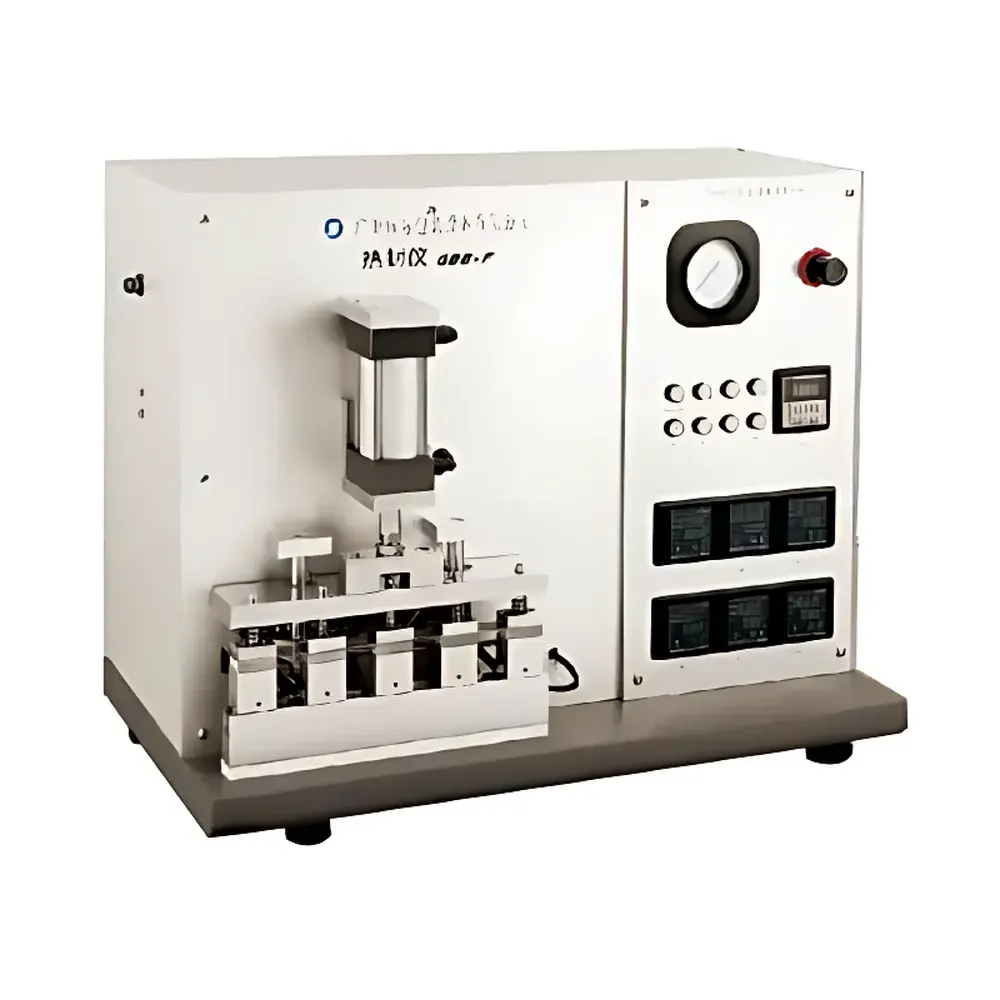
GBPI GBB-F Five-Point Heat Sealing Tester
| Brand | GBPI |
|---|---|
| Origin | Guangdong, China |
| Manufacturer Type | Manufacturer |
| Country of Origin | China |
| Model | GBB-F |
| Pricing | Available upon request |
| Sealing Temperature Range | Ambient to 300 °C |
| Temperature Control Accuracy | ±0.1 °C |
| Sealing Time Range | 0.01 s to 99.99 h |
| Sealing Pressure Range | 0.05–0.8 MPa |
| Sealing Jaw Dimensions | 45 mm × 10 mm (smooth surface) × 5 independent zones |
| Heating Method | Dual-zone electric heating (upper/lower) |
| Operation Modes | Manual and automatic (pneumatic cylinder actuated) |
| Power Supply | AC 220 V, 50 Hz |
| Overall Dimensions | 700 (L) × 400 (B) × 540 (H) mm |
Overview
The GBPI GBB-F Five-Point Heat Sealing Tester is an engineered laboratory instrument designed for precise, repeatable evaluation of heat seal integrity in flexible packaging materials. It operates on the principle of controlled thermal compression—applying calibrated temperature, pressure, and dwell time across five independently regulated sealing zones—to simulate industrial heat sealing conditions and quantify seal initiation, strength development, and process window boundaries. Unlike single-zone testers, the GBB-F enables parallel assessment of multiple thermal parameters within a single test cycle, supporting rapid optimization of sealing protocols for multilayer films, laminates, coated papers, aluminum foils, and pharmaceutical blister substrates. Its architecture adheres to fundamental thermomechanical principles governing polymer chain mobility at the interface, making it suitable for both R&D validation and routine QC verification in regulated environments.
Key Features
- Five independent sealing zones: Each zone features discrete temperature control (±0.1 °C accuracy), enabling simultaneous evaluation of seal initiation temperature, optimal sealing temperature, and upper thermal limit—all within one specimen run.
- High-resolution parameter control: Sealing time adjustable from 0.01 seconds to 99.99 hours; pressure precisely regulated between 0.05 and 0.8 MPa via integrated pneumatic system with internal cylinder.
- Dual-mode operation: Supports manual foot-switch activation for operator-controlled trials and automated sequential cycling for standardized batch testing.
- Configurable sealing interface: Standard 45 mm × 10 mm smooth-surface jaws with silicone-damped lower bar to ensure uniform pressure distribution and minimize specimen distortion.
- Thermal stability architecture: Dual-zone resistive heating elements with PID feedback loops maintain setpoint fidelity across extended dwell durations and repeated thermal cycles.
- Modular mechanical design: Base frame accommodates custom jaw geometries and material-specific interface modifications per user requirements (e.g., embossed, grooved, or stepped configurations).
Sample Compatibility & Compliance
The GBB-F accommodates a broad spectrum of thermoplastic and thermoset-based packaging substrates—including polyethylene (LDPE, HDPE, LLDPE), polypropylene (CPP, BOPP), polyester (PET), nylon (PA), ethylene-vinyl acetate (EVA), ionomer resins, and metallized or coated variants. It is validated for use with ASTM F2029 (Standard Test Method for Hot Tack of Thermoplastic Film), QB/T 2358 (Chinese standard for heat seal strength of plastic films), and YBB 00122003 (Chinese Pharmacopoeia standard for heat seal performance of pharmaceutical packaging). While not inherently 21 CFR Part 11 compliant, its deterministic parameter logging and traceable calibration paths support integration into GLP/GMP workflows when paired with validated third-party data acquisition software and audit-trail-enabled documentation systems.
Software & Data Management
The GBB-F operates as a standalone hardware platform with front-panel digital interface for real-time parameter entry and status monitoring. No proprietary software is bundled; however, all critical test parameters—temperature setpoints per zone, applied pressure, dwell duration, and actuation timestamp—are logged locally in non-volatile memory with UTC-stamped records. Export-ready ASCII-formatted logs can be retrieved via USB port for downstream analysis in Excel, MATLAB, or LIMS platforms. For regulatory applications requiring electronic signatures and audit trails, integration with validated external SCADA or ELN systems is recommended to satisfy FDA 21 CFR Part 11 and ISO/IEC 17025 documentation requirements.
Applications
- Determination of hot tack onset temperature and peak strength for vertical form-fill-seal (VFFS) and horizontal form-fill-seal (HFFS) line qualification.
- Mapping thermal sealing windows for coextruded barrier films used in medical device pouches and sterile packaging.
- Comparative evaluation of seal integrity under varying humidity and aging conditions (e.g., post-sterilization or accelerated shelf-life testing).
- Validation of seal compatibility between dissimilar polymers in multi-material laminates (e.g., PET/Alu/PE structures).
- Supporting formulation development by correlating resin melt index, additive package, and seal strength profiles.
- Academic research into interfacial diffusion kinetics during heat sealing using time-resolved peel testing protocols.
FAQ
What standards does the GBB-F comply with?
It meets the technical requirements of ASTM F2029, QB/T 2358, and YBB 00122003 for heat seal performance testing.
Can the sealing jaw dimensions be customized?
Yes—standard configuration uses 45 mm × 10 mm smooth jaws, but GBPI offers OEM customization for alternative lengths, widths, surface textures, or heating patterns.
Is the instrument suitable for testing paper-based laminates?
Yes, provided the substrate contains a thermoplastic sealing layer (e.g., PE-coated paperboard or extrusion-laminated kraft); pure cellulose substrates without polymer coatings cannot be sealed.
Does the GBB-F include calibration certification?
Each unit ships with a factory calibration report traceable to NIM (National Institute of Metrology, China); ISO/IEC 17025-accredited third-party calibration is available upon request.
What maintenance is required for long-term accuracy?
Annual verification of thermocouple drift, pressure transducer linearity, and pneumatic response time is recommended; silicone pads should be inspected and replaced after ~5,000 cycles to maintain consistent contact pressure.




