
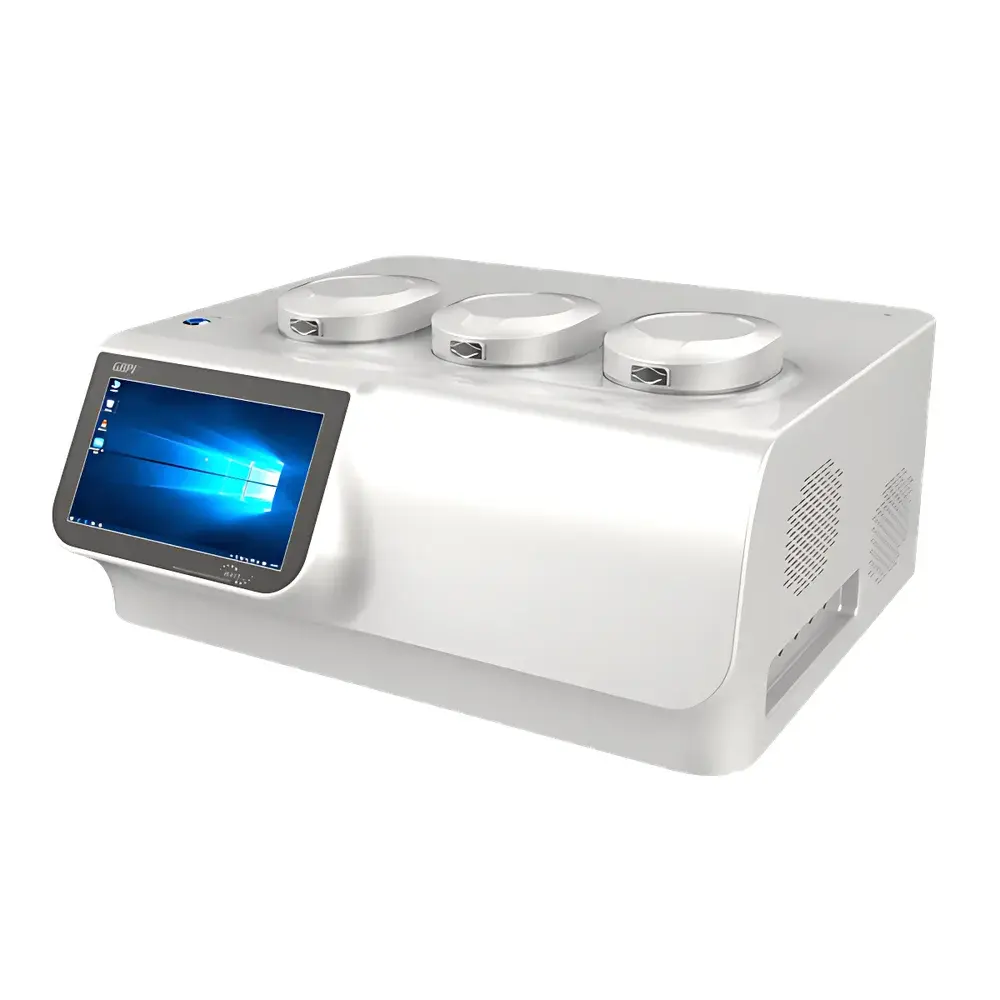
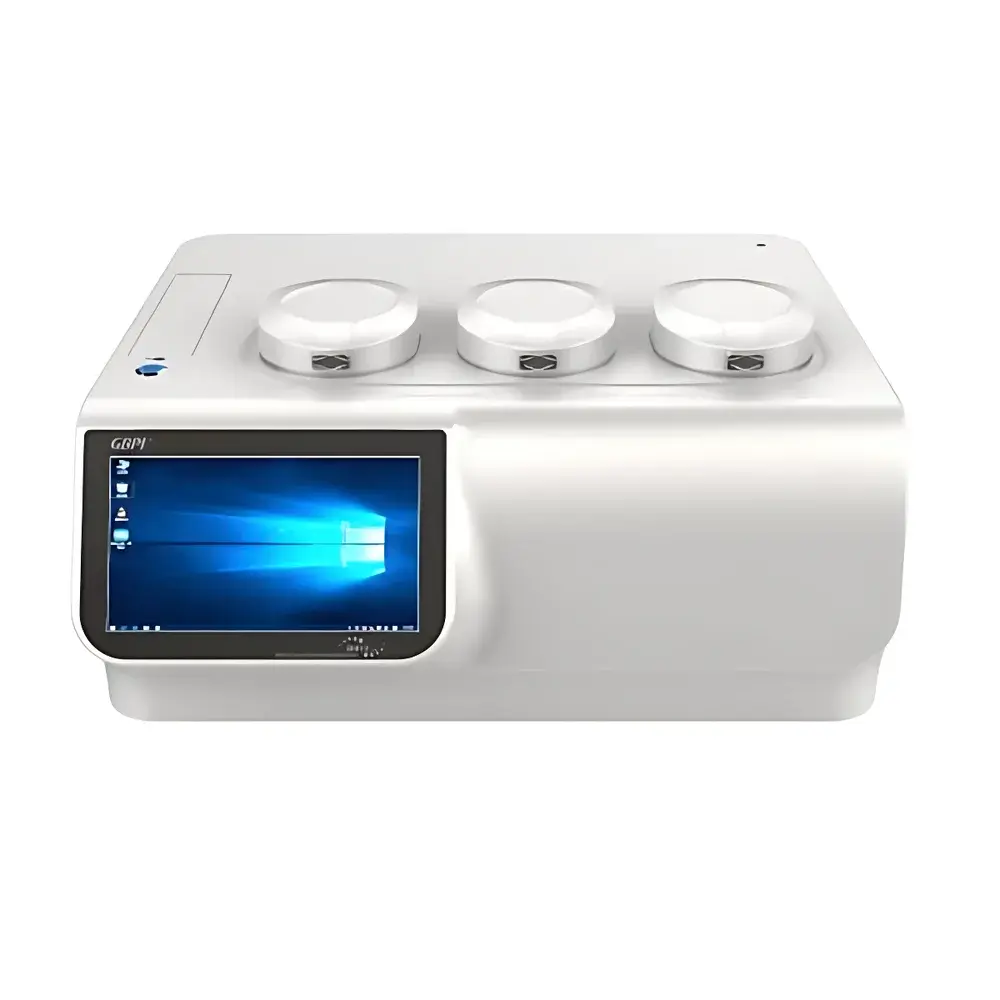
GBPI W413 2.0L Water Vapor Transmission Rate (WVTR) Tester
| Brand | GBPI |
|---|---|
| Origin | Guangdong, China |
| Manufacturer Type | Direct Manufacturer |
| Product Category | Domestic |
| Model | W413 2.0L |
| Price Range | USD 42,000–70,000 |
| Test Principle | Infrared Moisture Detection |
| Standards Compliance | GB/T 26253-2010, ASTM F1249-2013, ISO 15106-2:2005, JIS K7129-2008, YBB 00092003-2015 |
| Measurement Range | 0.002–500 g/(m²·24h) |
| Resolution | 0.001 g/(m²·24h) |
| Temperature Control Range | 15–45 °C |
| Temp. Accuracy | ±0.1 °C |
| Humidity Control Range | 0%RH (dry), 30–90%RH, 100%RH |
| RH Accuracy | ±1%RH |
| Test Area | 50.24 cm² |
| Specimen Diameter | Φ100 mm |
| Max. Specimen Thickness | ≤3 mm |
| Sample Capacity | 3 specimens per run |
| Carrier Gas | ≥99.999% N₂ |
| Gas Pressure | ≥0.1 MPa |
| Flow Rate | 5–100 mL/min |
| Pneumatic Clamping Pressure | ≥0.3 MPa |
| Power | 750 W, AC 220 V / 50 Hz |
Overview
The GBPI W413 2.0L Water Vapor Transmission Rate (WVTR) Tester is a precision-engineered instrument designed for quantitative determination of water vapor permeation through packaging and barrier materials under controlled temperature and humidity conditions. It operates on the principle of infrared moisture detection—where water vapor diffusing through a test specimen is carried by a dry nitrogen carrier gas stream to a high-sensitivity IR sensor that quantifies moisture concentration in real time. This method ensures traceable, linear, and highly reproducible measurements across a wide dynamic range—from ultra-low-permeability aluminum foils and multilayer laminates (down to 0.002 g/(m²·24h)) to highly permeable nonwovens and hydrogels. The system is fully compliant with international standard test methods including ASTM F1249 (for plastic film and sheeting), ISO 15106-2 (infrared detection variant), JIS K7129, and Chinese pharmacopoeial standards (YBB 00092003-2015), making it suitable for regulated environments in pharmaceutical packaging validation, medical device barrier certification, and food shelf-life modeling.
Key Features
- High-precision electromagnetic programmable temperature control (±0.1 °C), eliminating external chiller/heater units and minimizing thermal lag or overshoot.
- Dual-stream humidity generation system delivering stable, independently adjustable RH levels from 0% (desiccated) to 100% RH, with accuracy maintained at ±1% RH across the full operating range.
- Integrated 7-inch color touchscreen HMI—enabling standalone operation without external PC; real-time visualization of five synchronized parameter curves (temperature, RH, WVTR, gas flow, voltage).
- Pneumatically actuated clamping mechanism ensuring uniform, repeatable specimen sealing and rapid sample exchange (≤30 seconds per cycle).
- Modular hardware architecture with field-replaceable IR sensor modules and self-diagnostic firmware; includes automatic sensor over-range protection to prevent irreversible saturation damage.
- Fully automated test sequencing: auto-start, endpoint detection based on signal stabilization criteria, and auto-shutdown—reducing operator dependency and inter-laboratory variability.
Sample Compatibility & Compliance
The W413 2.0L accommodates flat, rigid, or semi-flexible specimens up to 3 mm thick and 100 mm in diameter—including monolayer polymers (PET, PE, PP), metallized films, Al foil laminates, barrier-coated papers, siliconized release liners, solar backsheet composites, OLED encapsulation films, transdermal patch substrates, and sterile medical pouches. Its 50.24 cm² defined test area conforms to ISO 15106-2 and ASTM F1249 geometric requirements. All measurement data are traceable to GBW(E)130543/4 certified reference materials issued by China’s National Institute of Metrology, supporting metrological equivalence in cross-border regulatory submissions. The instrument meets the functional and documentation requirements of Annex 11 (Computerized Systems) and Annex 15 (Qualification & Validation) of the EU GMP Guidelines, as well as FDA 21 CFR Part 11 for electronic records and signatures.
Software & Data Management
GBPI’s proprietary WinWVTR software is developed in accordance with ICH GCP and ALCOA+ principles (Attributable, Legible, Contemporaneous, Original, Accurate, Complete, Consistent, Enduring, Available). It provides role-based user access control (administrator, analyst, reviewer), full audit trail logging (including login/logout events, parameter changes, report generation, and data export actions), and immutable timestamped records stored in an encrypted local SQL database. Reports are generated in bilingual (English/Chinese) PDF format with embedded metadata (instrument ID, calibration date, environmental conditions, operator ID, sample ID), and support digital signature workflows compliant with 21 CFR Part 11 §11.200. Raw sensor output, derivative curves, and statistical summaries (mean, SD, RSD, confidence intervals) are exportable for third-party statistical analysis or LIMS integration via CSV or XML.
Applications
- Pharmaceutical packaging: validation of blister cavity lidding foils, sachet laminates, and desiccant-containing vial closures per USP and Ph. Eur. 5.1.3.
- Food packaging R&D: comparative WVTR screening of biodegradable films, active packaging layers, and modified atmosphere packaging (MAP) structures.
- Medical device sterilization: barrier performance assessment of Tyvek®-based pouches, peel-open trays, and ISO 11607-compliant flexible packaging systems.
- Electronics encapsulation: moisture ingress testing of OLED display edge seals, photovoltaic module backsheets, and flexible printed circuit board conformal coatings.
- Regulatory submission support: generation of GLP-compliant datasets for FDA 510(k), CE marking technical files, and PMDA registration dossiers.
FAQ
What carrier gas is required, and why must it be ≥99.999% pure nitrogen?
Ultra-high-purity nitrogen eliminates interference from ambient moisture, CO₂, or hydrocarbons that could saturate or drift the IR sensor baseline—ensuring measurement fidelity at sub-0.01 g/(m²·24h) levels.
Can the W413 test irregularly shaped or non-flat samples such as bottles or cups?
No—the instrument is configured for planar specimens only. For 3D containers, GBPI offers complementary gravimetric cup-method systems (e.g., W3/030) compliant with ASTM E96.
Is calibration traceable to NIST or other international metrology institutes?
While GBW(E)130543/4 is China’s national primary standard for WVTR, its uncertainty budget is harmonized with NIST SRM 2820 and BIPM CCM key comparisons; full calibration certificates include cross-referenced uncertainty statements.
Does the system support IQ/OQ/PQ documentation packages for GMP facilities?
Yes—GBPI supplies vendor-qualified protocols, test scripts, and summary reports aligned with ASTM E2500 and ISPE GAMP5, including installation drawings, sensor linearity verification, and environmental stress mapping.
How frequently must the IR sensor be recalibrated?
Annual recalibration against certified reference materials is recommended; however, daily zero-point verification using dry nitrogen and in-run reference checks ensure ongoing validity between formal calibrations.






