
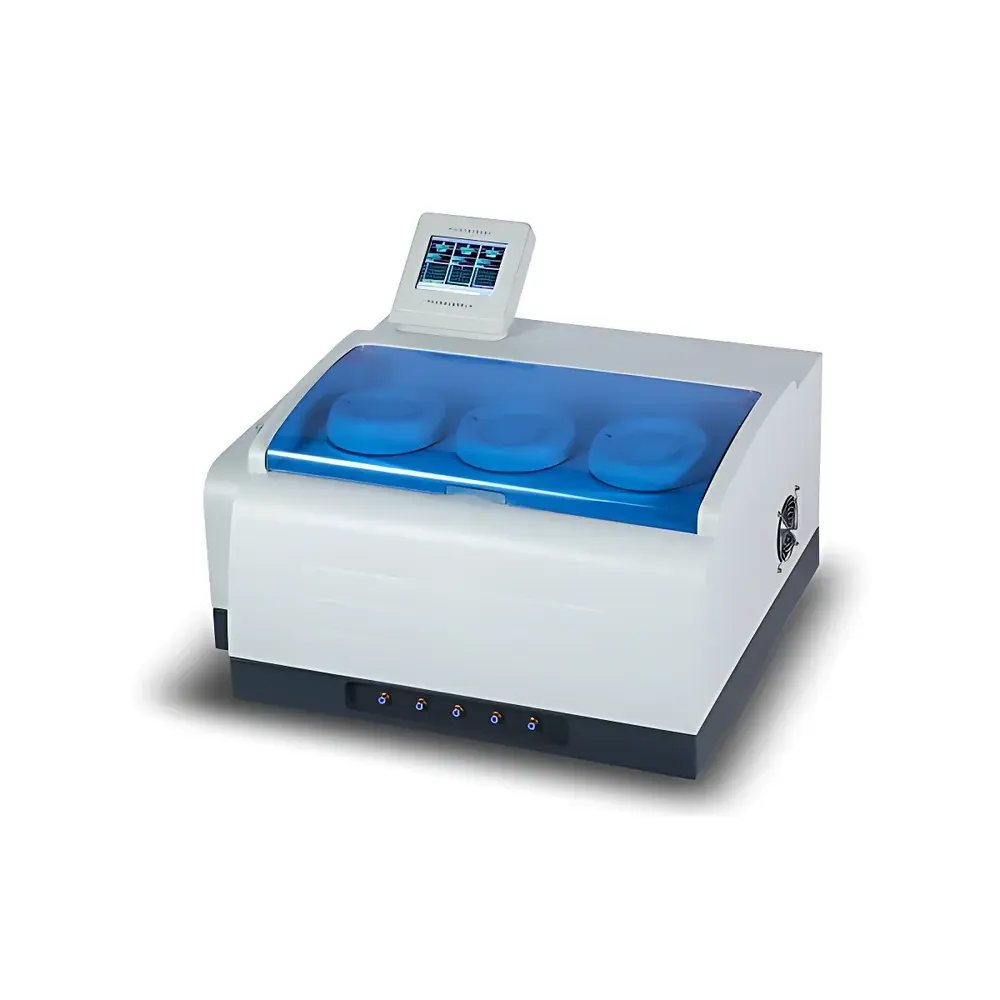
GBPI W405-LP Infrared Water Vapor Transmission Rate (WVTR) Tester
| Brand | GBPI |
|---|---|
| Origin | Guangdong, China |
| Manufacturer Type | Direct Manufacturer |
| Country of Origin | China |
| Model | W405-LP |
| Price Range | USD 42,000 – 70,000 |
| Test Range | 0.005–500 g/(m²·24h) |
| Test Accuracy | 0.001 g/(m²·24h) |
| Temperature Control Range | 15–45 °C (optional up to 60 °C) |
| Temp. Stability | ±0.1 °C |
| Humidity Control Range | 0% RH (dry N₂), 30–90% RH, 100% RH |
| Humidity Stability | ±1% RH |
| Test Area | 50.24 cm² (down to 0.785 cm² with optional fixture) |
| Specimen Size | Ø100 mm |
| Max. Thickness | ≤3 mm |
| Sample Capacity | 1–3 specimens per test cycle |
| Carrier Gas | ≥99.999% N₂, pressure ≥0.1 MPa, flow rate 5–120 mL/min |
| Gas Interface | 1/8″ metal tubing |
| Dimensions | 610 × 550 × 400 mm |
| Weight | 57.1 kg |
| Power | 1000 W, AC 220 V, 50 Hz (110 V available on request) |
Overview
The GBPI W405-LP is a high-precision, infrared-based Water Vapor Transmission Rate (WVTR) tester engineered for regulatory-compliant permeation analysis of packaging and functional barrier materials. It operates on the principle of modulated humidity gradient-driven diffusion across a conditioned specimen, coupled with real-time quantification via dual-beam infrared absorption spectroscopy. A test specimen is sealed between two isolated chambers: humidified compressed air flows over the upstream side, while ultra-dry nitrogen sweeps the downstream side. The resulting water vapor flux diffusing through the material is carried by the dry carrier gas to a thermally stabilized IR sensor, where absorbance at 2.7 µm is linearly correlated to vapor concentration. This method—designated as the arbitration standard in China’s 2015 Pharmacopoeia Packaging Materials Guidelines (YBB 00092003-2015)—ensures traceable, matrix-independent measurement unaffected by carrier gas composition or flow fluctuations. The system meets fundamental physical metrology requirements for barrier testing under dynamic equilibrium conditions, delivering results fully compatible with international gravimetric and coulometric reference methods.
Key Features
- Triple-chamber independent testing architecture enables concurrent evaluation of up to three dissimilar specimens—each with autonomous start/stop, parameter logging, and report generation—without cross-contamination or thermal crosstalk.
- ARM-based embedded control system supports stand-alone operation; no external PC required for routine testing, calibration, or diagnostics.
- Dual-stream humidity generation employs precision-mixed dry/wet nitrogen streams to achieve stable, programmable RH setpoints from 0% (anhydrous) to 100%, with closed-loop feedback control maintaining ±1% RH accuracy over 72-hour continuous operation.
- Electromagnetic stepwise temperature regulation ensures ±0.1 °C stability across 15–45 °C (extendable to 60 °C), minimizing thermal drift during low-flux measurements (<0.01 g/m²·24h).
- Modular sensor protection logic automatically isolates the IR detector upon out-of-range signal detection, preventing saturation-induced calibration drift or photodiode degradation.
- Full GMP-aligned software architecture compliant with FDA 21 CFR Part 11 and EU Annex 11 requirements—including role-based access control (Administrator, Operator, Reviewer), electronic signatures, and immutable audit trails covering system events, method changes, and raw data modifications.
Sample Compatibility & Compliance
The W405-LP accommodates rigid and flexible substrates up to 3 mm thick, including polymer films (PET, PE, PP), metallized laminates, aluminum foils, pharmaceutical blister lidding, solar backsheet composites, medical transdermal patches, and LCD protective overlays. Optional container fixtures extend capability to pouches, trays, bottles, and cups per ASTM F1249 Annex A3 and ISO 15106-2 Annex B. All measurements adhere to internationally harmonized standards: GB/T 26253-2010 (China), BS EN ISO 15106-2:2005 (EU), ASTM F1249-2013 (USA), and JIS K7129-2008 (Japan). Certified reference materials (CRM) traceable to NIM (National Institute of Metrology, China), with GBW(E)130543/4 certification, are supplied for on-site instrument verification and periodic recalibration—fully satisfying GLP audit requirements for method validation and equipment qualification.
Software & Data Management
The integrated Windows-based GBPI Permeation Suite features intuitive workflow navigation, customizable test protocols, and real-time visualization of four synchronized parametric curves: chamber temperature, relative humidity, IR signal intensity, and calculated WVTR. All raw sensor outputs, environmental logs, and metadata are stored in an encrypted local SQLite database with automatic daily backup. Reporting complies with ICH M7 and USP documentation standards: PDF and Office-exportable reports include instrument ID, operator ID, calibration certificate numbers, uncertainty budgets (k=2), and full audit trail appendices. Data export supports CSV for statistical process control (SPC) integration, while HL7-compatible APIs enable direct LIMS linkage in regulated QC environments.
Applications
This instrument serves critical quality control and R&D functions across multiple regulated sectors. In pharmaceutical packaging, it validates moisture barrier integrity of cold-form blisters, sachets, and child-resistant containers per USP and EP 3.2.9. In food packaging, it verifies shelf-life predictions for retort pouches, coffee bags, and dried snack liners under accelerated aging conditions. Electronics manufacturers use it to qualify encapsulation films for OLED displays and flexible PCBs against humidity-induced delamination. Medical device firms apply it to assess vapor transmission in wound dressings and sterile barrier systems per ISO 11607-1. Solar energy labs employ it for accelerated lifetime modeling of PV module backsheets per IEC 61215-2 MQT10.
FAQ
What carrier gas specifications are mandatory for valid operation?
Ultra-high-purity nitrogen (≥99.999%) is required; oxygen or hydrocarbon impurities will interfere with IR absorption at 2.7 µm and invalidate calibration. A dedicated 40-L cylinder with dual-stage regulator and particulate/moisture filtration is recommended.
Can the system be validated for 21 CFR Part 11 compliance?
Yes—the software includes electronic signature workflows, biometric or token-based authentication options, and tamper-evident audit logs meeting all predicate rule requirements for computerized system validation (CSV) in FDA-regulated facilities.
Is gravimetric calibration supported?
No—this is a primary infrared method instrument; gravimetric correlation is performed externally using certified reference films. Internal calibration relies exclusively on NIM-traceable moisture standards (GBW(E)130543/4).
How is leakage testing performed prior to sample measurement?
An automated blank run executes sequential purge, stabilization, and baseline acquisition cycles under zero-humidity differential; system integrity is confirmed if background drift remains below 0.0005 g/m²·24h over 60 minutes.
What maintenance intervals are recommended for long-term accuracy?
IR sensor sensitivity verification every 6 months using CRM film; annual full metrological recalibration by GBPI-certified service engineers; quarterly inspection of O-rings, gas fittings, and desiccant cartridges in the dry gas path.




