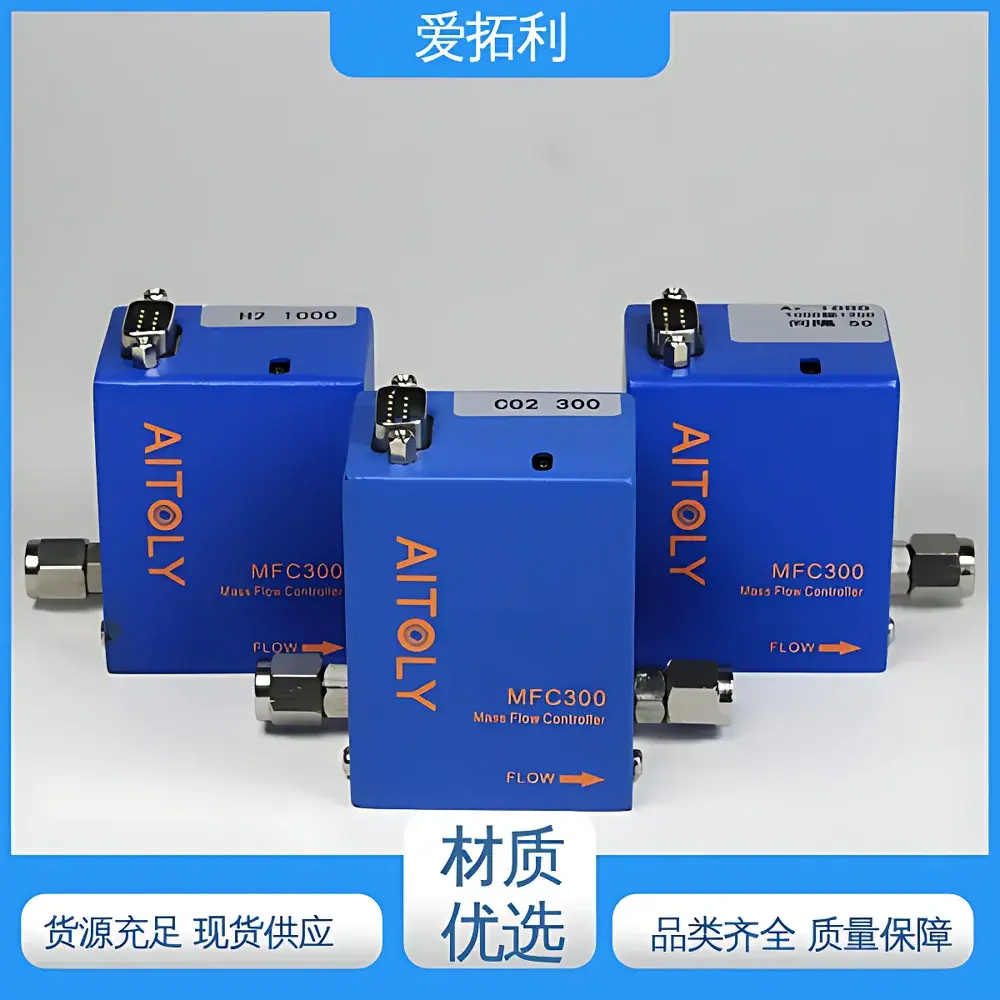
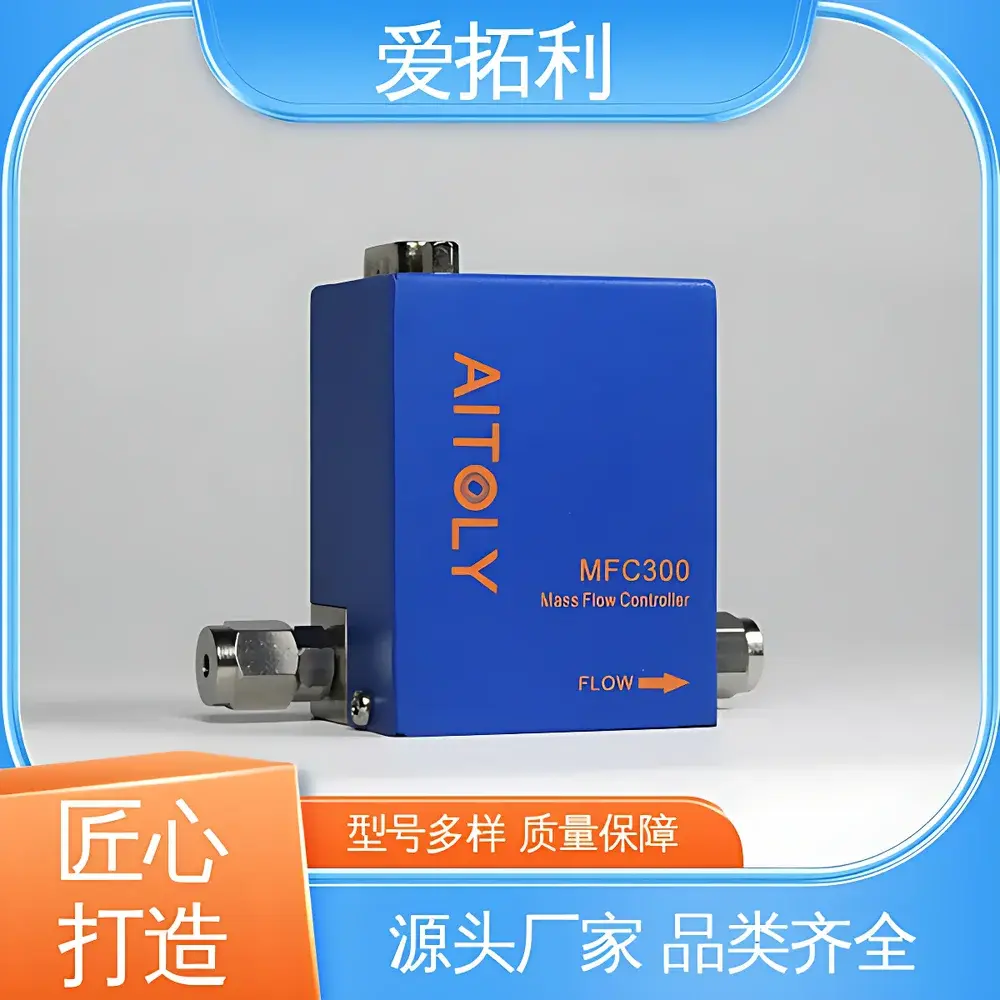
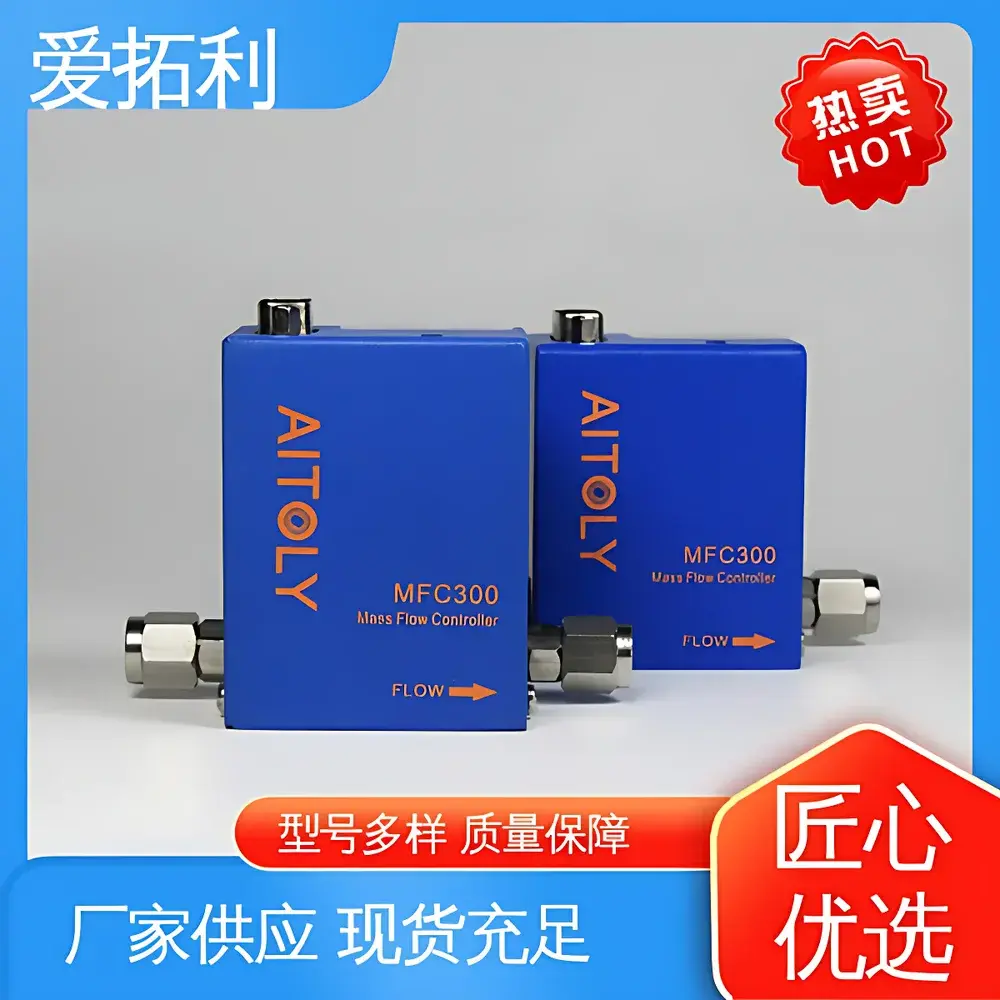
AITOLY MFC330 Series Thermal Mass Flow Meter / Controller
| Brand | AITOLY |
|---|---|
| Origin | Jiangsu, China |
| Model | MFC330 (Domestic Alternative to Alicat) |
| Flow Principle | Thermal Mass Flow Measurement |
| Sensor Type | Capillary-tube-based with Bypass Shunt |
| Valve Type | Normally Closed Proportional Control Valve (Optional All-Metal) |
| Display | Optional Integrated LCD |
| Accuracy | ±1% FS |
| Repeatability | ±0.2% FS |
| Linearity | ±0.2% FS |
| Flow Range | 0–500 sccm / 0–500 slpm (Configurable) |
| Control Range | 1–100% FS (1:100) |
| Measurement Resolution | 0.5% FS (1:200) |
| Response Time | <3 s |
| Warm-up Time | 5 min (T95), 30 min for Optimal Stability |
| Operating Pressure Drop | 0–1 MPa |
| Gas Compatibility | >98 gases (clean, dry) |
| Power Supply | 24 VDC |
| Output Signals | Analog (0–5 V / 4–20 mA), RS-232/RS-485 (Modbus RTU) |
Overview
The AITOLY MFC330 Series Thermal Mass Flow Meter and Controller is an engineered solution for precise, real-time measurement and closed-loop control of mass flow rates in clean, dry gas streams. Based on constant-temperature anemometry (CTA), the instrument employs a capillary-tube thermal sensor integrated with a precision bypass shunt channel. This architecture enables direct mass flow measurement independent of gas temperature and pressure fluctuations—eliminating the need for external compensation algorithms or secondary transducers. Unlike volumetric flow devices, the MFC330 reports flow in standardized units (sccm or slpm) referenced to STP (0 °C, 101.325 kPa), ensuring traceability and consistency across laboratory, pilot-scale, and industrial process environments. Designed as a functional domestic alternative to established international platforms—including Alicat Scientific’s MFC series—the MFC330 maintains compatibility with common process interfaces while delivering high reproducibility under dynamic operating conditions.
Key Features
- Thermal mass flow sensing with capillary-tube element and calibrated bypass shunt for enhanced signal-to-noise ratio and long-term stability
- Proportional control valve with normally closed configuration; optional all-metal construction for inert gas compatibility and extended service life
- Wide operating differential pressure range (0–1 MPa) with low pressure drop (<100 Pa typical at full scale), minimizing system backpressure impact
- Fast dynamic response (<3 s settling time) and high repeatability (±0.2% FS) suitable for pulsed flow, feedback-controlled reactors, and gas blending applications
- Gas selection library supporting over 98 pre-calibrated gases—including N2, O2, Ar, He, CO2, CH4, H2, and specialty mixtures—enabling accurate operation without manual gas factor adjustment
- Configurable analog (0–5 V / 4–20 mA) and digital (RS-232 / RS-485 Modbus RTU) outputs for integration into PLC, DCS, or SCADA systems
- Optional built-in LCD display with real-time flow, setpoint, valve position, and diagnostic status—reducing dependency on external HMI or host software
Sample Compatibility & Compliance
The MFC330 is validated for use with non-corrosive, particle-free, and moisture-free gases. Applications involving aggressive media (e.g., Cl2, NH3, HF) or condensable vapors require prior consultation and optional material upgrades (e.g., 316L SS wetted parts, Hastelloy C-276 seals). While not certified to IEC 61508 or SIL standards, the device meets general-purpose industrial electromagnetic compatibility (EMC) requirements per EN 61326-1 and operates within safety limits defined by IEC 61010-1 for measurement/control equipment. Its measurement methodology aligns with ASTM D7213 (Standard Test Method for Determining Mass Flow Rate of Gaseous Effluents) and supports GLP-compliant data recording when paired with compliant software.
Software & Data Management
The MFC330 supports bidirectional communication via Modbus RTU over RS-485, enabling centralized configuration, real-time monitoring, and batch logging through third-party SCADA or LabVIEW-based acquisition systems. Firmware allows user-defined gas selection, custom calibration offsets, and alarm thresholds (e.g., flow deviation >±2% FS, valve timeout). Audit trail functionality—including timestamped parameter changes and firmware updates—is available when used with validated PC software that implements 21 CFR Part 11-compliant electronic signatures and access controls. Data export formats include CSV and XML, facilitating import into LIMS or statistical process control (SPC) platforms.
Applications
- Gas delivery and ratio control in semiconductor CVD/ALD process tools
- Calibration reference for environmental emission analyzers (e.g., FTIR, GC-MS)
- Feedstock metering in catalytic microreactors and fuel cell test stations
- Leak testing and purge verification in vacuum and high-purity piping systems
- Research-grade gas blending for atmospheric simulation chambers and combustion studies
- Quality assurance in medical gas manifold validation (ISO 8573-1 Class 2–3 compressed air/gas purity verification)
FAQ
Is the MFC330 compatible with corrosive or humid gases?
No—only clean, dry, non-corrosive gases are supported. For aggressive or condensing media, consult factory for material and seal upgrades.
Does it require external temperature or pressure compensation?
No—thermal mass flow measurement is inherently insensitive to upstream T/P variation; no external sensors or compensation routines are needed.
Can it be used in vacuum applications?
Yes, provided the absolute inlet pressure remains ≥10 kPa and the differential pressure across the device stays within 0–1 MPa.
What is the recommended recalibration interval?
Annual recalibration is advised for ISO/IEC 17025-compliant operations; stability data shows drift <±0.15% FS/year under controlled lab conditions.
Is firmware upgradable in the field?
Yes—via RS-232 using AITOLY-provided utility software; version history and checksum verification are supported.